Payment Terms for Contractors: Net 30 and Beyond

The standard advice about payment terms for contractors is to keep them simple. Net 30, invoice on the first, wait. That clause is often the most expensive line in the agreement because it decides who funds the work between delivery and cash. It is you. Payment delays past the stated term are common enough that entire industries publish annual reports tracking them (Rabbet's 2024 Construction Payments Report). A fractional CFO, a part-time CTO, a two-person growth studio: the exposure is identical, and the position is worse. You have no collections department, and the person approving your invoice may be the founder you advise three days a week. The term has to do the work the relationship cannot, and it has to be written down before the first invoice goes out. Put the clock and the cash protection in the contract, not in a follow-up email.
Table of Contents
- Standard Payment Terms and What Each One Means
- Five Deal Structures and How Each One Pays
- Writing the Payment Clock and Cash Protections
- Defining Outcome-Based and Revenue-Share Pay
- Tax Reporting and Contractor Status to Get Right
- Confirm the Payment Terms Before You Sign
Standard Payment Terms and What Each One Means
The term decides who funds the work between delivery and cash, which makes it at least as important as the rate. A net 30 invoice turns you into an unsecured lender for a month at zero interest. The stated term also isn't the actual one: in a 2024 UK government survey, 71% of businesses said 30 days was the most common term suppliers offered, while 49% reported paying 30 days after the invoice date and 11% paid within seven days (UK government late payments research).
| Term | Clock starts | Who carries the wait | Best fit |
|---|---|---|---|
| Due on receipt | When the invoice arrives | Client | One-off projects with small scope |
| Net 15 | 15 days after invoice | Contractor, for two weeks | Short engagements with clean approvals |
| Net 30 | 30 days after invoice | Contractor, for a month | Monthly retainers and agency work |
| Net 60 | 60 days after invoice | Contractor, for two months | Rarely justified for solo executives |
| Upfront deposit | At signing | Client | Projects with heavy early costs |
| Milestone-gated | After each accepted milestone | Shared, by deliverable | Defined deliverables with clear acceptance |
The same survey found the wait grows with the client: 23% of microbusinesses paid within seven days, against 4% of medium-sized businesses and 0% of large businesses. Your safest-looking client is often the slowest one, which is why net 60 is the row I'd push back on hardest. A solo operator can't float two months of work.
Say a retainer invoice goes out on the first and is due thirty days later. You have already delivered a full month before the first dollar arrives, and if payment slips a week, you're funding six weeks of your own work.
The test that matters: choose the term you can survive if the client pays on the last day of it, not the term that's easiest to get signed.
Five Deal Structures and How Each One Pays
Match the structure to how much of the outcome you personally control. That's the whole decision, and it's the one most founders skip when they open with "we'd love to do this partly on results."
| Structure | How the amount is set | Who carries the risk | Best fit |
|---|---|---|---|
| Fixed monthly retainer | Flat fee for reserved days or hours | Client pays for capacity whatever the result | Ongoing functions such as part-time CFO or COO |
| Milestone pay | Fee per accepted deliverable | Shared, split by deliverable | Projects with a definable output |
| Outcome or success fee | Percentage or bonus after a measured result | Contractor, until the result is verified | Targets the contractor largely controls |
| Revenue share | Percentage of attributable, collected revenue | Shared, and the contractor waits on collections | Sales or growth work with clean revenue tracking |
| Equity for services | Shares or options in place of cash | Contractor, with illiquid upside | Early-stage roles where cash is tight and the operator can wait |
The retainer is the default for ongoing functions because the client buys reserved capacity, not a guaranteed result. Milestone pay only works when the milestone has an objective test. A schedule can split payment at signing, after acceptance of a named work product, and after a measurable milestone, but that milestone has to be something a stranger could verify, like a delivered board package or an approved technical specification. A promise to improve growth is not a milestone, it's a wish with a date attached.
Outcome and revenue-share deals concentrate the wait in one place: the contractor. You deliver, then you wait for the result to be measured, then you wait again for the money to be collected. Price that double wait into the percentage or accept that you are financing the client's growth. Equity sits furthest out, because illiquid upside pays nothing until an exit or a secondary sale, so treat it as upside rather than as compensation for months of work.
Most operators I'd trust end up on a hybrid: a base fee for reserved capacity plus a smaller milestone or a capped upside. The base covers the rent, and the upside pays for the risk you took on. The question to settle first is simple. How much of the result can you drive without the client's hiring, budget, or sales team?
Writing the Payment Clock and Cash Protections
Net 30 doesn't say when the 30 days start. Tie the clock to an event the client can't argue about. The U.S. federal prompt-payment rule is a sane benchmark: unless the contract states another date, payment is generally due 30 days after the agency receives a proper invoice, and for many contracts the deadline is the later of 30 days after invoice receipt or 30 days after acceptance of the service, per the Bureau of the Fiscal Service prompt payment FAQ.
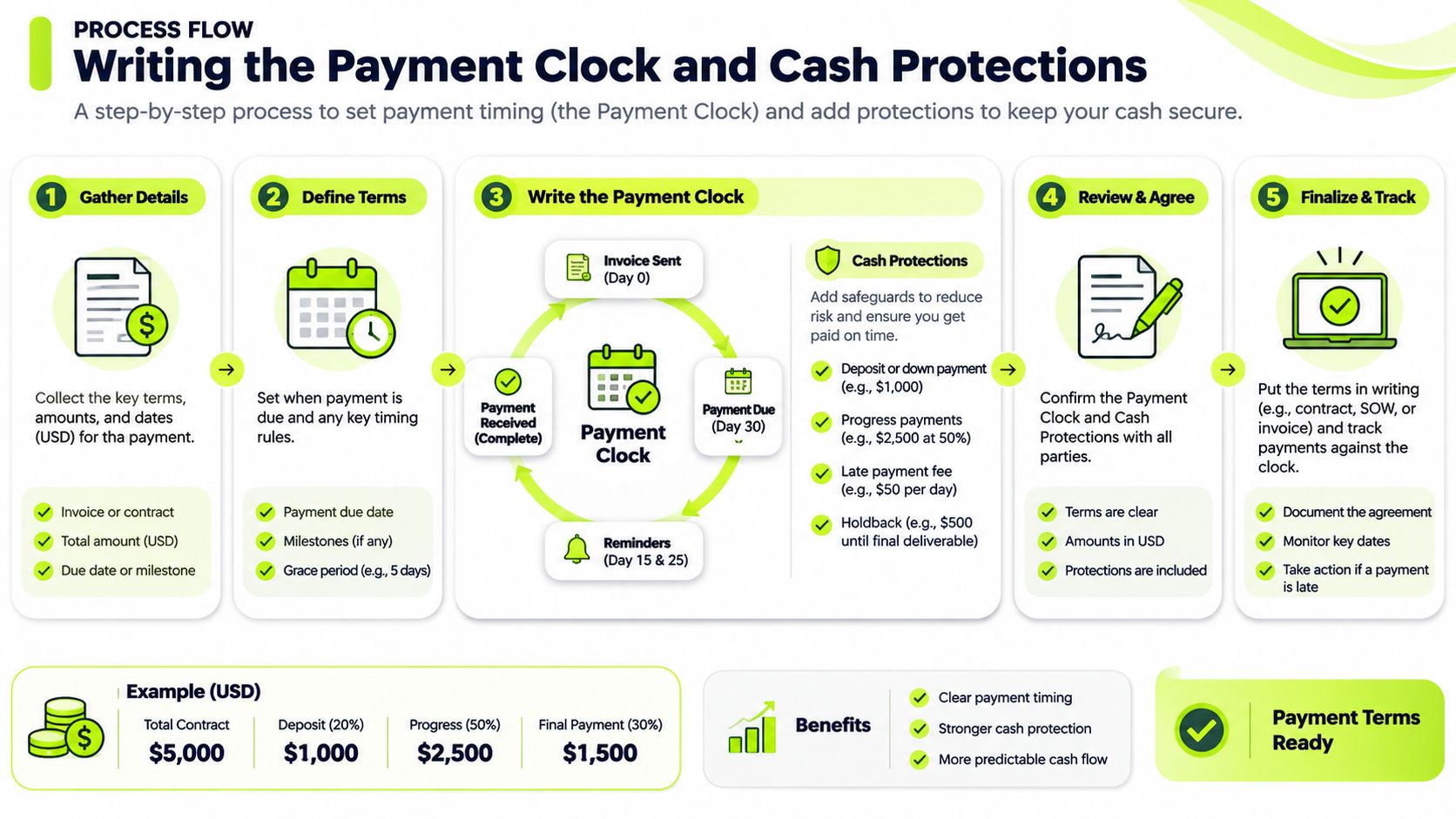
Six clauses that keep the clock moving
- Name each deliverable and what done looks like, in writing. "Upon completion" disputes are born from vague language.
- Set an acceptance window of five business days and make silence count as approval. Otherwise a busy founder parks the invoice indefinitely and calls it review.
- List what a proper invoice contains, such as the PO number, period covered and milestone reference, so a bill can't bounce on a technicality.
- Start the clock on acceptance, in days. Never on completion, never on "when we're happy with it."
- Pay undisputed amounts while a single line is disputed. One objection should never freeze the whole bill. A dispute applies to the disputed amount, and the rest of the invoice pays on schedule.
- Name who can accept work for the client, by role, plus a backup. Most approval bottlenecks are one person on vacation.
Cash protections that move the wait back to the client
A 30-day term is an interest-free loan from you unless the agreement says otherwise. Put a mobilization payment at signing, bill the retainer at the start of each period rather than the end, take milestone deposits on long builds, and add a pause right once an invoice passes a short grace period. Route escalation to a named sponsor, not the same inbox that ignored you.
The stakes are measurable: Xero data reported in the Atradius U.S. payment practices barometer put the average wait for U.S. small businesses at 29.3 days in the second quarter of 2026, with payments arriving 8.5 days late on average. On our deals the default is deliberately shorter than net 30: work is accepted, the operator invoices, and payment is due 15 days later. The mechanics of gating each payment on a verified deliverable are set out in this milestone payment schedule guide, and they only hold up if the milestones are dated before work starts.
Defining Outcome-Based and Revenue-Share Pay
A fully contingent deal reads founder-friendly and turns unfair the moment the executive controls only part of the outcome. Waiting 90 days for a success fee compounds it. The fix isn't refusing upside; it's splitting the deal into three parts with different risk profiles.
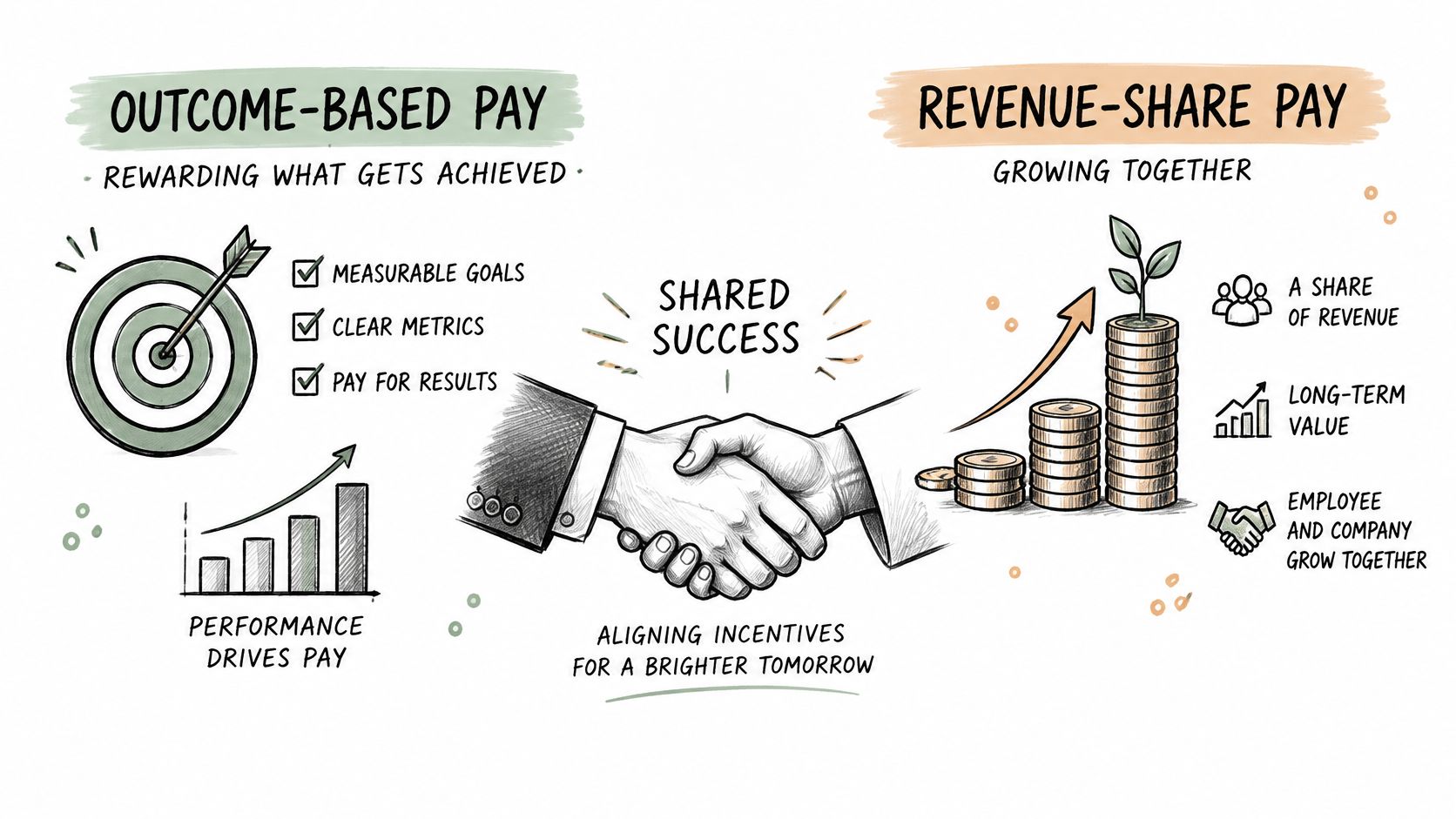
A guaranteed base fee pays for reserved capacity and completed work. Milestone payments cover objectively verifiable deliverables. A capped upside ties to one clearly defined metric, per the fractional executive engagement breakdown. Each part needs the same seven definitions: baseline, measurement period, attribution rules for shared causality, data source, payment date, treatment of refunds or churn, and what happens if scope changes or required access never arrives.
Revenue share applies to attributable, collected revenue, never bookings or pipeline. If a $100,000 deal collects in two installments, you're paid on the cash as it lands, so the client's collection risk doesn't become yours. Equity for services needs counsel on vesting, repurchase, dilution, termination and tax before anyone signs. The two-document structure that keeps these terms in one master agreement and the scope in a project assignment is laid out in how agreements work.
Tax Reporting and Contractor Status to Get Right
Payments to an independent contractor for services can trigger Form 1099-NEC, including small ones, so keep a running total from the first invoice. The payment generally has to be for services performed in the course of the business, made to someone who isn't an employee, and paid to an individual, partnership, estate or certain corporations. The threshold is $600 for payments made through 2025 and $2,000 for payments made in 2026, aggregated per contractor across the calendar year rather than invoice by invoice, per IRS guidance on reporting payments to independent contractors. Backup withholding creates a filing duty regardless of amount.
Status is the other half. Operators are independent contractors, not employees: nobody withholds taxes, provides benefits, or directs how the work gets done, only what gets delivered and by when. Collect the legal entity name and a W-9 before the first invoice. The contractor vs employee comparison covers where that line sits in practice.
Confirm the Payment Terms Before You Sign
All three pieces have to be in the draft before you sign: the structure, the payment clock and the cash protections. A draft missing any of them isn't ready, no matter how good the rate looks. Two checks catch what the rest of the negotiation misses.
The cash-survival test. Could you cover the full wait if the client paid on the last day of the term? If not, shorten the term or add a deposit before signature, not after the first late invoice.
The tax position. The contractor's legal entity is on record, and the running total is checked against the 1099-NEC threshold for the tax year.
Then send the draft to a founder who has signed something similar and ask where a clause surprised them. Deals like this move quickly, often from first conversation to signed agreement in one to two weeks, so the review has to happen in parallel with the negotiation rather than after it.
Capstacker exists to make the payment structure the starting point rather than the afterthought: milestone payouts, revenue share, equity, deferred fees or a hybrid, all written into a project assignment before work begins so nobody negotiates the clock after the invoice is already late. Funds are secured upfront through escrow-like infrastructure and released as milestones are met, which keeps the working-capital risk on the funded side of the table. If you want the paperwork and the payment clock handled in one place, start at Capstacker.