Milestone Payment Schedule for Founder Deals

Most founders copy the wrong model. They take a construction split, put 30% at signing, 40% in the middle, 30% at delivery, and expect it to govern a fractional executive who isn't building one thing.
That advice fails because leadership work isn't a prototype. A fractional CFO, CMO, CTO, or COO makes weekly decisions, builds systems other people run, and hands work off. If you gate every dollar behind revenue or a vague launch, you'll pay late for good work and argue about bad definitions.
A milestone payment schedule should release money when a named deliverable passes a written acceptance test. For ongoing leadership, keep a predictable base and attach a small, capped pool to controllable gates. That's the structure that protects your cash without turning executive pay into an uncollectible commission.
Table of Contents
- The Schedule of Values You Can Sign
- Retainer Plus Milestones or Fully Gated Pay
- Writing Each Gate and Payment Line
- Sizing the Base, the Pool and the Holdback
- A 90-Day CMO Schedule in Practice
- Termination, Resubmits and Pushback
- Lock the Schedule Before Work Starts
The Schedule of Values You Can Sign
A milestone payment schedule releases money when a named deliverable passes a written acceptance test, never when a month closes or hours are logged. If a stranger can't tell whether the gate passed, you don't have a schedule. You have a future argument.
The format below is a schedule of values. Copy the columns, replace the percentages with your dollar amounts, and put it in the assignment before kickoff. The terms belong in the agreement itself, not in a platform default or an email thread.
Sample milestone payment schedule for a fractional CFO
| Milestone | Acceptance test | Fee share | Invoice evidence | Review window | Payment term |
|---|---|---|---|---|---|
| Approved cash-flow model | Written sign-off that the model opens and uses the agreed assumptions | 30% | Model file and assumption notes | 5 business days | Net 15 from acceptance |
| Board-ready reporting package | Package includes the agreed statements and a one-page variance note | 30% | Report files and source data extract | 5 business days | Net 15 from acceptance |
| Forecasting process in use | One forecast cycle completed with the agreed owners and calendar | 40% | Process note, sample forecast, and written sign-off | 5 business days | Net 15 from acceptance |
Professional-services guidance in Payouts' contractor payment terms guide says payment terms should state whether Net 10, Net 30, or another period begins when the milestone is accepted or when a valid invoice is received. This example uses Net 15 from acceptance, so your sign-off starts the clock. After work is accepted, the operator submits an invoice, and payment is due within 15 days by default.
Read the first row before you sign anything
The cash-flow model row does four jobs at once. It names the artifact, which is the model file. It names the test, which is written sign-off that the file opens and uses the agreed assumptions. It names the evidence needed to invoice, and it gives the reviewer five business days to say yes or give a specific reason for no.
Notice what's missing. There's no promise that the forecast will be right, no fundraising target, and no revenue number. Those outcomes depend on you, your team, and the market. Don't make the whole fee wait on them.
Practical rule: If the acceptance test needs a meeting to interpret, rewrite the test.
The third row carries the largest share for a reason. A model and a report are files. A forecasting process that has run one full cycle with named owners is a system your company keeps using after the CFO leaves. Pay more for the gate that leaves an operating habit behind.
I would also name the reviewer in the assignment, even if it's just you. "Founder reviews" is enough, but "the team reviews" isn't. One person has to be able to accept, reject, or stay silent past the deadline.
Retainer Plus Milestones or Fully Gated Pay
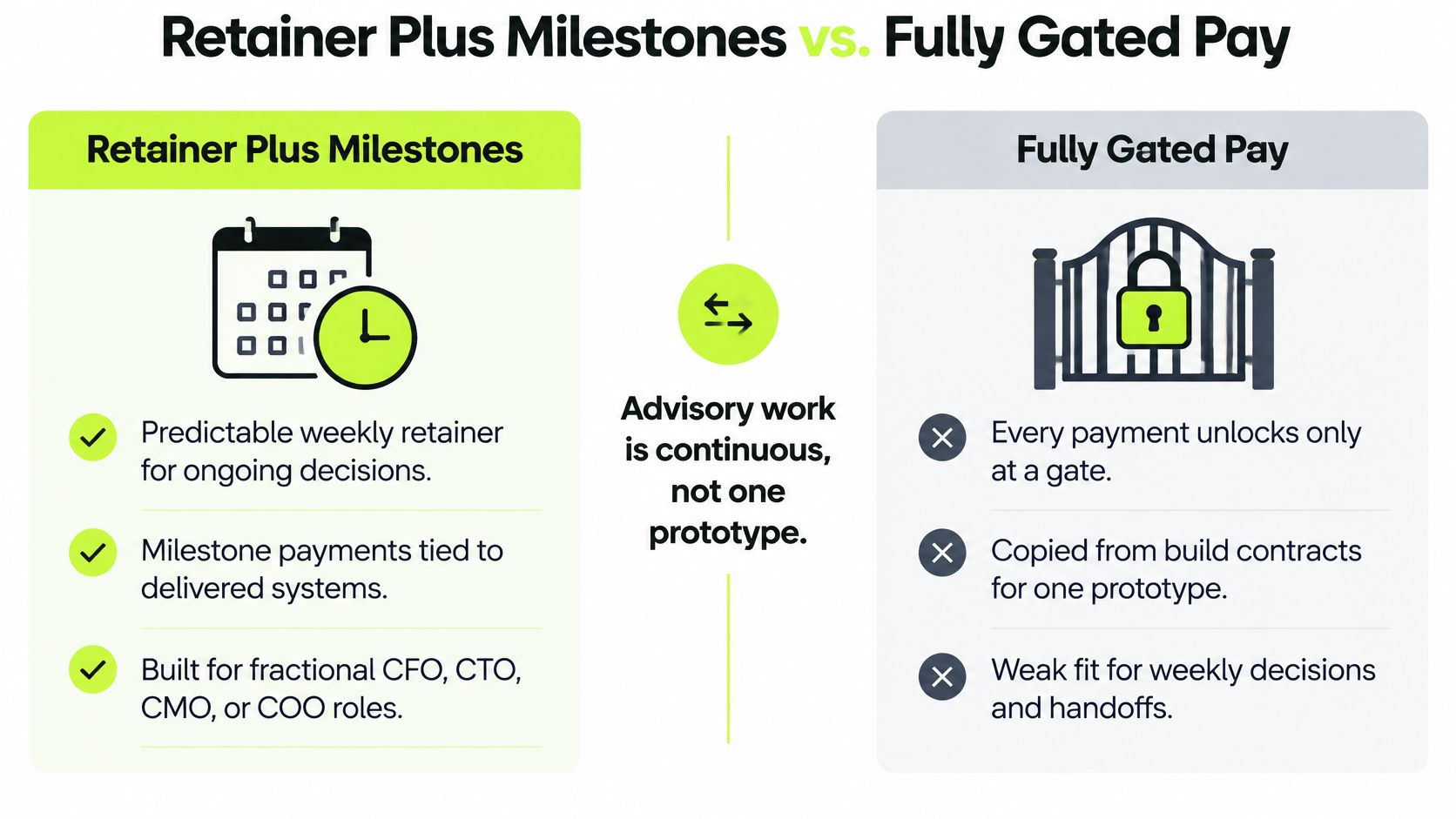
A fractional executive schedule should not copy a construction 30/40/30 build split, and it should not put the whole fee on revenue. Construction has drawings you can measure. Revenue has a dozen owners besides the person you hired. Separate a predictable base from a small set of gates the operator can finish.
In week one, your COO is in operating meetings, killing bad priorities, and fixing handoffs. Nothing is ready to accept yet. The work is real, and you would notice if it stopped. A pure project split has no line for that week, so the operator either pads later gates or starts negotiating before the first artifact exists.
Experienced operators usually want a base for ongoing leadership rather than putting all pay behind outcomes they only partly control. Keep the contingent piece small and named. Do not drop milestones just because the base exists.
Three ways to attach pay to a fractional engagement
| Structure | Fits when | Paid for the work itself | Contingent piece |
|---|---|---|---|
| Retainer plus milestone pool | Weekly leadership as CFO, COO, CMO, or CTO | Monthly base for the agreed days | A capped pool for named deliverables |
| Monthly draw plus success fee | Growth or sales help with one commercial result | Draw that covers operating work | Fee after a defined launch or pipeline event |
| Fully milestone-gated | A build with artifacts you can accept | Nothing until the first gate passes | The entire fee, only if every gate is controllable |
Pick by what you're actually buying
Retainer plus milestone pool is my default for ongoing leadership. The base buys the agreed days and the decisions that come with them. The pool pays for artifacts you can inspect, like a hiring scorecard, a pricing model, or a reporting cadence. If the pool is larger than the base, you have rebuilt a fully gated deal and called it a retainer.
Monthly draw plus success fee fits one commercial event you can define tightly. A fractional growth lead rebuilds outbound, and the fee triggers on a documented pipeline threshold inside a named window. The draw funds the operating work. The fee rewards that result. Leave closed revenue out of the trigger when pricing, product readiness, and your own sales team also move the number.
Fully milestone-gated pay fits a build. A dashboard, a launch kit, a completed hiring process. If you can list the files, test them, and use them without the operator in the room, gating works. If the value is judgement in weekly meetings, a 30/40/30 split only delays the argument until the last invoice.
Putting 100% of compensation behind milestones moves the argument to payday when pricing, product readiness, cash, and your own execution also move the outcome.
Three controllable handovers beat seven vague ones. Each gate should be something the operator can submit without waiting on a board vote, a funding round, or a revenue target you still have to hit yourself.
Writing Each Gate and Payment Line
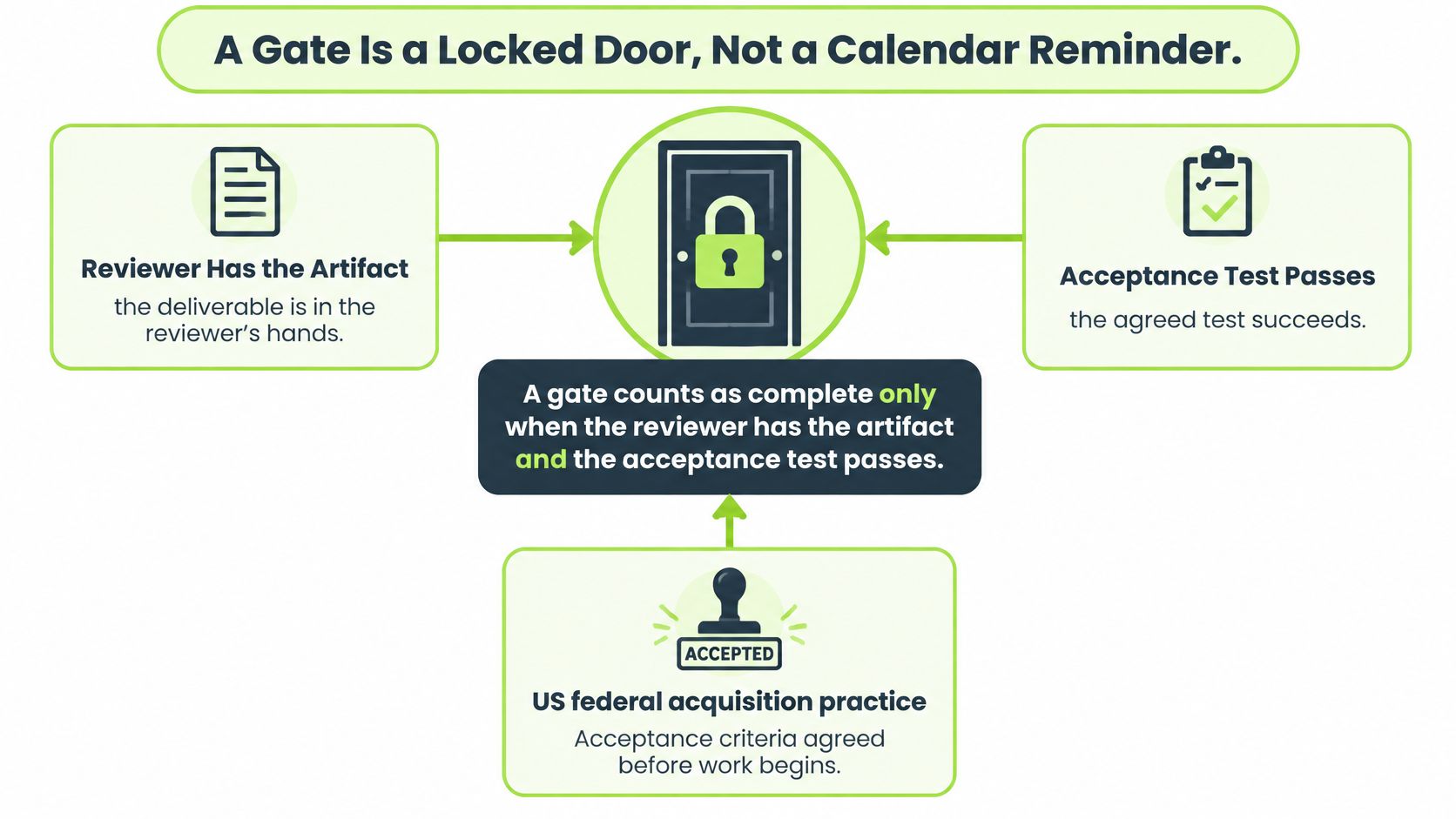
A gate counts as complete only when the reviewer has the artifact and the acceptance test passes. Treat it as a locked door, not a calendar reminder. If the milestone isn't completed, payment doesn't trigger.
The U.S. Federal Acquisition Regulation Subpart 32.10 requires every performance-based payment event to be integral to contract performance and to specify what constitutes successful completion, and cumulative milestones can't be paid until all preceding milestones are achieved. The UK Model Services Contract buyer guidance says a milestone shouldn't count as complete until all deliverables and acceptable test results have been provided, and each payment should be no greater than the supplier's related input costs.
The seven-line drafting sequence
- Name a handover, not an activity. Write "approved 90-day operating plan," "functioning reporting dashboard," or "completed sales-funnel redesign." Never write "support growth" or "make progress."
- Write a test a stranger could apply. Name the files, the data inputs, and what has to be true when they open them. "Dashboard shows weekly revenue by channel and refreshes from the named source" beats "dashboard complete."
- Assign a dollar amount or percent. Tie it to the operator's input cost for that gate, not to the value you hope the work creates someday.
- Name the reviewer and deadline. One person, five business days, written response. If two people must approve, say which one's silence counts.
- Add deemed acceptance and a dependency pause. If the client doesn't object inside the window, the gate passes. If a named client input is late, the operator's clock pauses until it arrives.
- State the invoice evidence. List the exact files that accompany the invoice and start the payment term at acceptance.
- Protect undisputed amounts. A dispute on one line doesn't freeze payment on lines that already passed.
We don't judge work quality. The parties decide when work is complete, and payment is triggered only once the pre-agreed approval condition is met. That's why your test has to do the judging in advance, in writing, while everyone still agrees.
The rejection loop
When a gate fails, the reviewer gives the specific reason tied to the test. The operator fixes that reason and resubmits against the same gate. There's no partial payment for effort and no new negotiation about what "done" meant. Our guide to tracking project milestones covers how to keep that loop visible to both sides.
Fill this in before kickoff: "Milestone 1 passes when ________ receives ________ and confirms in writing that ________."
If you can't complete that sentence in one try, the gate isn't ready. Don't start the work and hope the sentence writes itself later. It won't. Later is when money is attached to the disagreement.
Sizing the Base, the Pool and the Holdback
Keep the base tied to the day commitment, keep the milestone pool small and capped, and attach a holdback only with a dated release event. Those three rules prevent most sizing fights.
Price each line separately
Step 1, the base. Multiply the agreed days per month by the day rate. If you want two days a week of a fractional COO, you're buying roughly eight or nine days a month of decisions, meetings, and follow-through. Price that and check the anchor against the fractional executive cost guide before the number goes into the assignment.
Step 2, the pool. Cap the milestone pool at a fixed amount per named deliverable, so the total is known before kickoff. Say a 90-day engagement has a monthly base plus three gates with fixed fees. Both sides can add the maximum total on one line. Nobody discovers the price at the end.
Step 3, the holdback. If you need one, set it as a percentage withheld from each gate payment and name the release event, such as acceptance of the final gate. Never leave it as an open reserve that waits on revenue. A holdback without a release event is just unpaid money with a polite name.
Define a success fee like an accountant
Step 4, the measure. State whether the fee counts gross bookings or collected revenue, how refunds, taxes, chargebacks, and discounts are treated, and the date the amount is measured. "5% of revenue" tells nobody what to calculate. "5% of cash collected in June, net of refunds processed by June 30" does.
Step 5, the jurisdiction. Sprintlaw's revenue share agreement guide notes revenue-share agreements are generally governed by state contract law rather than one federal statute, so terms can vary by jurisdiction. Check payment timing, reporting duties, and late-payment remedies against your state before you sign.
I would keep the contingent piece small enough that losing it hurts but doesn't make the operator resent the base work. If the success fee is the only money that matters, you've hired a salesperson on commission and called them an executive.
A 90-Day CMO Schedule in Practice
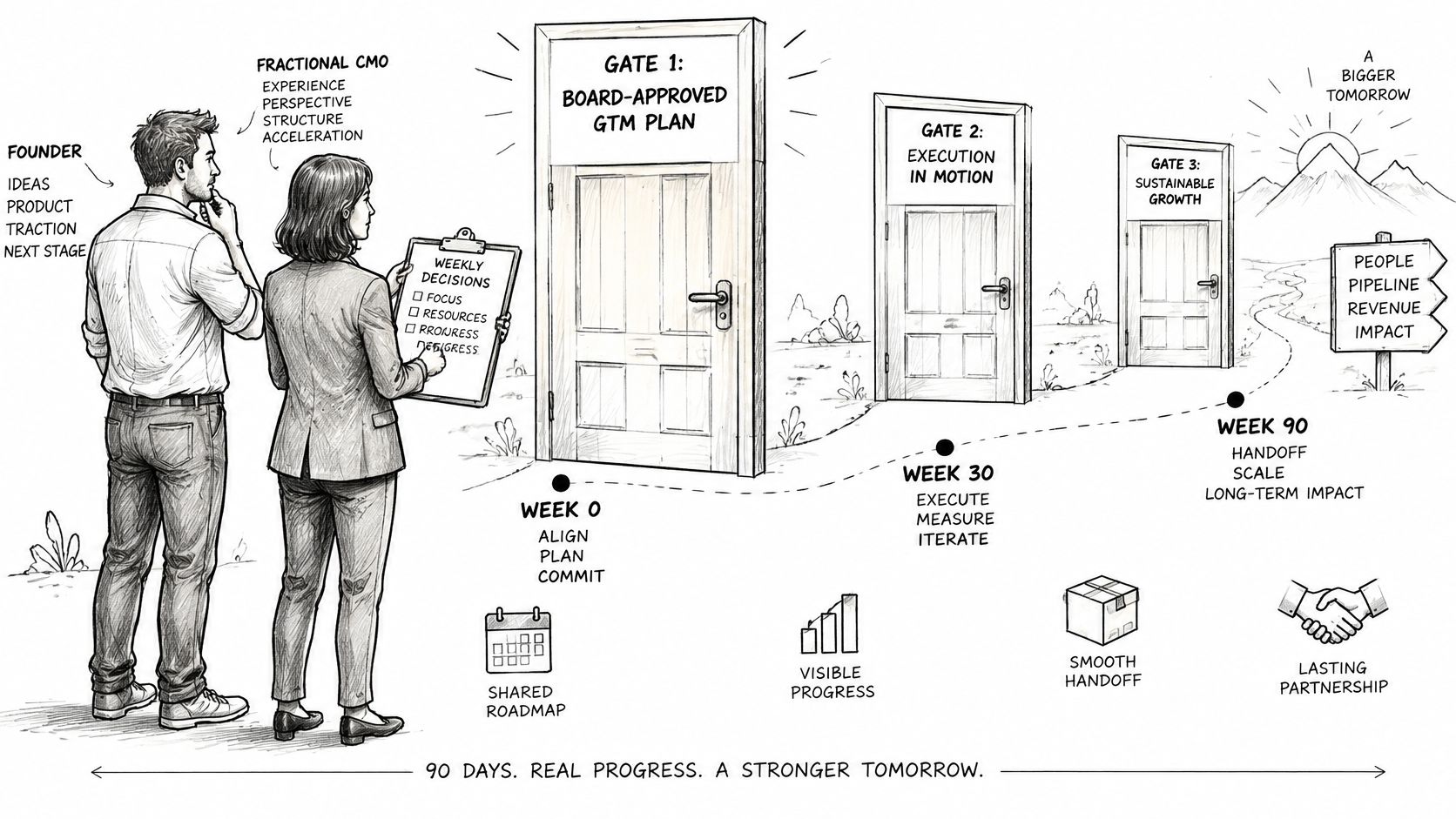
Say you hire a fractional CMO for 90 days. Before the first working session, at week 0, the assignment names three gates. No revenue target. No "successful launch." Three artifacts the company keeps.
Gate 1 is a board-approved go-to-market plan with the channel mix, the offer, and the 90-day metric. Gate 2 is a landing page and tracking live in production, not a deck about the page. Gate 3 is the first campaign shipped with the agreed creative, audience, and spend cap.
One pass, one rejection, one pause
Gate 1 passes cleanly. The plan lands, you read it against the test, and you sign off in writing inside five business days. The invoice clock starts that day. There's nothing to debate because the channel mix, offer, and metric are either in the document or they aren't.
Gate 2 fails once. The page is live and looks right, but the conversion event isn't firing. You reject it with that reason, in writing, tied to the tracking requirement. The CMO fixes the event, resubmits, and the same gate passes. The rejection isn't a judgement on effort. The test either passes or it doesn't.
Gate 3 hits a dependency. Ad-account access sits with you for ten days because the account is tied to your personal login and you're travelling. The operator's clock pauses under the dependency term. When access arrives, the campaign ships inside the agreed spend cap, and the miss on the calendar isn't treated as late work.
The bad version of gate 3
Now rewrite gate 3 as "successful launch" or a revenue number. The product, the pricing, your sales follow-up, and the market all touch that number. The CMO can ship a perfect campaign into a broken checkout and earn nothing. You can also hit the number because a partner mentioned you, and pay a fee for work that didn't cause it.
A payable milestone is an artifact the company could still use if the engagement stopped the next morning.
That test is brutal and useful. The plan passes it. The live page with working tracking passes it. A shipped campaign with documented creative, audience, and results passes it. "Marketing support for Q3" doesn't, which is exactly why it shouldn't be a gate.
Termination, Resubmits and Pushback
A milestone labeled "successful launch" fails when nobody can point to the event, the deadline, the evidence, or what happens to the fee. Both sides will still sign that line. Three months later one of you calls the launch done and the other does not, and nothing in the schedule can settle it.
Federal Highway Administration milestone guidance summarized by Commercial Funding Partners treats milestones as predetermined completion points. Finish on or ahead of the date and an incentive can pay. Miss the date and a daily disincentive can apply. Borrow that habit of naming the event, the date, the proof, and the money consequence. Leave the construction draw split alone, and do not park the whole fee on revenue. Keep a predictable base, then a small set of gates the operator can control.
When the engagement breaks early
If the engagement ends early, completed milestones are still paid under the agreed terms. Put that in one sentence in the assignment. Gates that never passed do not become payable because time was spent. A milestone that is not completed does not trigger payment.
Resubmits stay in the same milestone thread, and every version stays there. Many payment arguments are really arguments about which file was reviewed. One thread ends that fight. Payment applies to undisputed amounts, so a dispute on one gate does not hold the rest of the invoice.
The pushback you'll hear
An operator may ask to be paid for effort after a hard month. Counsel may want every dollar tied to a fundraise, because a raise feels protective. Those two requests pull the schedule in opposite directions.
Effort belongs in the retainer, priced by days. A fundraise, or any other result the operator does not control, sits in its own success fee with its own evidence. The line to use is short. "We'll pay this amount when this named deliverable passes this test." A consulting agreement template is where those clauses live, so the line still holds after the first disagreement.
Lock the Schedule Before Work Starts
Don't start until the assignment lists each gate, its acceptance test, the reviewer, the review window, and whether pay is a retainer plus a milestone pool or fully gated. That's the do-not-start rule. Everything else is detail.
Three to five gates is enough for a 90-day fractional deal. More than that and you're managing the schedule instead of the business. Confirm the base is priced off the day commitment, and that any success fee sits beside it with its own evidence and measurement date.
The agreement is always directly between the client and the operator, and the structure goes into the assignment before work begins. We support four deal models, Pay on Outcomes, Pay per Milestone, Share Revenue and Offer Equity, with compensation types including milestone-based, fixed or recurring, revenue share, equity, and hybrid combinations all defined in the Project Assignment. Funds are secured upfront through escrow-like infrastructure powered by Trustap and released as milestones are met.
See how agreements work for how that structure is set up, then sanity-check your numbers against the fractional executive cost guide and your trigger language against the performance-based contracts post. The aim is a schedule you can paste into the assignment before the first session, with the gates, tests, and payment clock settled before any invoice exists.
If you've got a fractional hire in mind and the pay structure is still a handshake, sort the schedule first. You'll get a signed assignment with named gates, acceptance tests, and a payment clock both sides agreed to before anyone did any work.
Bring your fractional deal to Capstacker and you'll get the milestone schedule, acceptance tests, and payment terms written into the assignment before the first session, with milestone, revenue share, and equity structures tracked in one place. No vague success fee, no invoice argument three months in.