Contractor vs Employee Rules for Fractional Hires

The popular advice is simple: sign an independent contractor agreement, pay an invoice, and you've avoided the cost and commitment of employment. That advice is wrong. In a contractor vs employee decision, the working relationship matters more than the label, the invoice, or the payment method.
For a fractional CFO, CMO, COO, or specialized agency, the safest structure is a genuine business-to-business engagement. Define outcomes, give the provider control over execution, tie payment to milestones where appropriate, and reassess the arrangement if the person becomes embedded in daily operations.
Table of Contents
- Why Your Contract Label Does Not Decide the Relationship
- The Economic Reality Tests That Actually Matter
- Structuring Milestone and Outcome-Based Agreements
- Navigating Equity and Revenue Share for Non-Employees
- The Fragmented Enforcement Landscape
- Comparing Fractional Platforms and Engagement Models
- Choosing the Right Structure for Your Runway
Why Your Contract Label Does Not Decide the Relationship
Signing an agreement that says “independent contractor” doesn't settle classification. Neither does paying a monthly retainer or receiving a 1099-style invoice. Federal agencies examine the economic reality of the relationship, including who controls the work, how permanent the engagement is, who carries financial risk, and whether the provider operates an independent business.
That distinction matters because independent contracting is common, not unusual. The Bureau of Labor Statistics counted 11.9 million independent contractors in their sole or main job in July 2023, equal to 7.4% of total employment. The category includes consultants and freelance workers, making it relevant to fractional executives and agencies engaged for defined services. The BLS survey also distinguishes independent contractors from workers supplied by contract firms, temporary-help agencies, and on-call arrangements.
Common doesn't mean automatically safe. A founder can create employee risk while believing they've hired a consultant. If you set the executive's daily schedule, dictate the methods they must use, provide employee-style training, require indefinite availability, and make them economically dependent on your company, the operating reality may look like employment.
Practical rule: Write the contract to describe the intended relationship, then run the business in a way that matches it.
For a useful primer on the tax and documentation problems that can follow a misclassification decision, review IRS audit and 1099 contractor issues. The contract should define services, deliverables, acceptance, payment timing, intellectual property, confidentiality, and termination rights. It can't override facts that point in the opposite direction.
The Economic Reality Tests That Actually Matter
A contract calling a senior fractional executive an independent contractor does not settle the question. The Department of Labor's framework examines the working relationship through six factors: the worker's opportunity for profit or loss, investments by the worker and business, permanence, the nature and degree of control, whether the work is integral to the business, and specialized skill. The Congressional Research Service summary explains that no single factor decides classification. Regulators weigh the facts together to assess economic dependence.
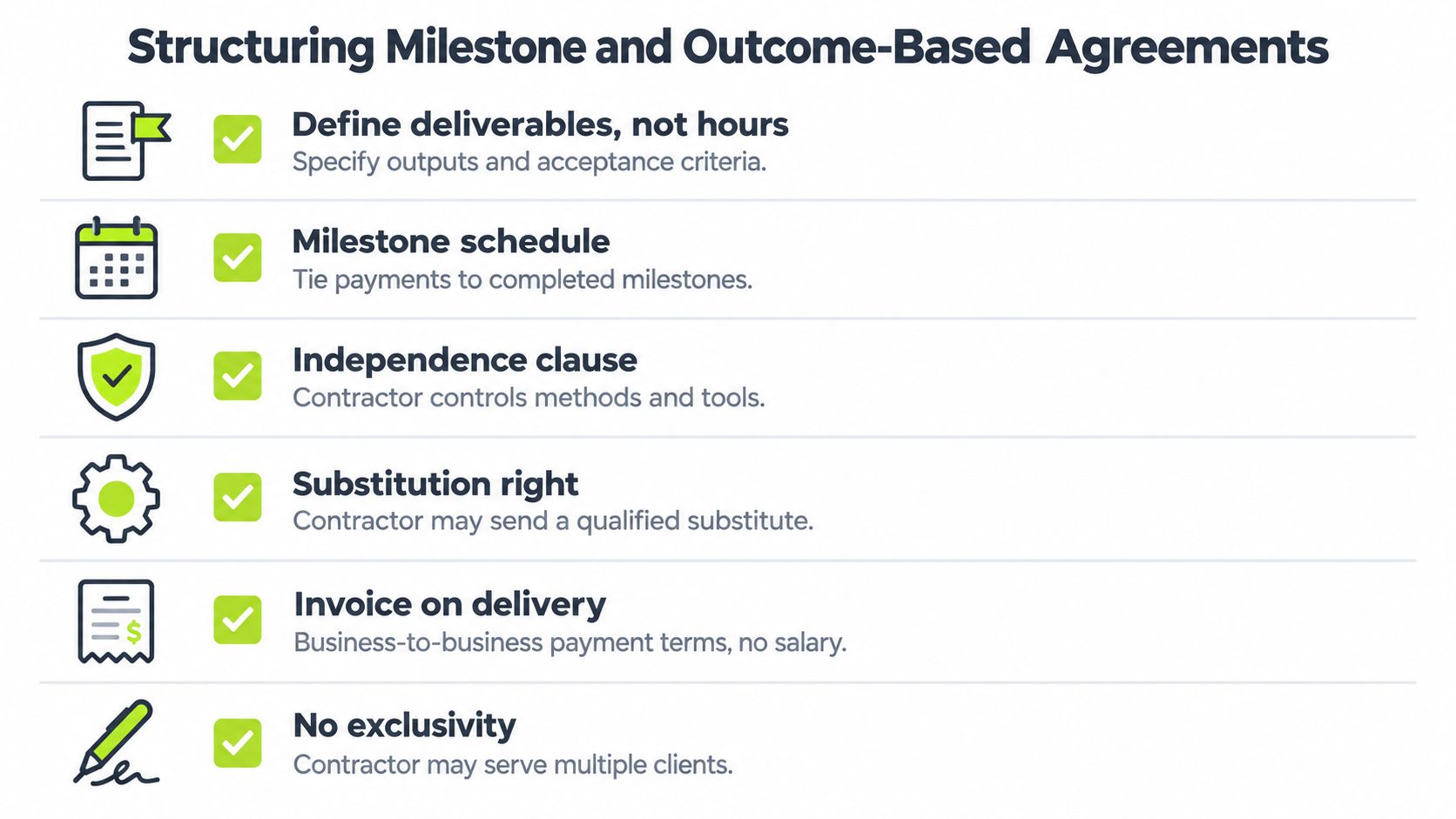
For a fractional executive, control is usually the pressure point. Define the business result, such as a completed pricing review, a board-ready finance package, or a qualified pipeline process. Avoid prescribing every method, requiring internal procedures, mandating fixed hours, or supervising the executive like an employee. Give the provider room to decide how the work gets done.
Economic dependence also matters. A fractional CFO may support your company's most important decisions and still operate independently, provided the engagement reflects a separate business that serves clients, invests in its own tools, and carries commercial risk.
The IRS reviews behavioral control, financial control, and the parties' relationship. Behavioral control covers instructions, training, schedules, and required methods. Financial control covers unreimbursed expenses, investment in tools or facilities, the ability to serve other clients, payment structure, and the opportunity for profit or loss. The IRS explains its classification categories, and the practical recommendation is clear: structure the provider to control delivery and operate as a business.
An indefinite, exclusive role with close day-to-day supervision creates facts that are difficult to defend, regardless of the contract label.
Structuring Milestone and Outcome-Based Agreements
A fractional executive agreement should buy a defined business result, not a block of availability. Replace “provide CFO support for twenty hours each week” with specific work products, decision boundaries, deadlines, dependencies, and acceptance criteria. A milestone might require a cash forecast, a completed fundraising data room, or an approved reporting process. State what qualifies as complete, which evidence proves delivery, and how quickly the company must accept or reject the work.
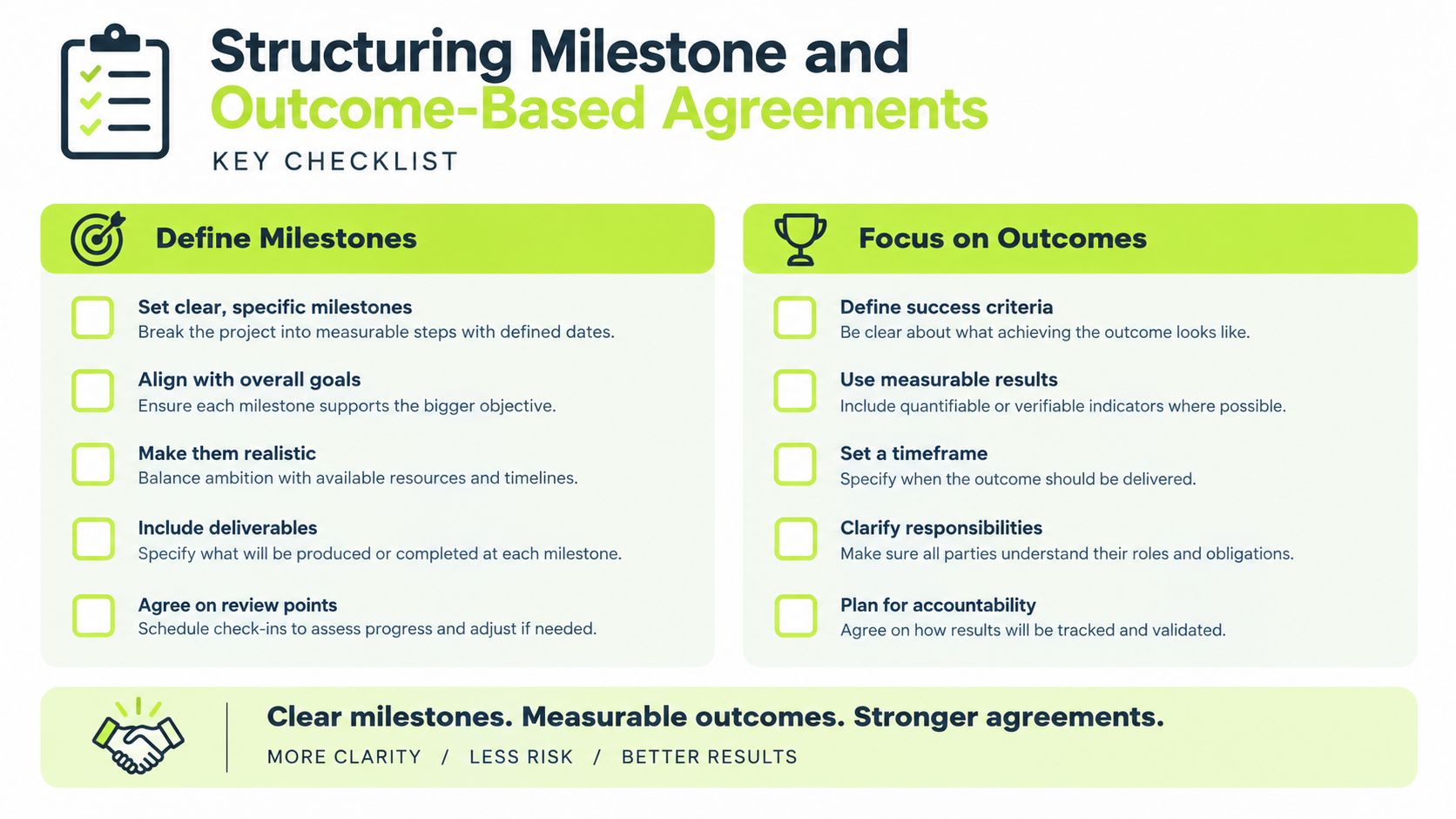
Payment should match the commercial structure of the engagement. Fixed fees, milestone payouts, success fees, revenue share, and retainers can all work, but no payment method determines classification by itself. Milestone-gated fees make sense when the provider controls delivery, uses its own systems, and accepts some risk of rework or additional cost.
Financial control includes unreimbursed expenses, the worker's investment in tools, the ability to market services to other clients, and the opportunity for profit or loss. IRS guidance supports treating the provider as an independent business, rather than disguising wages through a services invoice. Build those facts into the deal: let the executive use independent tools, serve other clients where appropriate, and carry clearly defined commercial responsibility.
Use these terms in the agreement:
- Deliverables: State the output, quality standard, dependencies, evidence of completion, and acceptance process.
- Milestones: Tie each payment to an observable event, not merely time spent or a calendar date.
- Decision rights: Separate founder-owned business decisions from the provider's choices about delivery.
- Expenses and rework: Specify absorbed costs, approval requirements, correction duties, and payment consequences when work fails acceptance.
- Intellectual property: Assign ownership of paid-for work while protecting the provider's pre-existing tools, methods, and know-how.
- Termination: Let either side end the engagement under stated terms, with payment rules for completed and accepted work.
Milestone language cannot disguise employee-style management. Fixed availability, prescribed methods, mandatory training, and indefinite service as an internal department head create facts that may support employee classification. If the role needs that level of control, review the structure before signing instead of relying on a contractor label.
Navigating Equity and Revenue Share for Non-Employees
Equity and revenue share can align a fractional executive with company outcomes, but they don't turn an employee into a contractor or solve classification risk. Treat upside as a commercial term attached to defined services, with clear vesting or payment triggers, reporting rights, eligibility conditions, and what happens when the engagement ends.
A revenue-share arrangement should answer practical questions before anyone signs. Which revenue counts? Is the calculation based on booked, collected, or recognized revenue? What happens with refunds, cancellations, renewals, discounts, or customer disputes? Who supplies the records, and when can the provider inspect them?
Deal rule: If you can't calculate the payment from a clear source record, you haven't finished drafting the compensation term.
A success fee can support a genuine services relationship when the provider controls execution and carries meaningful commercial risk. Equity requires more care because the instrument, recipient's tax position, securities-law requirements, and company approvals can vary. Don't copy an employee option package into a contractor agreement without legal advice.
For operational context on tracking variable payouts and managing global compliance for SaaS startups, use a dedicated record of milestones, calculations, approvals, and payments. Founders considering equity for services should also review this equity for services guide before agreeing to terms. Legal review is especially important when the deal includes equity, exclusivity, or a long-running revenue share.
The Fragmented Enforcement Landscape
There isn't one universal contractor rule that protects a fractional executive engagement everywhere. The U.S. Department of Labor's FLSA rule became effective March 11, 2024, while enforcement postures vary alongside continuing state actions and international regimes such as the UK's IR35 system. The Department of Labor's rulemaking page is the appropriate place to monitor federal developments.
That matters for a U.S. startup hiring someone abroad. The provider's location, the company's location, control over the work, exclusivity, permanence, and the actual services can all affect the analysis. An invoice from another country doesn't create a safe harbor.
The Netherlands ended its contractor-enforcement moratorium on January 1, 2025, the UK continues to place significant IR35 responsibility on engaging companies, and Australia is expanding an employee-like category. These regimes don't produce a single global answer. They reinforce the need to assess the arrangement in each relevant jurisdiction.
Before adding exclusivity, make the founder answer a blunt question: can this person realistically serve other clients? If the answer is no because your company controls their time, methods, and availability, the commercial relationship may be moving toward employment.
Cross-border fractional hiring is a legal design problem, not a payment-processing problem.
If the role has become indefinite operational leadership, consider employment or an employer-of-record solution rather than forcing a contractor label onto an employee-shaped arrangement.
Comparing Fractional Platforms and Engagement Models
Platforms differ less by their landing pages than by the deal mechanics they support. Hourly directories and managed marketplaces can work for straightforward assignments, but they may be a poor fit when a fractional executive is paid through milestones, revenue share, success fees, or equity.
A founder evaluating options should ask whether the platform supports the actual agreement, records acceptance, tracks variable payouts, and keeps the commercial terms clear. A practical guide to startup finance can help define the executive's scope before choosing the payment structure.
| Platform | Primary Model | Outcome-Based Support |
|---|---|---|
| Deel | Global contractor and employment infrastructure | Useful for contractor or employment administration, but complex custom upside needs careful legal drafting |
| Upwork | Marketplace with hourly and project engagements | Suitable for scoped freelance work, less naturally suited to equity-heavy executive arrangements |
| Catalant | Marketplace for consulting and specialized project work | Stronger fit for consulting projects, with custom agreement needs for ongoing fractional leadership |
| Capstacker | Deal structure and payment model for operator engagements | Supports milestone payouts, revenue share, equity deals, legal templates, and tracking |
Capstacker structures operator engagements as independent-contractor arrangements rather than employment. Its stated model assumes operators control how work is performed, may work with other clients, handle their own taxes, and receive payment based on agreed deliverables or milestones. It also states that it isn't an employer of record or staffing company.
For founders comparing tools, Deel alternatives for milestone-based pay is a useful next read. Don't select a platform because it makes contractor payments convenient. Select the structure that matches the work, then confirm that the platform can document the deal without pretending that software replaces legal judgment.
Choosing the Right Structure for Your Runway
Choose the structure based on the work you need, not the title you want to give the person.
A defined-scope services agreement fits a project with a clear output and end state. A retained fractional role can work when the executive provides recurring services with measurable deliverables, genuine control over methods, and a defined review point. If the person owns an ongoing core function, works under your daily direction, or must remain continuously available, use employment or an employer-of-record arrangement.
The IRS states that a worker is generally an employee when the business has the right to control both what will be done and how it will be done, including instructions, training, and required methods. The IRS classification explanation should be part of your review before the engagement begins, not after a dispute.
Don't use a contractor agreement to disguise a full-time role. Define the deliverables, document independence, set payment triggers, preserve the provider's ability to serve other clients, and get legal advice before adding equity, exclusivity, or cross-border terms.
Capstacker gives founders a way to structure operator engagements around milestone payouts, revenue share, equity deals, legal templates, and payment tracking rather than informal promises. If you're hiring a fractional executive, visit Capstacker to put the economics and delivery terms in writing before the first payment.