Part Time CTO: What They Do and What It Costs

Most part time CTO cost pages quote a monthly retainer and stop. That figure tells you little about what you'll spend.
The cheapest retainer can be the most expensive deal. Pay for meetings alone and the build team, QA and incident cover sit outside the quote, unpriced and unmanaged. I'd split the budget into two lines, leadership fees and implementation cost, then gate each leadership payment behind evidence you can inspect: a shipped architecture decision, a signed hiring plan, a release that passed review.
Table of Contents
- Part Time CTO Costs at a Glance
- What a Part Time CTO Owns and Where the Job Ends
- When a Part Time CTO Makes Sense for Your Stage
- How to Structure Milestone Payments for a CTO
- Cash, Equity and Revenue Share Compared
- Confirm These Terms Before You Sign
Part Time CTO Costs at a Glance
A fractional or part time CTO on one to two days per week usually costs $12,000 to $25,000 a month. Interim cover costs more.
| Engagement | Typical commitment | Monthly cost |
|---|---|---|
| Advisory retainer | 4-8 hours per month | $2,000-$8,000 per month |
| Fractional CTO | 1-2 days per week | $12,000-$25,000 per month |
| Interim CTO | 3-4 days per week | $25,000-$45,000 per month |
Those bands come from Recruit Fractional's fractional CTO cost guide, which puts an advisory retainer of four to eight hours per month at roughly $2,000 to $8,000, one to two days per week at approximately $12,000 to $25,000 per month, and three to four days per week at approximately $25,000 to $45,000 per month.
Labels aren't standard. One firm calls eight hours a week fractional, another calls it advisory. Buy the weekly time commitment, not the title on the proposal.
Three things move price most. Hours per week is first. Seniority is second. Third is whether the role is leadership only or also hands-on delivery. Stage matters too. Diligence preparation or team leadership can command more than occasional technical review at the same day count.
If a proposal leads with an hourly cap but won't name deliverables, decision rights and response times, you don't have a price yet. You have a billing method.
What a Part Time CTO Owns and Where the Job Ends
The verdict is simple. A part time CTO sets direction. They don't automatically build the product.
They choose architecture and vendors, plan engineering hiring, manage technical risk and tell you plainly whether delivery is healthy. Daily coding, running every sprint ceremony and open-ended incident response sit outside that role unless you've priced them separately.
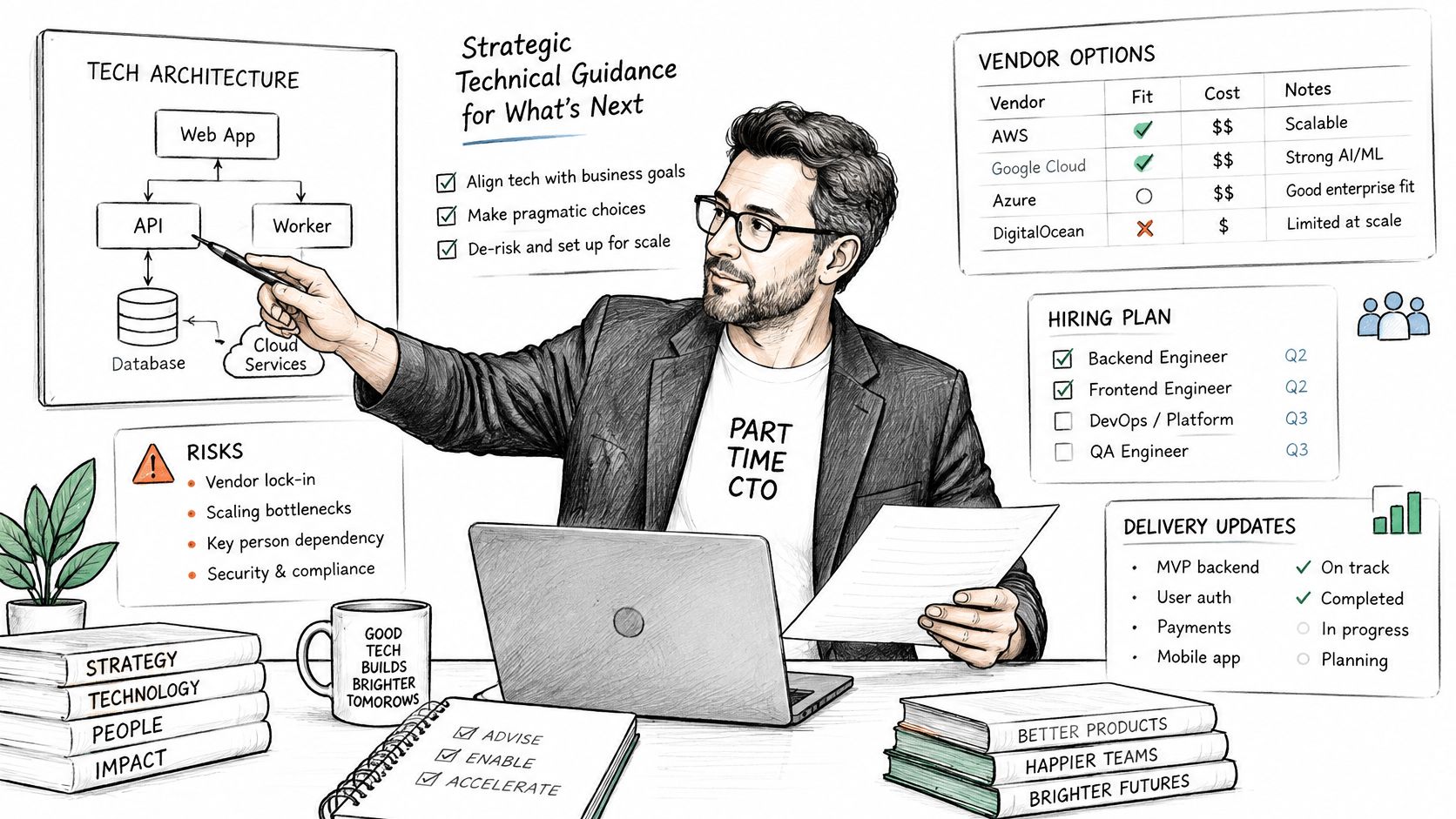
Budget the total engagement, not the retainer. As Wise Hustlers' fractional CTO versus agency comparison notes, engineering, frontend and QA delivery may require an additional $20,000 to $40,000 per month on top of the CTO fee.
| Work | Usually owned by | How it is priced |
|---|---|---|
| Architecture decisions | Part time CTO | Advisory deliverable |
| Vendor selection | Part time CTO | Advisory deliverable |
| Engineering hiring plan | Part time CTO | Advisory deliverable |
| Feature code | Build team | Build deliverable |
| Sprint delivery and QA | Build team | Build deliverable |
| Incident response beyond agreed hours | Unassigned until priced | Separate budget |
Write that split into the agreement as advisory deliverables and build deliverables. It helps to compare different product development engagement models before you assume one contract covers both. On our platform, that distinction is common because founders hire fractional executives, product development companies and specialist teams for different parts of the same job.
When a Part Time CTO Makes Sense for Your Stage
Hire one when you need senior technical judgment for defined milestones, not a full-time executive in every standup.
The clear triggers are specific. You're getting an architecture review before a fundraise. You're moving from an agency-built or no-code MVP to a codebase you own. Outages keep repeating and nobody owns reliability. Or you're about to hire engineers and need a credible technical plan first.
GoFractional's CTO rate data puts the average fractional CTO rate at approximately $203 per hour, based on 18 job posts and 1,282 candidate profiles reviewed over a 90-day period. At 15 hours per week, it reports a corresponding monthly cost of approximately $9,000 to $15,000. I wouldn't negotiate from the hourly number alone. I'd negotiate from the milestone.
When it's the wrong model
Skip it if you need someone making daily tradeoffs with the team, owning every sprint and answering Slack all day. That's a full-time technical lead. Also skip it if you can't yet say what success looks like. A part time CTO can't price fog.
Work that is high-value and tied to outcomes, not hourly task work, is the right fit. That's our general rule too. Operators can work with other clients unless the Project Assignment restricts it, and founders can meet multiple operators for the same role until there's a fit. If you want a broader service view before deciding, the MR2 Solutions guide to CTO services is a useful companion read.
Do a quick self-check. Count the days each week you need a technical leader in the room, then match that count to the cost table.
How to Structure Milestone Payments for a CTO
Most retainer arguments start with one number that was never split. A part time CTO's fee usually pays for two different jobs: technical judgement on architecture, hiring and vendors, and implementation like deployments and security fixes. Bundle them and nobody can say which one released the payment. Separate the cash fee from contingent payments and define each piece mathematically in the agreement.
- Set a modest retainer for recurring availability, not unlimited access.
- Pick three to five milestones. Choose deliverables someone can test, not themes.
- Define each milestone in writing: baseline, deliverable, deadline, evidence, acceptance owner, cure period and payment trigger.
- Attach a fixed payment. Money moves on acceptance, not on effort.
- Keep fuzzy work time-based. Incident response, open-ended management and discovery don't price cleanly by outcome.
- Add upside only with attribution. Revenue share or equity needs a cap and an end date.
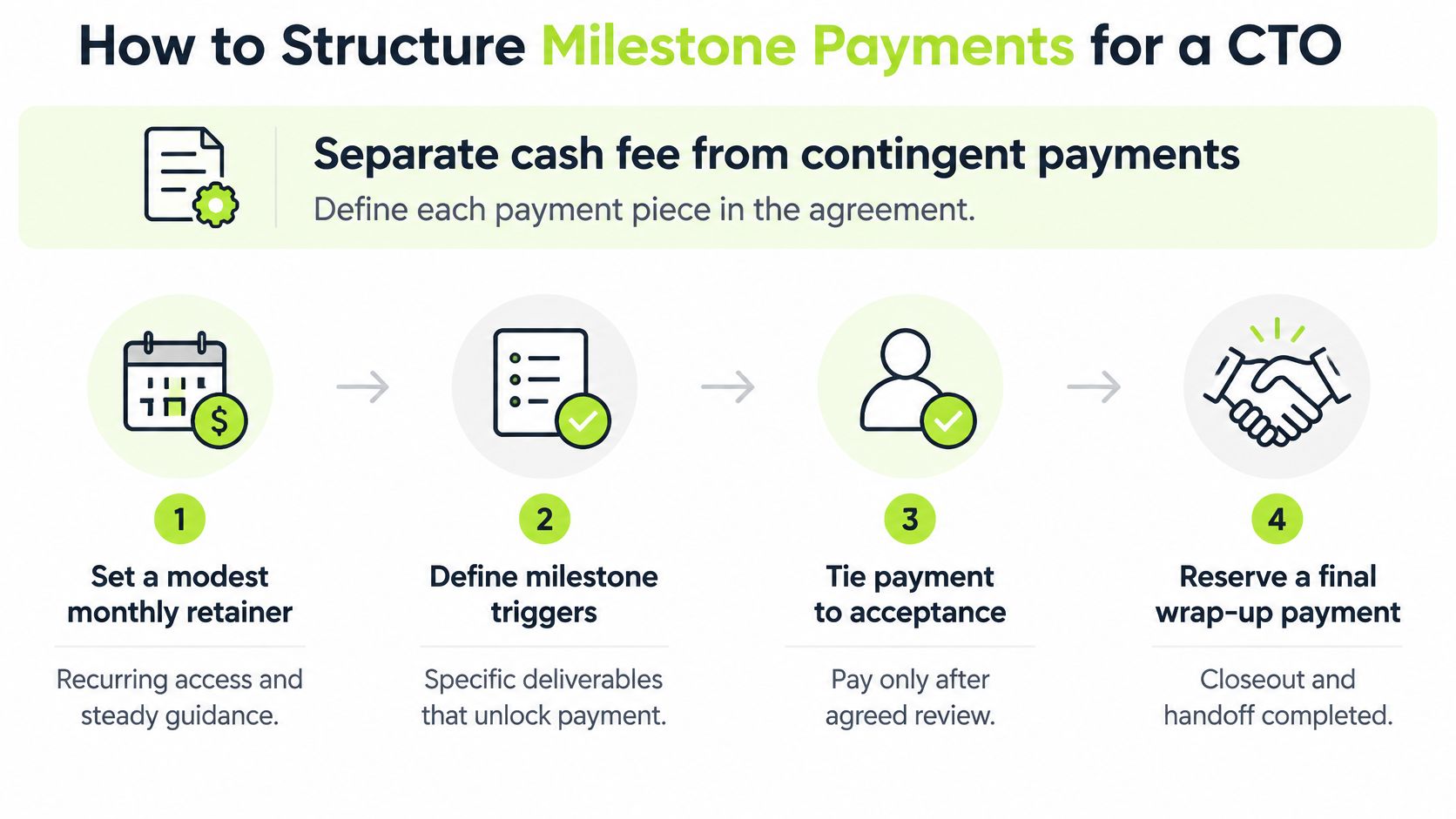
HyperResearch's consultant rate guide describes this same shape: a modest retainer plus fixed payments at objectively testable milestones, with capped revenue share or service equity only where attribution is clear.
| Milestone | Evidence that releases payment | Who accepts it |
|---|---|---|
| Architecture review | Written review and a decision log the founder has accepted | Founder |
| Documented deployment process | Runbook used for two consecutive releases | Founder and lead engineer |
| Security remediation plan | Third-party report with high-risk items closed | Founder |
| Incident rate reduction | Incident count below the agreed baseline across the measurement period | Founder |
| Hiring plan delivered | Approved role list and hiring timeline | Founder |
Where the evidence is technical, name the lead engineer as a second acceptance owner. A founder signing off alone tends to approve effort. An engineer signs off a runbook that ran twice in production.
The common slip is paying for weeks of meetings with no acceptance criteria. Don't. Capstacker helps startups hire fractional talent and service teams who only get paid when results are delivered, so the acceptance test stays practical instead of becoming a monthly invoice.
Release test: if a document or metric can't release the next payment, rewrite the milestone.
Cash, Equity and Revenue Share Compared
My rule is blunt. Pay cash for bounded work. Use equity or revenue share only when the CTO changes a number you can measure and stays long enough to affect it.
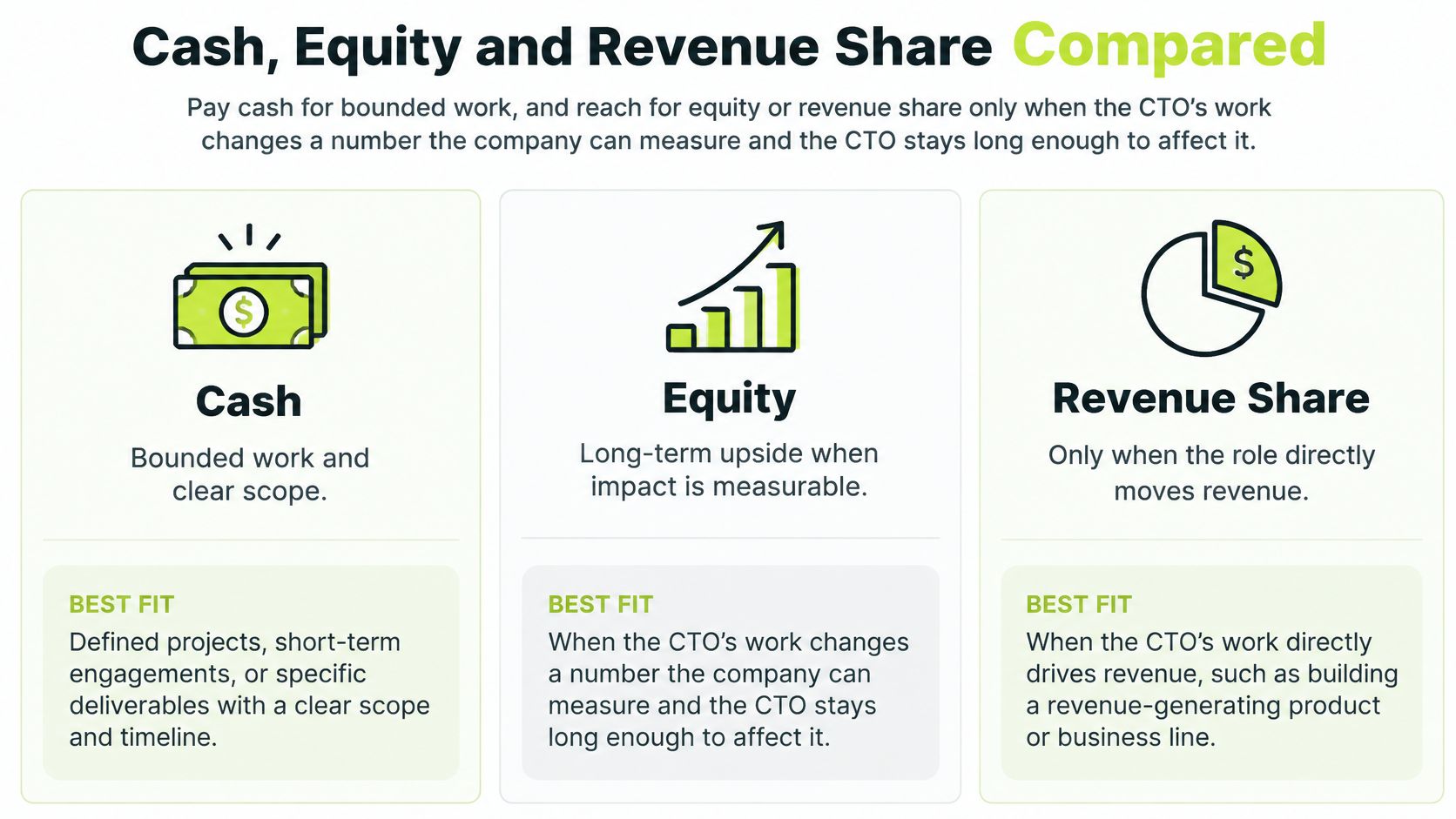
| Structure | What the founder gets | What it costs or risks |
|---|---|---|
| Cash only | Predictable monthly cost and clean termination | Bill continues whether or not milestones land |
| Cash plus equity | Lower cash burn while pre-revenue | Vesting, dilution, termination and valuation to agree in writing |
| Cash plus revenue share | CTO paid on revenue they can influence | Attributable revenue, exclusions, audit rights, cap and end date to define |
Cash isn't lazy. For a six-week architecture review, it's often the cleanest answer. Equity gets messy fast because both sides must settle instrument, vesting and what happens on exit. Get the equity vesting schedule right before you promise upside. The tradeoffs are similar to those in Florida startup legal fee arrangements, where deferring cash only works if the replacement consideration is precise.
These structures combine well. A small retainer, milestone cash and a capped grant can suit a longer rebuild. But if you can't name the metric a revenue share would track, don't use revenue share. Pay cash on milestones and keep the guesswork out.
Confirm These Terms Before You Sign
Don't sign until the agreement fixes scope, acceptance and exit in writing.
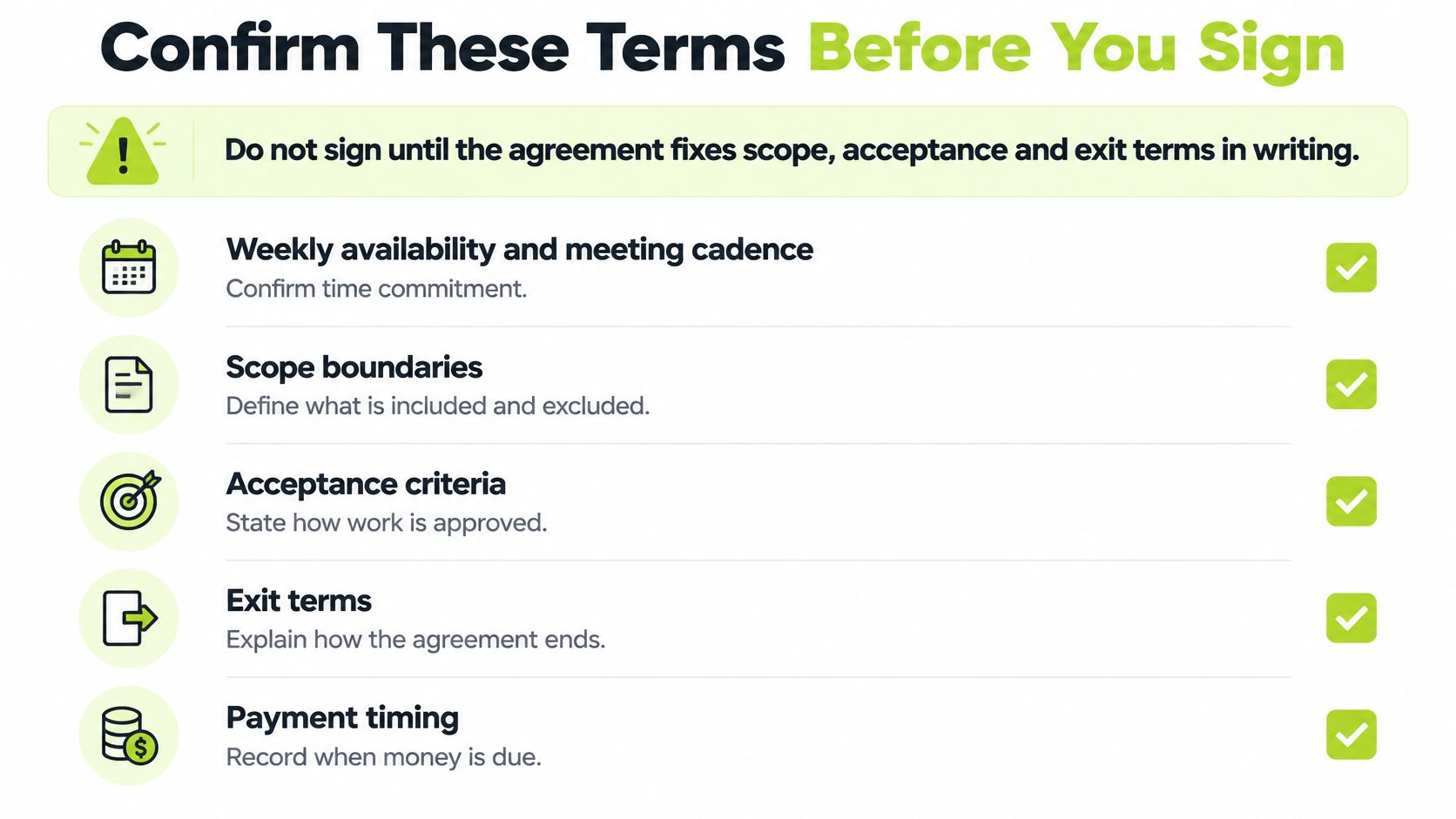
- Availability: weekly hours, meeting cadence and response expectations.
- Deliverables: advisory work separated from build work.
- Decision rights: who approves architecture and vendor choices.
- IP and confidentiality: ownership, access and company accounts.
- Termination: what gets paid for completed work after exit.
Classification matters. The IRS Form 1099-NEC guidance states that worker classification depends on the client's right to control and direct how the work is performed, not merely on whether someone is paid part time, full time or hourly. Our operators are independent contractors, not employees. Clients don't withhold taxes, provide benefits or direct how work is done, only what is delivered and by when. Businesses generally report qualifying nonemployee compensation on Form 1099-NEC.
Use a solid consulting agreement template and review how agreements work before the first candidate call. Then do one thing first. Write your milestone list before you talk money.
If you're hiring a part time CTO, we can help you scope the milestones, set cash, equity or revenue share terms and put the agreement, tracking and payouts in one place. Start with a short intake and a 1:1 call, then meet matched operators before you commit. Visit Capstacker and bring the milestone list you want priced.