Equity Vesting Schedule for Fractional Executives

Stop copying the employee plan for a service deal. An equity vesting schedule for a fractional executive or agency should vest over the months you are buying, or when you accept named milestones. The standard four-year, one-year cliff can leave a good operator with zero after months of real work. Pick the row that fits the engagement first. Talk percentages second.
Table of Contents
- Equity Vesting Schedules That Fit Service Deals
- How a One-Year Cliff Actually Pays Out
- Monthly Quarterly or Milestone Releases
- A Fractional CFO Grant Worked in Tranches
- Restricted Stock Options and the 30-Day Election
- Lock the Schedule Before Work Starts
Equity Vesting Schedules That Fit Service Deals
Here's the part founders get backwards: the schedule is a design choice, and the employee default is the wrong choice for a contractor. Vesting is the timetable for earning a grant, not the decision about how much to grant. For a fractional executive or agency, that timetable should run on the months you're buying and the deliverables you'll accept.
Four-year grants with a one-year cliff remain the common default for employee plans, so contractor offers keep inheriting terms built for someone expected to stay for years. On a nine-month engagement, that borrowed clock can mean the equity never starts at all.
| Schedule | When equity vests | Fits | If the work stops early |
|---|---|---|---|
| Four-year with a one-year cliff | Nothing for 12 months, then 25%, then monthly | Full-time employees | Nothing before the cliff |
| Two-year monthly, no cliff | Monthly over two years, no cliff | Advisors and longer retainers | Only the unvested months |
| Monthly over the contract | Equal slice each month of a 3, 6, 9, or 12-month term | Fractional executive engagements | Unearned months only |
| Milestone tranches | On acceptance of a named result | Agency or narrow outcome work | Missed or unaccepted milestones |
| Hybrid time plus outcome | Part monthly, part on a target | Ongoing help that must also hit a result | Time portion if service ends; outcome portion if the target misses |
Lock the schedule shape first, then argue about grant size. The wrong row is expensive: hand a nine-month fractional CFO a four-year schedule and the end-of-engagement fight is about forfeited months, not results.
If you're also sorting founder rights across borders, take the time to explore Israeli startup partnership agreements so the service grant doesn't clash with the founder documents.
Practical rule: if the engagement is six months, the vesting clock shouldn't be four years.
How a One-Year Cliff Actually Pays Out
On a 1,000-share grant, the usual cliff pays nothing in year one. That structure is a market convention, not a legal requirement, and on the first anniversary 250 shares, or 25% of the grant, vest at once, with the remaining 750 shares vesting in equal monthly installments over the next 36 months, approximately 20.83 shares per month, as the Westaway vesting schedule FAQ explains.
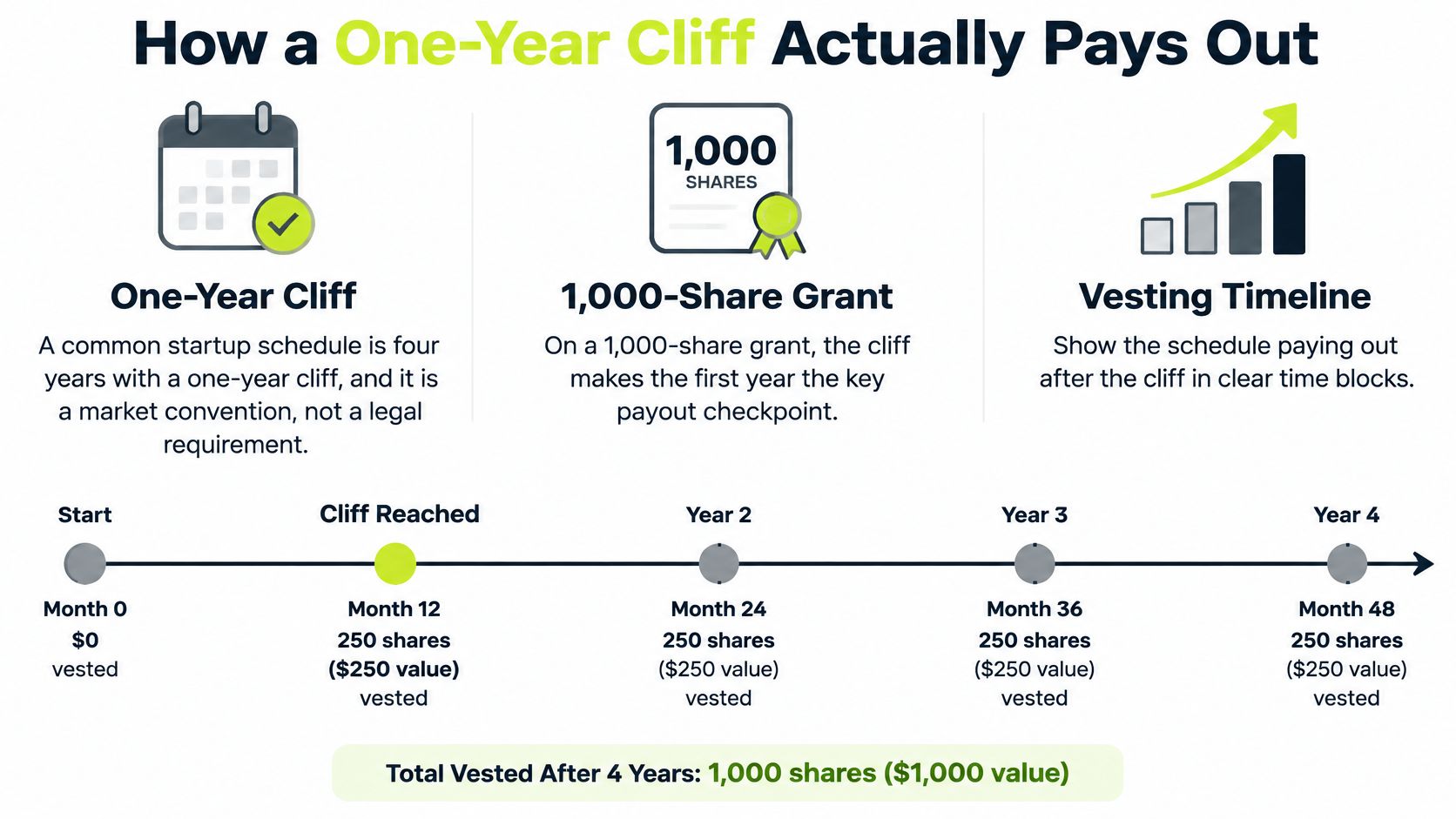
Run that against a contractor deal. A provider who finishes month eleven of a twelve-month engagement owns zero if you end the work before the cliff, even if the work was good. That's not alignment. That's a binary test that invites a dispute.
What to write instead
Name the vesting start date explicitly, whether that's the signature date, the first working day, or a milestone date. If you want a trial period, use a shorter cliff, such as three months, and say exactly what gets forfeited before it. Don't borrow the post-cliff monthly pattern and assume it fixes a term that isn't four years.
If a one-year cliff doesn't match the deal length, the release has to move to monthly, quarterly, or milestone vesting. That cadence choice matters more than founders think.
Monthly Quarterly or Milestone Releases
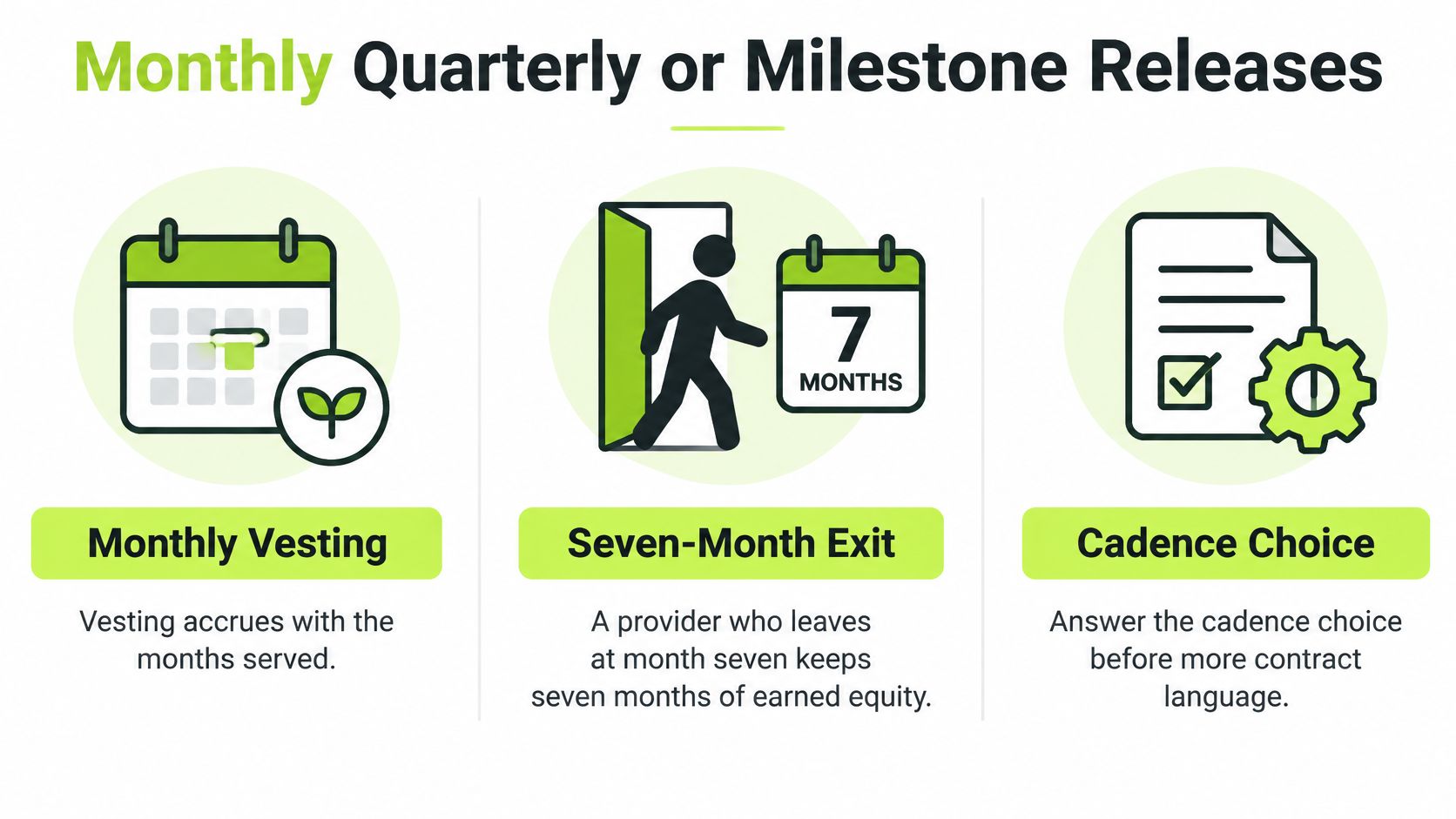
Monthly is my default for any term under a year. It accrues with the months served, so a provider who leaves at month seven keeps seven months of earned equity and forfeits only the rest. That's fair, and it's easy to audit.
Cadence also changes by entity. In private-equity-backed-company data, 63% of initial executive grants at corporations used monthly vesting, compared with less than 10% at LLCs, where 72% vested annually, according to Carta's PE executive equity report. Don't ignore that gap. Profits interests, LLC units, options, and restricted stock don't carry the same economics, voting rights, or transfer rules.
| Cadence | Term it fits | Risk on a short deal |
|---|---|---|
| Monthly | Ongoing service under 12 months | Low forfeiture; more grant admin |
| Quarterly | Six to twelve months with review gates | Up to one quarter of work can stay unvested |
| Annual | Multi-year employee or management grants | A sub-year engagement can end with zero equity |
| Milestone | A named result with an acceptance date | Vague targets or a company delay can block the release |
Use quarterly only with a dated review and a partial-credit rule. Reserve annual for a real multi-year term. For a defined deliverable, milestone vesting beats time, but only if the metric, acceptance process, and payout date are in the contract.
A Fractional CFO Grant Worked in Tranches
A worked example beats an abstract rule. Say a fractional CFO takes a 12,000-share option grant on a 12-month assignment. Split it into a 4,800-share time portion vesting at 400 shares a month while services continue, plus three outcome tranches of 2,400 shares each. If the engagement ends early, unvested time shares stop; earned tranches stand. Anyone modeling the grant size can sanity-check the inputs with our startup equity calculator before the split gets negotiated.
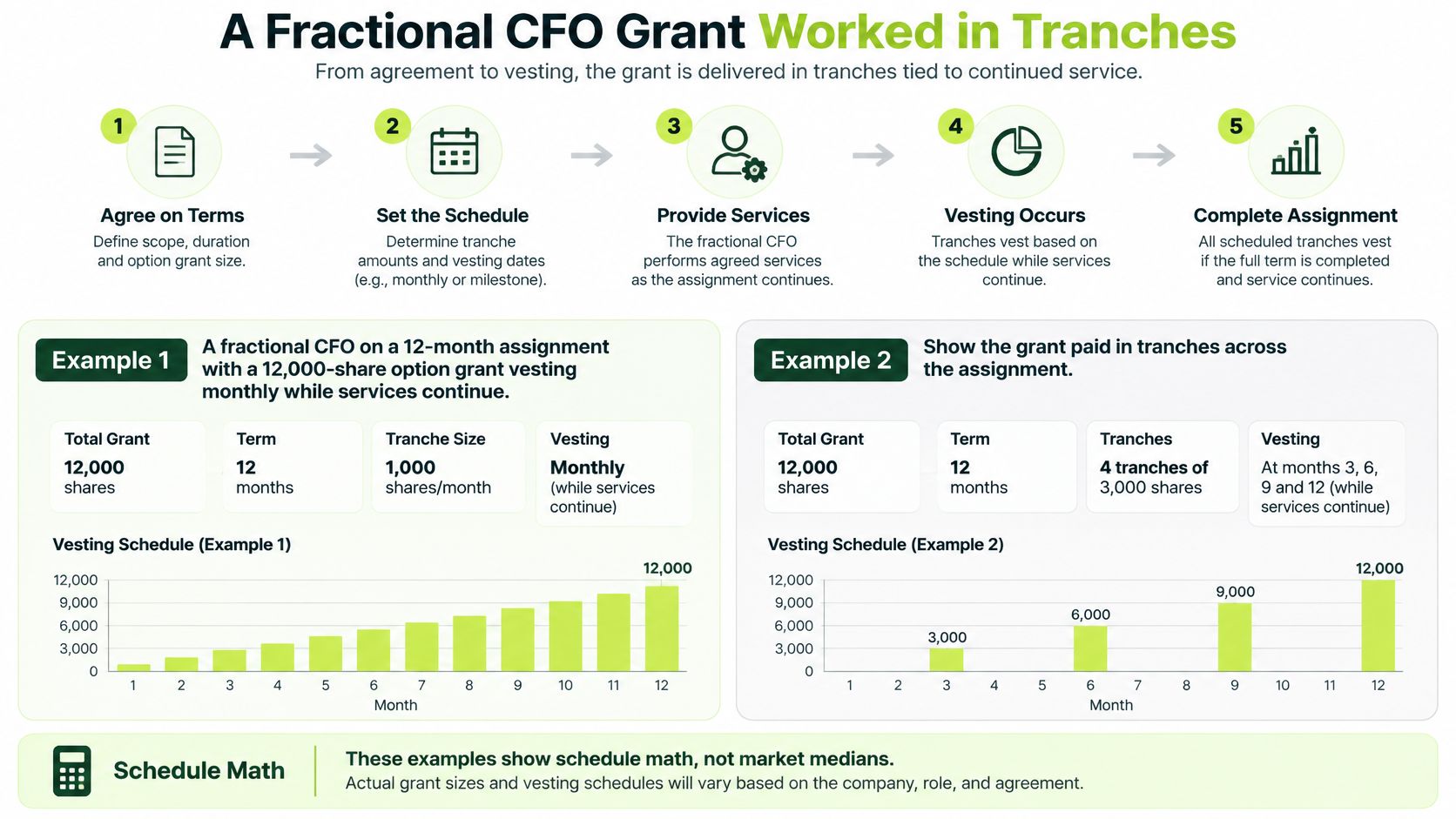
Why the split? Because a service deal should pay for delivered work. Most private-company plans still default to four-year vesting, per Pave's long-term incentive plan guide, and that employee convention answers nothing about how a short fractional engagement should pay out. For the finance outcomes worth writing into the contract, fractional CFO guidance for growing businesses is a useful reference for what those deliverables look like in practice.
| Portion | Release trigger |
|---|---|
| Time portion (40 percent) | 4,800 shares vesting monthly over 12 months of service |
| Outcome tranche 1 (20 percent) | Accepted completed financing package |
| Outcome tranche 2 (20 percent) | Accepted working forecast system |
| Outcome tranche 3 (20 percent) | Accepted defined runway target |
Each outcome tranche releases on acceptance, on a dated test rather than a calendar page. Write the acceptance test, define substantially complete, and state that a company-caused delay doesn't forfeit a finished tranche. For a three-month agency build, skip time vesting entirely. Release on accepted delivery, with forfeiture only after a stated cure period if the milestone misses.
Settle acceleration in one sentence. Single-trigger means vesting accelerates on a sale alone. Double-trigger needs both a change in control and a qualifying termination. They're different promises, and double-trigger is the one a buyer can live with on a 12-month grant.
Restricted Stock Options and the 30-Day Election
Put the 30-day election on the calendar at signing, not after the first invoice. The commercial vesting schedule and the tax clock are separate things, and confusing them gets expensive.
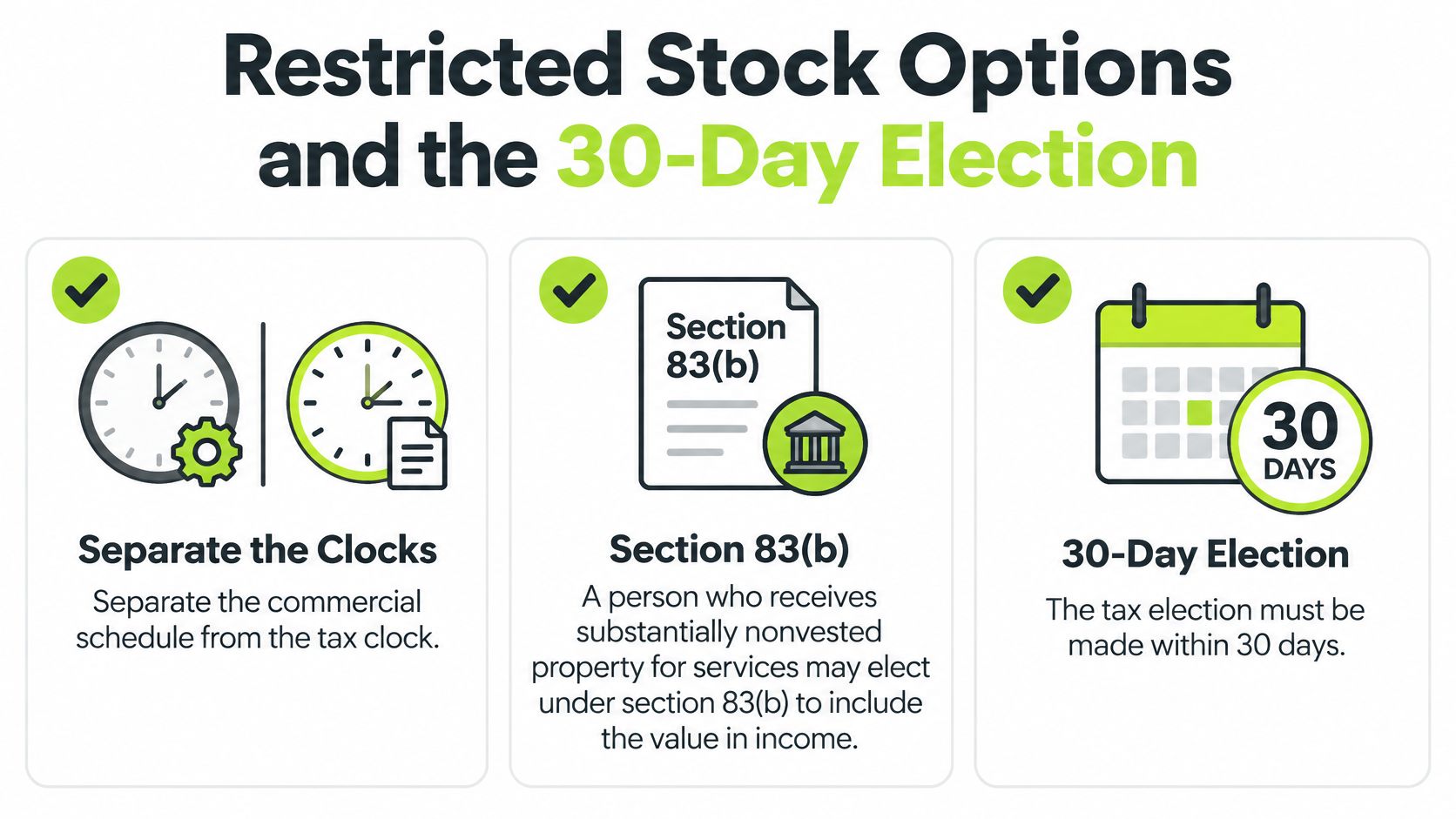
The IRS explains that an individual receiving substantially nonvested property for services may make an election under Section 83(b) to include the property's value in income when transferred rather than when it later becomes substantially vested, and the election must be filed no later than 30 days after the property is transferred, per the IRS Section 83(b) election form. If day 30 falls on a weekend or legal holiday, a postmark on the next business day can generally still be timely. Don't plan around that edge case.
Restricted stock is generally taxed when it vests, at fair market value minus anything paid, unless the election moves income to the transfer date. Early-stage shares are often cheap then, which is why people file, but a later drop in value doesn't undo the election. If you want to model the restricted stock side before filing, Blue Sage Tax & Accounting's RSU calculator can help you frame the numbers for your own tax advisor.
Options are a different instrument and don't follow that same income timing. Your agreement should name the instrument, the transfer date, forfeiture or repurchase terms, who supplies the filing numbers, and that each side gets its own tax advice. Filing doesn't make unvested equity earned. It only changes when income is recognized.
Lock the Schedule Before Work Starts
Don't start work until five things are written down as line items, not buried in a template. Most service equity deals go wrong at that point.
- Grant and instrument: the exact size, and whether it's restricted stock, options, units, or another form.
- Start date: the day the vesting clock begins.
- Cadence or milestones: the monthly releases, or the milestone list with acceptance tests.
- Early exit: what happens to unvested equity if either side ends the deal.
- Tax filing owner: who prepares the 83(b) filing if the grant is restricted stock.
We run every engagement on two documents, the Operator Agreement as the master contract and the Project Assignment (Exhibit A), which defines scope, milestones, compensation, and what done looks like. Compensation can be milestone-based, fixed or recurring, revenue share, equity, or a hybrid, all defined in that Project Assignment before work begins. Our consulting agreement template guide shows how those terms sit together, and our page on how agreements work covers where the vesting row and milestone list belong.
Earned equity is real compensation. If equity is earned but not issued, the services are treated as unpaid and IP does not transfer.
Bring the schedule row you picked and the acceptance tests you drafted. Get both signed before the first working day.
If you're structuring equity for a fractional executive or agency, bring us your chosen vesting row, milestone list, and acceptance tests, and we'll help you get them written into a Project Assignment with the cash, equity, and milestone terms lined up before work starts. Visit Capstacker to scope the deal with us founder to founder.