Consulting Agreement Template for Startup Deals
A usable consulting agreement template is two documents: baseline legal terms, plus a project schedule naming scope, milestones, the fee model, and termination treatment. Downloading a form and filling in the fee isn't enough, especially when you're hiring a fractional executive rather than buying a finished project.
A blank fee field is not a template. The useful version tells both parties what the operator can decide, when payment becomes due, and what survives an early exit.
Meta description: Consulting agreement template with a master contract, objective milestone acceptance, and capped revenue share or equity on exit.
Slug: consulting-agreement-template
Table of Contents
- What This Consulting Agreement Template Actually Covers
- The Clauses Every Service Engagement Needs
- How to Choose the Payment Model
- Scope Capacity and Milestone Acceptance
- Revenue Share That Survives an Audit
- Equity for Services Without a Handshake
- Termination Intellectual Property and Confidentiality
- When the Documents Disagree
- Fill the Schedule Before You Sign
What This Consulting Agreement Template Actually Covers
Use a master agreement for baseline legal terms and a project schedule, often called Exhibit A, for the commercial deal. Name the parties, term, and independent-contractor status in the master contract.
Before signature, fill these blanks:
- Services and authority: Deliverables, exclusions, and decision rights.
- Capacity: Hours, availability, and outside-client permissions.
- Acceptance: Objective tests for completed milestones.
- Compensation: Hourly, retainer, milestone, revenue share, equity, or base plus upside.
- Exit: Treatment of unpaid work, unissued equity, and future revenue.
The contractor clause should exclude employee, partner, agent, and joint-venturer status and assign the consultant responsibility for their related obligations. That wording doesn't replace a properly structured working relationship.
Xero's independent-contractor guide identifies scope, deliverables, milestones, compensation, confidentiality, ownership, and termination as core agreement terms.
Negotiate the schedule, not a slogan about best efforts.
The Clauses Every Service Engagement Needs
A fee field alone does not make a usable agreement. The contract needs clear baseline terms, and the project schedule needs to set capacity, objective acceptance criteria, payment gates, and any limits on post-termination obligations.
| Clause | Write this specifically | If you leave it blank |
|---|---|---|
| Parties and status | Names; independent-contractor relationship and limits on authority | Classification and authority disputes |
| Term | Start, end, and renewal terms | Unclear availability |
| Scope and deliverables | Services, decision rights, and exclusions | Work expands beyond the intended role |
| Capacity | Hours, meetings, response window, and outside-client permissions | Disputes about availability and effort |
| Milestones | Deliverable, measurable acceptance criteria, deadline, approver, and partial payment | No objective way to decide whether work passed |
| Fees | Payment model, invoice timing, due date, currency, taxes, and late-payment terms | Unclear payment process |
| Expenses | Pre-approval requirements and reimbursement deadline | Disputes over informal expenses |
| Confidentiality | Covered information and obligations after termination | Unclear protection for client information |
| Intellectual property | Ownership of deliverables and terms for disclosed pre-existing tools | Ownership disputes over embedded frameworks |
| Termination | Termination rights, notice, and payment for completed work | Unclear treatment of unfinished work and future obligations |
| Disputes | Escalation steps and external resolution process | No agreed way to resolve a disagreement |
Use each row to answer a practical question: who approves a milestone, what evidence shows it passed, and what happens if the parties disagree? “Best efforts” does not tell either side when payment is due.
Add a separate non-solicitation clause if the parties want one. Keep confidentiality focused on protecting information, including after the engagement ends. For help selecting counsel to review the finished agreement, consult the Los Angeles startup counsel hiring checklist.
How to Choose the Payment Model
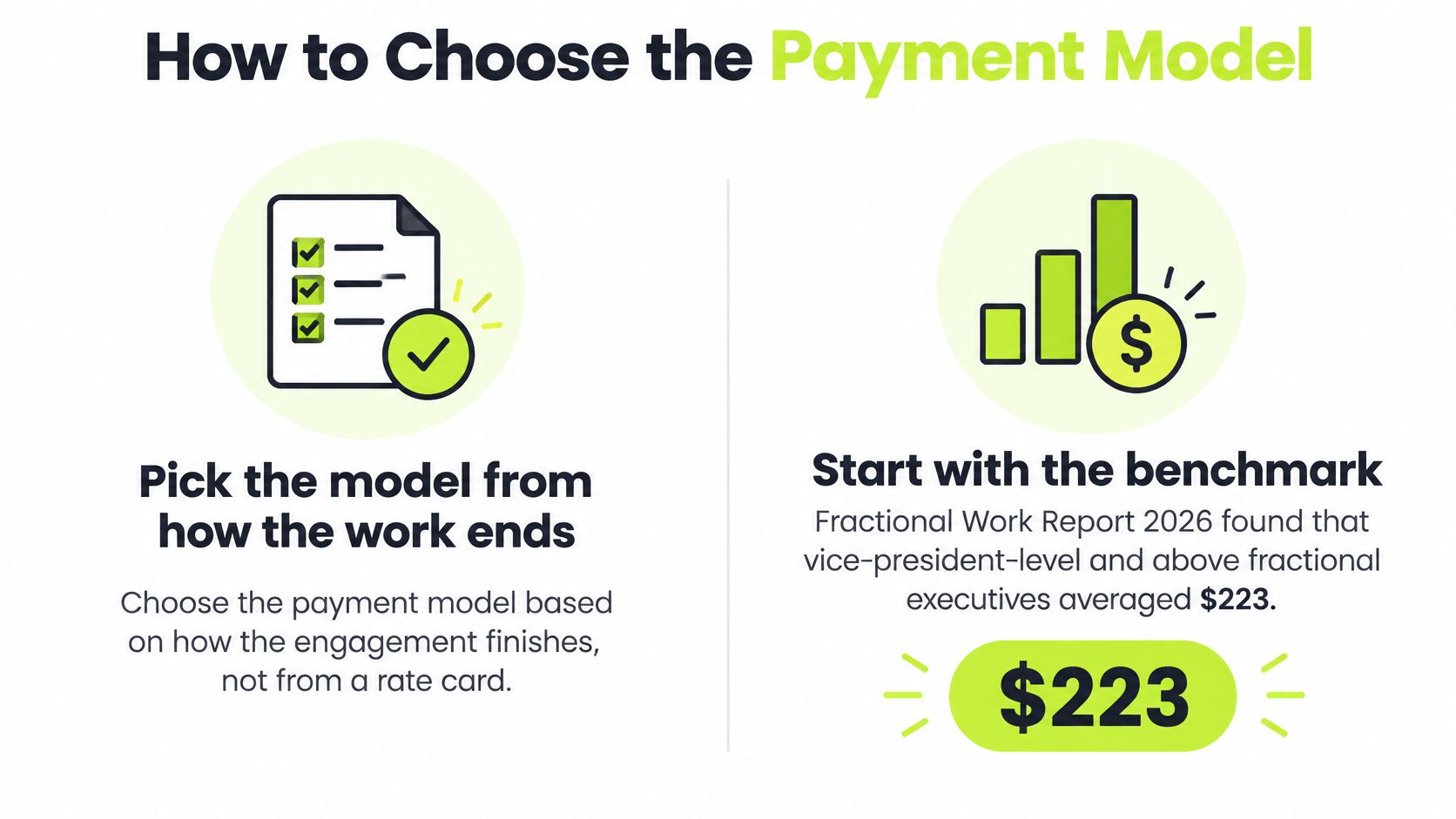
Choose the model from how the work ends, not from a rate card. The Fractional Work Report 2026 found that vice-president-level and above fractional executives averaged $223 per hour, while 46% billed primarily through monthly retainers.
| Model | Fits when | Main risk | Schedule must state |
|---|---|---|---|
| Hourly | Short, bounded advice | Unlimited availability | Rate, cap, unused hours, written overage approval |
| Monthly retainer | Ongoing fractional seat | Salary-like expectations | Included work, response time, meetings, prep, reporting |
| Milestone fee | Clear finish line | Vague effort language | Amount, test, deadline, partial completion |
| Revenue share | Influenced commercial results | Undefined revenue | Base, deductions, period, cap, end date |
| Equity for services | Bona fide advisory work | Informal share promise | Security, vesting, plan, exit treatment |
| Base plus upside | Influence without control | All cash contingent | Base, gated upside, measurement fallback |
Benchmarks aren't negotiated prices. A cheaper hourly rate won't protect your budget without a hard cap.
I'd use a guaranteed base plus gated upside when the operator doesn't control pricing, product, or sales execution. Suby's invoicing guidance can help you set clearer freelance payment terms, particularly around billing and overdue invoices.
Scope Capacity and Milestone Acceptance
Separate deliverables from availability. In our process, the Operator Agreement is the master contract; the Project Assignment (Exhibit A) defines scope, milestones, compensation, and what done looks like.
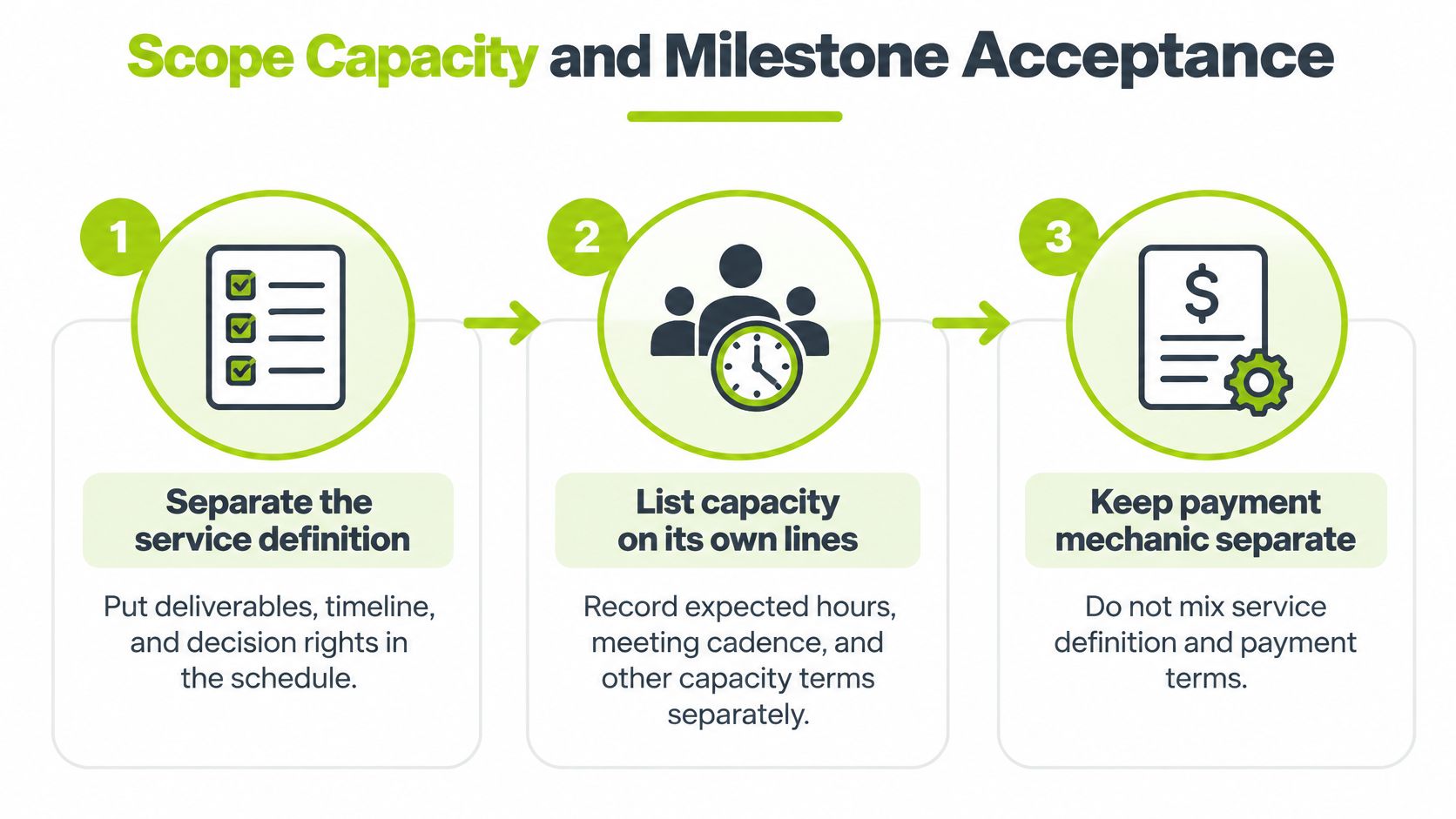
Give each milestone a deliverable, baseline metric, target, measurement period, data source, approver, deadline, payment amount, and partial-completion rule. Record expected hours, meeting cadence, response windows, and permitted outside clients separately.
Set a fixed business-day acceptance window: the client must accept or give a specific written rejection; silence triggers deemed acceptance. Clients can request revisions with time-stamped reasons tied to agreed criteria, not newly invented scope.
The fee clause should identify disputed amounts the client may withhold while requiring payment of undisputed sums. A SEC-filed consulting agreement requires properly submitted expenses to be paid within 30 days, illustrating why reimbursement needs an explicit deadline.
Revenue Share That Survives an Audit
Define the revenue base before negotiating the percentage. Specify gross or adjusted revenue, allowed deductions, when revenue counts as earned, calculation period, reporting, payment deadline, dollar cap, and end event.
Fynk's capped revenue-sharing agreement describes adjusted gross revenue as gross income less agreed deductions such as cost of goods sold, with payments after each calendar quarter and termination at a maximum payout or another specified event.
Name the data holder, audit access, and cure period for missing reports. Our revenue-share model guide helps frame that negotiation.
Exit rule: Pay accrued share through the contractual end date. Future revenue is excluded unless an explicit, capped tail says otherwise.
Name a fallback fee when the client changes strategy or prevents measurement. For revenue milestones gating lump-sum payments, use the agreed acceptance criteria rather than creating a competing test.
Equity for Services Without a Handshake
Put equity compensation in writing before services begin. The SEC's Rule 701 guidance covers certain private-company securities issued under a compensatory plan or written compensation contract to consultants and advisors providing bona fide services; recipients must receive that plan or contract.
Name the security, grant amount or formula, vesting or delivery conditions, and governing plan. The company must confirm the exemption and disclosure requirements with counsel.
For outcome-based work, tie vesting to objective acceptance. Time-based vesting fits an advisory retainer better than a results-only deal.
State what happens to unvested or unissued equity after client convenience termination, operator termination, or partial achievement. Cap the grant and document any acceleration. The equity-for-services guide provides context, but counsel still needs to check the securities treatment.
Termination Intellectual Property and Confidentiality
Write exit economics before work starts: convenience notice, cause, accepted-milestone pay, and any partial-completion entitlement. Apply the agreed equity and revenue exit provisions without creating contradictory exceptions.
The client should own deliverables. Under our terms, operators retain disclosed pre-existing tools and frameworks; clients receive a perpetual, worldwide, royalty-free license to use them within the deliverable.
Our confidentiality obligation covers product data, financials, strategy, and the engagement's existence, and continues after exit. Use the NDA essentials from Miles Hansford Law Firm to review coverage and exceptions.
Operators also agree not to solicit client employees during the engagement and for one year afterward. Contractual escalation precedes external dispute resolution; platform records provide evidence, not a platform verdict.
When the Documents Disagree
Treat payment structure as classification evidence, not the whole test. The IRS-style independent-contractor guidance hosted by Oregon distinguishes employment-like periodic payments from commission or project-completion payments, while recognizing periodic distribution of a lump-sum fee.
Our Project Assignment prevails over the Operator Agreement only for clauses it explicitly references and overrides. A fee line can't override confidentiality.
Cross-check the equity plan against delivery promises, the revenue end date against termination, and the capacity cap against milestone obligations. Resolve contradictions before signature.
Fill the Schedule Before You Sign
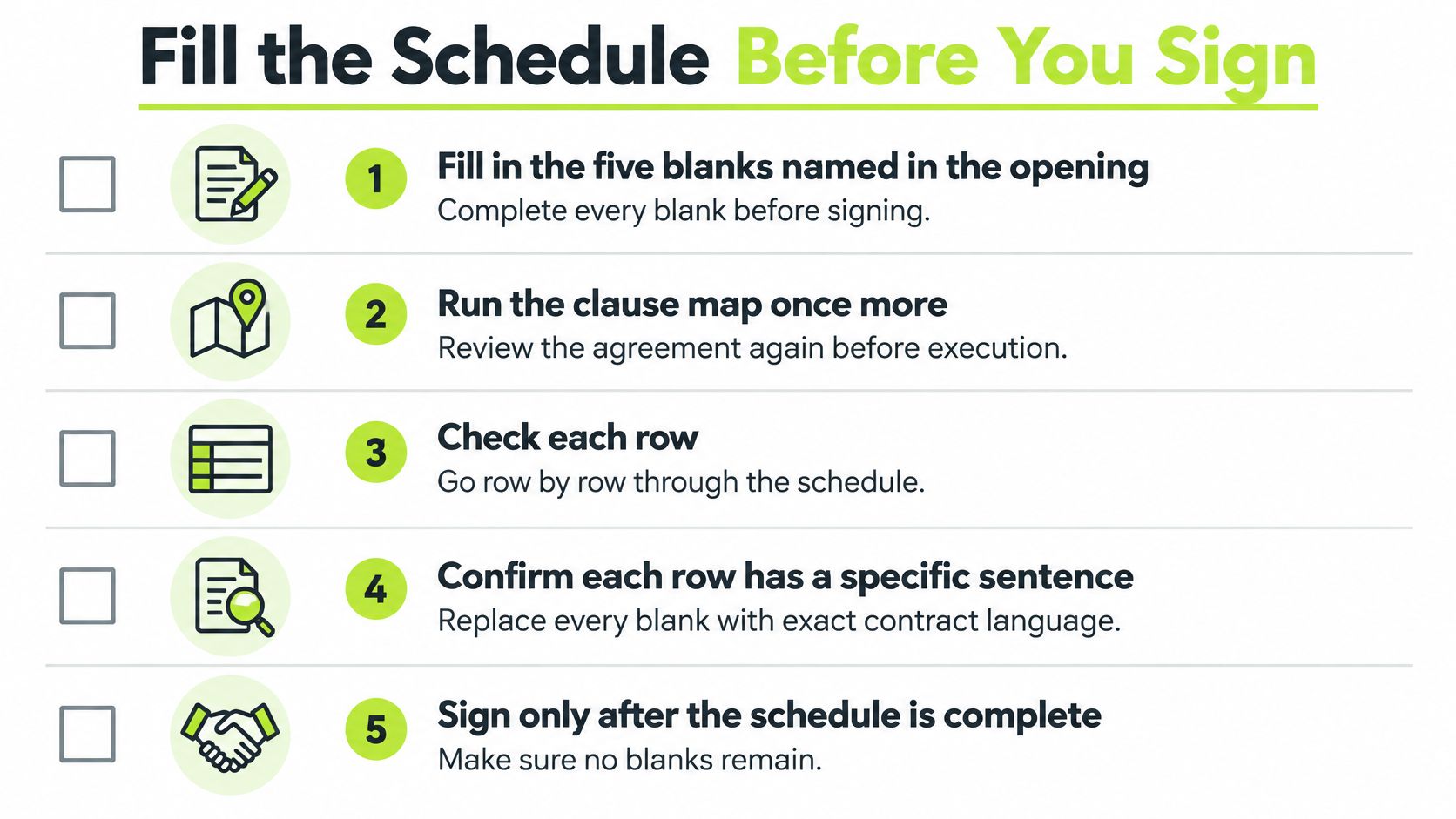
Complete the commercial blanks, then check every clause for a specific sentence. Have counsel review the finished schedule, especially equity and revenue share. This is a drafting structure, not legal advice.
If you want to inspect the structure before drafting, start with how agreements work. The agreement remains directly between you and the operator, with Project Assignments signed through third-party e-signature tools or off-platform as the Operator Agreement specifies.
Send the completed schedule before anyone starts work.
Capstacker provides shared standard contracts, milestone tracking, payment records, and integrated cash payouts for service engagements. Visit Capstacker if you want to put scope, payment triggers, and exit terms into a structured agreement with your operator.