Hire Fractional Cto

Hire a fractional CTO for $3,000 to $15,000+ per month, or $50,000 to $150,000 per year, and judge the deal on milestones, not the hourly rate. If you only compare talent and ignore structure, you'll end up with a retainer in nicer clothes.
Most founders get this backward. They chase a network, a polished résumé, or a clean rate card, then act surprised when the CTO is expensive to manage and vague to measure. The better move is to design the engagement first, because that's what decides whether you get real technical leadership or just expensive availability.
Table of Contents
- Why Most Fractional CTO Hires Fail Before the First Call
- What a Fractional CTO Actually Costs in 2026
- Where to Find a Fractional CTO Worth Hiring
- Interviewing and Screening a Fractional CTO
- Comparing Deel, Upwork, GoFractional, Toptal, and Catalant
- Structuring Outcome-Based and Milestone-Gated Pay
- Equity and Revenue Share for Fractional CTO Services
Why Most Fractional CTO Hires Fail Before the First Call
Founders usually think the hard part is finding the right person. It isn't. The hard part is writing a deal that makes the work measurable, the scope honest, and the payment tied to something you can verify.
The two failures I see over and over
First, teams pay for time instead of output. That sounds harmless until you realize a senior operator can spend 10 hours talking strategy and leave you with nothing concrete to approve, launch, or audit. Second, they skip the contract detail that protects both sides, so every delay turns into a debate about who owns the problem.
That's why deal design beats pure sourcing, especially for pre-seed to Series A companies. At that stage, the right fractional CTO is usually advising founders, steering vendors, and tightening execution at the same time, so the agreement has to be more than “X hours per month.” If you want a practical warning sign checklist for hiring decisions more broadly, the guide to smarter startup hiring in the UAE makes the same basic point, bad process creates expensive regret.
Practical rule: if you can't explain what gets approved, what gets paid, and what happens when a dependency slips, you don't have a contract yet.
The rest of this article is built around that reality. Cost matters, but structure matters more. Sourcing matters, but only after you know what kind of engagement you're buying.
What a Fractional CTO Actually Costs in 2026
Price follows capacity. A light advisory role, an embedded operator, and an interim technical leader are different jobs, even if the title is the same.
The price bands that actually show up
The most practical benchmarks put hourly pricing at $150 to $500 and monthly retainers at $3,000 to more than $15,000, with project work often landing in the $15,000 to $75,000 range depending on complexity, according to Buttercloud's fractional CTO pricing guide. Another published comparison places yearly fractional arrangements at $50,000 to $150,000, while a fully loaded full-time CTO lands around $300,000 to $500,000 or more once salary, benefits, equity, and hiring costs are included, according to Truvisory and Fractional CTO Experts. A separate market source puts the hourly range at $200 to $400 and monthly work at roughly $8,000 to $15,000 for about two days per week, which shows how sharply cost moves with involvement, according to Simple Proposals. For a parallel on executive ROI, see this guide to fractional CIO ROI.
| Involvement | Hours/week | Monthly range | Annual range |
|---|---|---|---|
| Light advisory | Roughly 5 to 8 | About $2,500 to $6,000 | About $30,000 to $72,000 |
| Embedded operator | Roughly 15 to 25 | About $8,000 to $15,000 | About $96,000 to $180,000 |
| Interim leadership | Roughly 25 or more | About $20,000 to $40,000 or more | About $240,000 to $480,000 or more |
Treat those ranges as a fit test, not a shopping list. If you need architecture reviews and founder-level judgment, you do not need full-time capacity. If you need someone to run technical leadership like a department head, you are in a different price band. For a comparison-friendly overview, the earlier fractional CTO cost guide is the right companion read.
My take: never ask “what's your rate?” before you ask “how many decisions will you own, and how fast do you need to respond?”
Why the full-time comparison gets misused
People like the “60% to 70% less expensive” framing because it sounds clean. It is also sloppy. A fractional executive gives you fewer hours, may serve multiple companies, and usually owns a narrower slice of the problem than a full-time CTO, so the savings are not a like-for-like comparison.
Ask a better question. What capacity do you need in hours per week, who has decision rights, and how much technical complexity is already sitting on the table? Answer that, and you will know whether you belong in the light advisory band, the embedded band, or a milestone-based project structure.
Where to Find a Fractional CTO Worth Hiring
Warm referrals first. Vetted platforms second. Open marketplaces last. That order saves time and improves the odds that you get a founder who can negotiate a usable scope instead of a polished profile with no operating scar tissue.
What to screen before you even book a call
I'd look for prior operating experience, stage fit, and proof that they've handled equity or mixed compensation before. I'd also ask for references who can speak to execution, not just advice. If the person can't write a one-page scope before quoting a price, that's a bad sign.
Founders usually get better deal terms through trusted networks because both sides already have context. That doesn't mean marketplaces are useless, it means they're weaker on trust and stronger on volume. One of the better ways to think about the sourcing ladder is the same way you'd think about any senior hire, which is why Rite NRG's talent solutions fit as a useful reference point for broader operator hiring, even if you still need to do the deal work yourself.
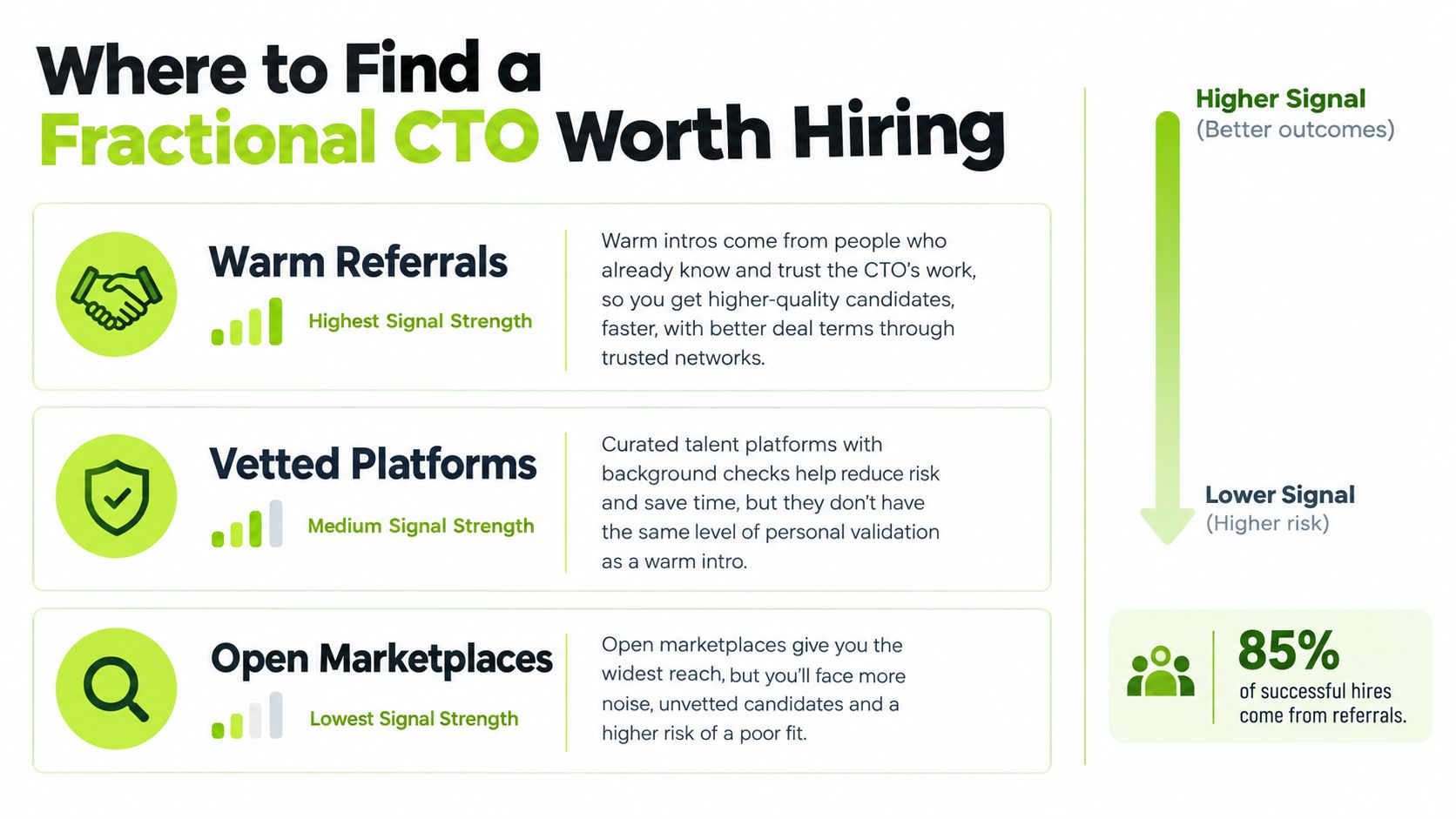
Screen for deal readiness, not just credentials. A great résumé can still hide a person who won't commit to acceptance criteria, documentation, or milestone-based billing.
What good sourcing looks like in practice
Start with operators who have hired or worked beside the person before. Then move to curated fractional talent pools if you need more volume. Use open marketplaces only when the scope is small, the risk is limited, or you already know exactly how the engagement should be structured.
A founder who wants clean technical leadership should be asking one blunt question in every intro, “Can this person scope the work before they price it?” If the answer is no, keep looking.
Interviewing and Screening a Fractional CTO
I don't trust a fractional CTO interview that sounds like a normal executive coffee chat. You need a paid diagnostic, a scenario test, and references that talk about what the person shipped, cleaned up, or prevented from breaking.

The interview structure that actually filters people
Start with a short written scope request. Ask for a one-page diagnostic plan covering the codebase, infrastructure, engineering team, and release process for the first 30 days. Then give them a scenario: an architecture choice, a hiring bottleneck, or a launch delay, and ask how they'd make the trade-off.
The strongest candidates answer in decisions, risks, and sequencing. The weak ones drown you in opinion. The reference check should probe execution. Did they create clarity? Did they speed up hiring? Did they improve delivery? Did they leave behind documentation that a team could use without them?
A good diagnostic deliverable is concrete. It names what's broken, what's urgent, what's risky, and what gets fixed first. If the deliverable looks like a vague slide deck with no owners or acceptance criteria, that's not a diagnostic. That's theater.
The red flags that save you pain later
Refusal to scope in writing is a deal killer. So is resistance to milestone-based pay, because it usually means the person wants to bill activity instead of outcomes. I'd also be cautious if they have no fractional experience at your stage, because early companies need more founder alignment and less executive abstraction.
Before you sign, get the scope, decision rights, documentation expectations, and exit terms in writing. The best fractional CTOs won't fight that. They'll appreciate it.
Comparing Deel, Upwork, GoFractional, Toptal, and Catalant
These platforms are not interchangeable. Some are fine for short technical help, some are better for fractional executive relationships, and some make deal structure easier than others. Choose based on how much structure you want to impose, not on brand recognition.
| Platform | Fractional CTO fit | Deal structure support | Vetting depth | Best for |
|---|---|---|---|---|
| Deel | Medium | Medium | Medium | Global engagements with formal contracting needs |
| Upwork | Low | Low | Low to medium | Short, tactical work where you already know the scope |
| GoFractional | High | Medium to high | Medium to high | Fractional executive hiring with a clearer leadership fit |
| Toptal | Medium | Low to medium | High | Strong individual talent for defined engagements |
| Catalant | High | Medium to high | High | Structured advisory and fractional leadership work |
What I'd actually use them for
If I wanted a clean fractional CTO engagement with genuine leadership expectations, I'd start with a platform that supports executive-style work and then tighten the scope myself. GoFractional and Catalant sit closest to that need. Toptal can be solid for specialized work, but it's not where I'd start if the actual problem is contract shape. Upwork is for narrow jobs, not senior operating ownership. Deel is useful when cross-border contracting is part of the problem.
The point is simple. Platform choice should follow the deal you want to run. If you already know you need milestones, acceptance criteria, and transition terms, a general freelancing marketplace is usually the wrong first stop.
Best use case: match the platform to the level of governance you need, not the charm of the profile.
Structuring Outcome-Based and Milestone-Gated Pay
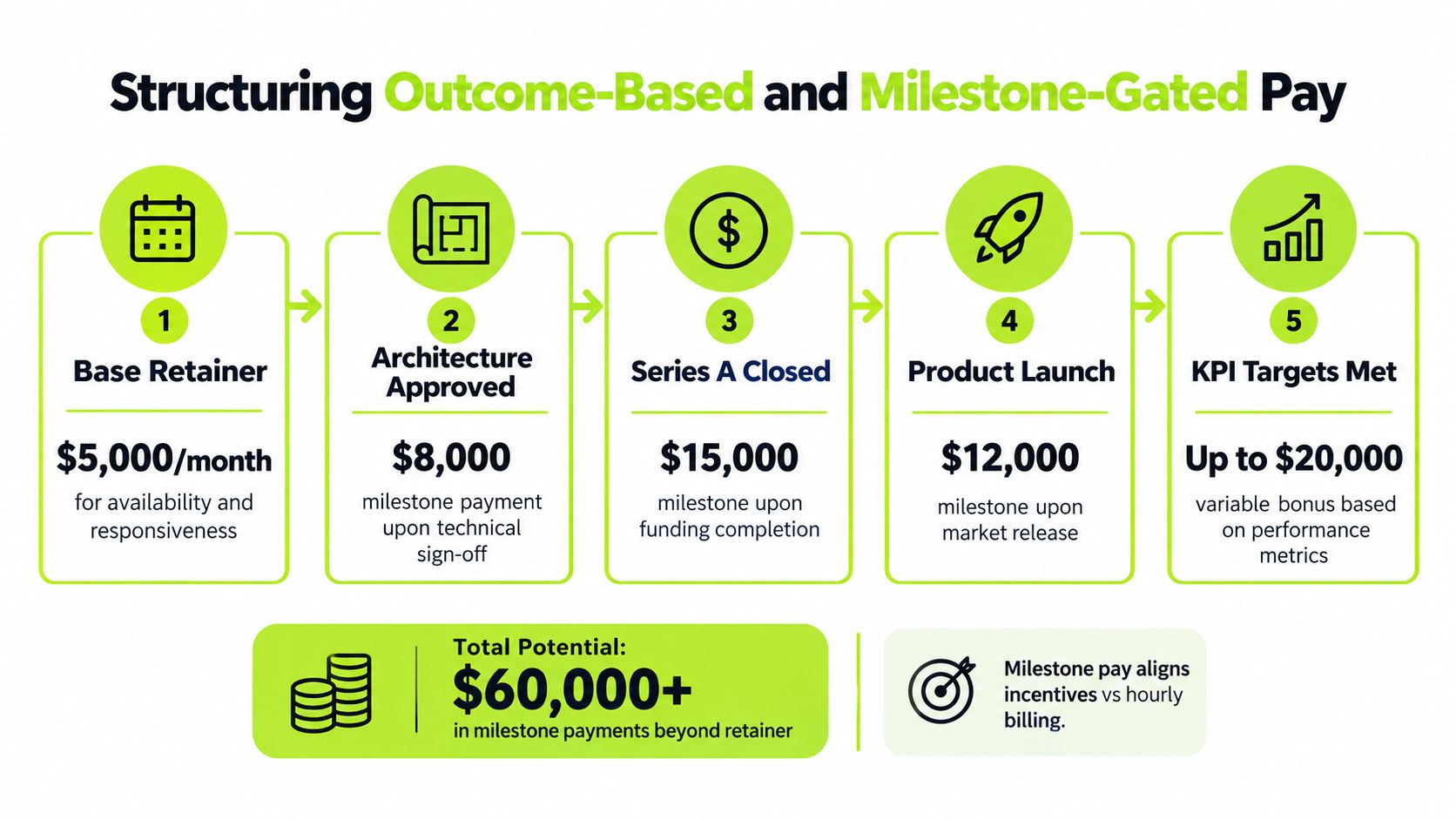
I'm blunt about this. If you hire a fractional CTO on a pure hourly or loose retainer basis, you've probably overpaid for ambiguity. The better structure is a base retainer for availability, milestone payments for verifiable deliverables, and a change-control process for anything outside the CTO's control.
The payment model that doesn't collapse under real work
Use the retainer to buy responsiveness and scheduled time. Use milestones for things you can inspect, approve, and archive, like an architecture approved, a production launch completed, a security remediation accepted, or a hiring plan executed. That's the exact kind of structure Simple Proposals recommends for avoiding payment fights, because it ties money to verifiable output instead of loose effort.
Don't pay revenue share for reliability or compliance work. Those outcomes are too delayed and too multi-causal to attribute cleanly. If the CTO can materially influence revenue, then revenue share can make sense, but only when the event, calculation, payout frequency, governing law, and dispute venue are spelled out clearly. For a usable agreement structure, Capstacker's success fee agreement guide is the right internal reference.
A clean allocation often looks like this in practice, a base for access, milestone payments for delivery, and a holdback for disputed or incomplete work. I'd rather see a smaller guaranteed base with well-defined releases than a fat monthly fee with no proof of progress. That's how you keep the CTO focused on outcomes without pretending every outcome is fully under their control.
How to keep the contract honest
Record the baseline before work starts. Define acceptance criteria. Set a dispute window. Add change control for dependencies that the CTO can't own alone. And don't forget a rollback path when the scope changes midway through the engagement.
That last part matters more than people admit. Most bad fractional deals fail because the contract can't survive reality.
Equity and Revenue Share for Fractional CTO Services
Equity and revenue share are not the same thing, and they shouldn't be used like interchangeable bonus language. Pure equity makes sense when a fractional executive is taking meaningful company risk. Milestone cash is better when the work is a defined deliverable, like an MVP, launch, hire, or technical audit. That line matters, and Capstacker's equity for services guide says the same thing plainly.
What equity needs to say in writing
If you use equity or a mixed package, the agreement should spell out the percentage or amount, vesting schedule, cliff, milestone trigger, and source of dilution. If the person is giving up cash for upside, those details need to be explicit. Vague equity language just creates a future dispute with prettier stationery.
Revenue share needs different precision. Define the revenue calculation, the transaction or revenue event, the payout frequency, governing law, and the dispute venue. Without that, you'll end up arguing about attribution instead of execution. I don't recommend revenue share for reliability work, compliance work, or anything with a long causal chain, because those outcomes are too hard to tie to one person's decisions.
The clauses a real agreement needs
A serious fractional CTO agreement should include scope of work, decision rights, IP assignment, confidentiality, reimbursement cap, acceptance criteria, change control, termination, and transition. It should also address unused hours, work documentation, and what happens when you hire a full-time CTO. If you skip the exit path, the fractional arrangement can linger long after it stops making sense.
The best agreements make the handoff boring.
That's the goal. Clean ownership, clean documentation, and a clean end state if the company outgrows the arrangement.
If you want help turning a fractional CTO relationship into a clean milestone agreement instead of a fuzzy retainer, use Capstacker to set the payment model, track acceptance, and keep the deal room organized. It's the kind of setup I wish I'd had before my first two fractional CTO contracts went sideways.