Fractional CTO Cost: What You Will Actually Pay in 2026

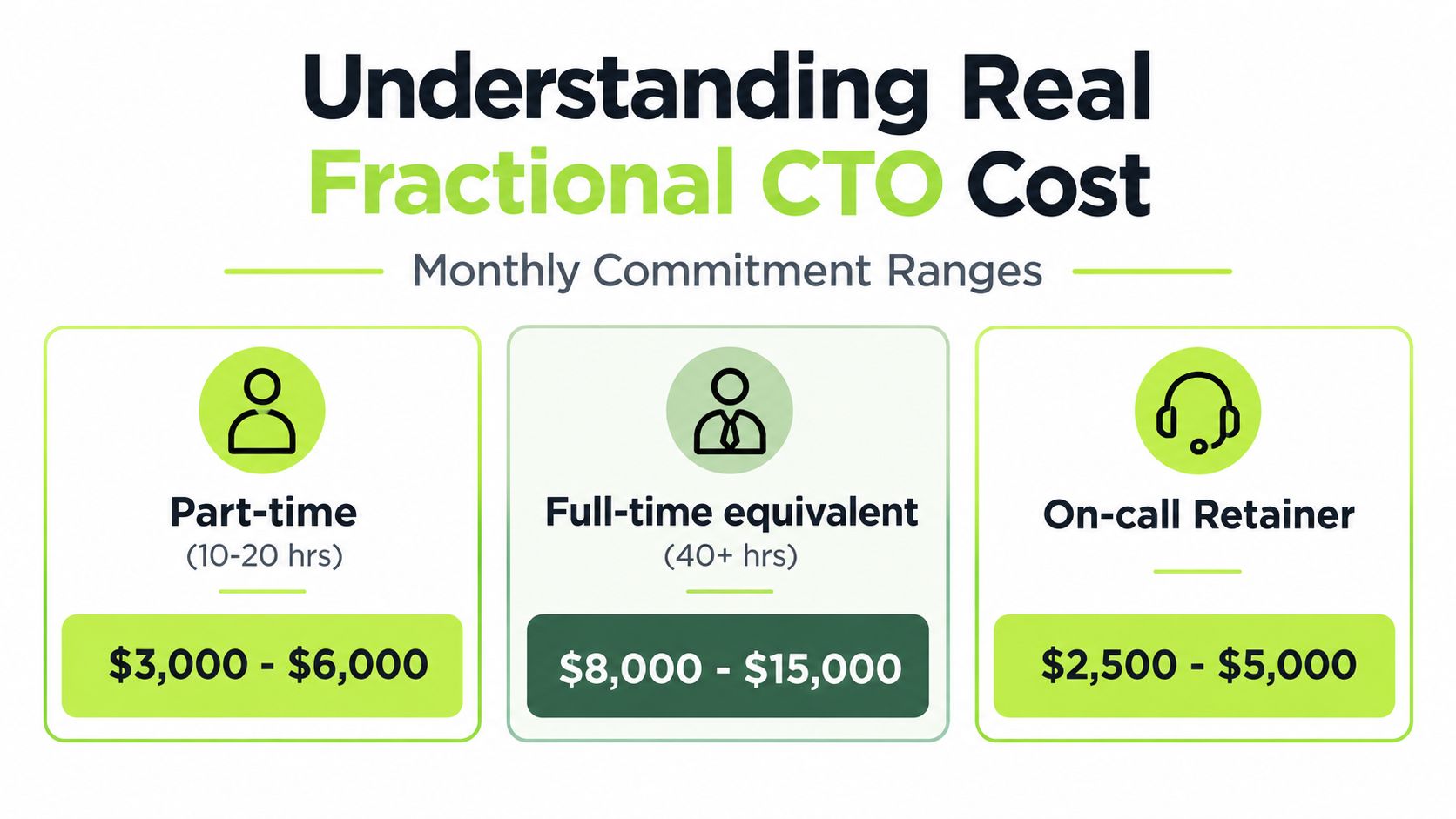
Fractional CTO cost usually falls between $3,000 and $25,000 per month, with many structured early-stage engagements landing around $8,000 to $15,000 per month for roughly two days per week. The right budget depends less on the title and more on the CTO's availability, technical risk, decision authority, and measurable deliverables.
The counterintuitive part is that a lower hourly quote can produce a higher monthly bill. A CTO who spends time attending meetings, reviewing work, and reacting to emergencies may cost less per hour while delivering less that you can verify. Meanwhile, senior specialists often charge more because they can compress difficult architecture, security, cloud, or hiring decisions into a smaller engagement.
The practical answer to fractional CTO cost is to compare the complete deal, not just the rate card. That means looking at reserved availability, response obligations, strategic responsibility, hands-on execution, milestone fees, and any equity or revenue share.
Table of Contents
- Understanding Real Fractional CTO Cost
- How Fractional CTO Payment Models Work
- Fractional CTO Alternatives and Platforms
- Contract Terms That Control Total Cost
- When Equity or Revenue Share Makes Sense
- Choosing the Right Structure for Your Startup
Understanding Real Fractional CTO Cost
The quote moves with the work, risk, and commitment you are buying. A technical advisor who reviews architecture once is priced differently from an executive who owns engineering decisions, manages vendors, handles incidents, and joins investor or diligence calls. Buttercloud's fractional CTO pricing overview presents the market range as a practical estimate, not a universal benchmark. Its comparison also places a fully loaded full-time CTO at approximately $300,000 to $500,000 or more annually.
Why the quote moves so much
Four variables usually explain the spread:
- Scope: An architecture review costs less than leading engineering, managing vendors, and preparing for technical due diligence.
- Seniority: Deep cybersecurity or cloud architecture experience commands more than general technology advice.
- Industry risk: Regulated products, sensitive data, and strict reliability requirements raise the consequences of poor decisions.
- Engagement structure: Hourly consulting, a monthly retainer, fixed deliverables, and equity arrangements place different risks on the founder and the executive.
Published pricing guides commonly put general hourly work around $150 to $500, but those figures are provider-reported estimates rather than a global benchmark. The 2025 IEEE-USA consultant fee survey surveyed approximately 9,000 consultants. About one in five charged at least $300 per hour, while the median rate for full fee-based consultants stayed unchanged from 2024 to 2025.
Part-time availability does not automatically produce a lower hourly rate. IEEE-USA found that partial consultants had a median rate equal to full fee-based consultants, although 9% of partial consultants charged less than $100 per hour. Reduced weekly hours may lower the monthly commitment without reducing the value of each hour.
Compare commitment, not just rate
A proposal should put the monthly fee, expected hours or availability, decision rights, response expectations, and deliverables in one place. A $200 hourly quote can work for a defined architecture audit. It can become expensive for continuing leadership when the founder is paying for open-ended access without clear ownership or limits.
The guide to fractional executive compensation helps founders compare cash, milestones, equity, and other components within one agreement. A blended structure often protects runway better than choosing pure cash or pure equity. Use a retainer for dependable leadership access, then tie additional payment to defined milestones. That keeps the monthly commitment visible while connecting extra spend to delivered progress.
Founders should also include executive costs in the wider operating plan. Some teams pair technical leadership planning with advice on how to boost cash flow with a fractional CFO. Equity may reduce immediate cash use, but it creates dilution and should not disguise an undefined workload. Likewise, emergency coverage, repeated change requests, and hands-on implementation can erase the expected saving.
Practical rule: Budget the monthly commitment first. Use the hourly rate to understand capacity and overage exposure.
How Fractional CTO Payment Models Work
The payment model should match the uncertainty of the work. A narrow technical question can be billed hourly. A continuing leadership role needs reserved availability. A defined transformation should include milestone payments. Most early-stage founders get the best protection from combining those structures instead of forcing every responsibility into one fee.
Hourly work for contained problems
Hourly billing works when the output is easy to bound. Examples include reviewing a proposed architecture, assessing a vendor, investigating an incident, or preparing questions for technical due diligence.
The market evidence supports a wide range. Toggl's consulting pricing guide places mid-level practitioners at $150 to $300 per hour and senior cybersecurity or cloud architecture specialists at $250 to $500 or more per hour. It also reports average daily rates of $1,645 in the United States, $1,423 in the United Kingdom, and $1,302 in Australia, which equate to roughly $206, $178, and $163 per hour when an eight-hour day is assumed.
Put an hourly ceiling in the agreement. Require written approval before the CTO exceeds it, and state whether meetings, preparation, travel, and follow-up count as billable time. Without those details, a supposedly small review can become an unplanned advisory retainer.
Retainers for continuing leadership
A retainer buys access and accountability over a period, not a list of disconnected tasks. It fits a startup that needs someone to run technical planning, manage engineering leadership, select vendors, establish hiring processes, or maintain executive visibility.
One published benchmark separates advisory work at $4,000 to $10,000 per month for approximately 10 to 15 hours monthly, active fractional work at $10,000 to $25,000 per month for 20 to 40 hours monthly, and near-full-time or interim work at $20,000 to $40,000 per month. A.Team's fractional CTO rates guide stresses that effective capacity and accountability matter as much as the nominal monthly fee.
A retainer should specify reserved time, meeting cadence, response expectations, and what happens to unused capacity. It should not include unlimited engineering execution.
Milestones for verifiable outcomes
Milestone billing works when both parties can agree on an acceptance test. Useful milestones include a completed technical roadmap, a security-risk register, a production-readiness review, a hiring system, or an accepted migration plan.
The U.S. Federal Acquisition Regulation guidance on performance-based payments illustrates the underlying principle. Payment terms should identify the performance basis rather than rely on vague objectives such as “improve the technology stack.”
For most startups, the strongest structure is a smaller retainer for leadership availability plus milestone-gated fees for completed outcomes. That model gives the CTO enough continuity to make decisions while preventing the founder from paying a large amount for undefined access. If the arrangement includes legal or equity terms, specialist boutique business law for startups can help review the agreement before signing.
Fractional CTO Alternatives and Platforms
The right alternative depends on what you're buying. A platform that helps you hire a contractor isn't automatically suited to an executive who must own architecture, engineering direction, and technical risk. Likewise, a curated fractional executive service may help with access, but the payment structure still needs to define outcomes.
| Option | Typical structure | Best fit | Main trade-off |
|---|---|---|---|
| Direct fractional CTO | Retainer, hourly work, milestones, or hybrid | Ongoing leadership with negotiated accountability | Founder must source, assess, and contract directly |
| Deel | Contractor or employment administration | Teams that need support with worker engagement and payments | Administrative infrastructure doesn't define CTO outcomes |
| Upwork | Hourly or project-based freelance work | Contained technical reviews or execution tasks | Executive authority and long-term accountability need separate negotiation |
| GoFractional | Fractional executive engagement | Founders seeking a fractional leadership arrangement | The commercial terms still need to clarify scope and acceptance |
| Toptal | Curated specialist engagement | Access to experienced technical professionals | A talent access model doesn't by itself create milestone governance |
| Catalant | Expert and consulting engagements | Strategic projects and specialist advice | Project expertise may not equal embedded CTO ownership |
Where each route works
Deel is relevant when the central problem is engaging and paying a contractor across jurisdictions. It doesn't decide whether the person is acting as an advisor, an embedded executive, or a hands-on engineer. The founder still needs to document authority, deliverables, IP, confidentiality, and termination.
Upwork can make sense for a tightly scoped audit or implementation task. It becomes less comfortable when the startup needs a CTO to make sensitive hiring, architecture, or vendor decisions over time. Hourly activity can become the default measure even when the business needs a completed result.
GoFractional, Toptal, and Catalant can help founders reach specialists or fractional leaders, but their value differs by hiring model and engagement design. Before comparing candidates, ask whether the commercial arrangement supports a retainer, fixed project fee, milestone payment, equity, or revenue share. If the platform's standard process only supports time-based billing, you'll need a separate agreement for outcome-based accountability.
For a broader comparison of sourcing approaches, see this guide to fractional executive platforms. Smaller firms can also review how Starward Navigators supports small firms when deciding whether they need an individual executive or a broader fractional service.
The key distinction is simple: a platform may improve access, administration, or matching, but the contract controls the economics. No marketplace removes the need to define acceptance criteria, revision limits, availability, and decision rights.
Contract Terms That Control Total Cost
Most cost overruns start in the agreement, not in the quoted rate. A founder signs for “technical leadership,” then discovers that the CTO's interpretation includes strategy meetings, hiring, incident response, implementation oversight, and hands-on delivery with no boundary between them.
Write the operating boundary
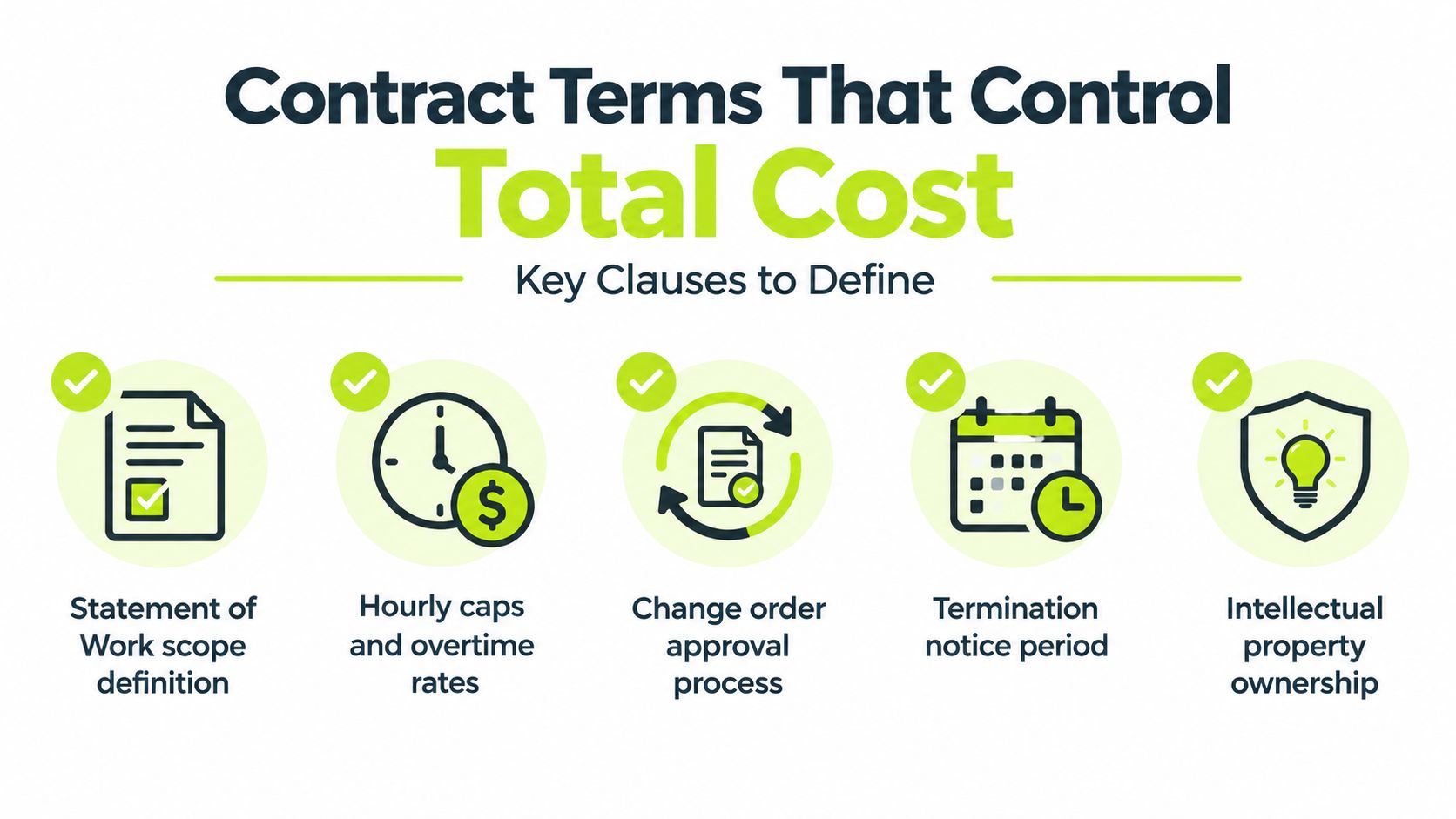
The statement of work should identify what the CTO owns and what remains with the engineering team or another contractor. Separate strategic leadership from hands-on engineering. If coding, incident response, or delivery management is included, specify the expected capacity and approval process.
A useful agreement should cover:
- Scope: List the decisions, meetings, deliverables, and exclusions.
- Availability: Define reserved hours, working windows, response expectations, and emergency support.
- Hourly controls: Set an hourly cap and state the overtime rate before any excess work begins.
- Change orders: Require written approval when the founder adds a new system, deadline, team, or responsibility.
- Revisions: State how many review cycles a milestone includes and what counts as a new requirement.
Make acceptance objective
Each milestone needs an owner who accepts it, a due date, a deliverable, and an acceptance test. “Security improved” isn't an acceptance test. “Security remediation plan delivered with prioritized risks, owners, dependencies, and agreed review date” is much easier to evaluate.
Adobe's contract guidance identifies payment timing, late fees or penalties, work-product ownership, and termination responsibilities as core service-agreement terms. Add a dispute process for rejected milestones, including the time allowed to explain deficiencies and whether undisputed work remains payable.
Protect the exit
Termination terms should state notice, payment for completed work, treatment of work in progress, and access to company systems after the engagement ends. The contract should also assign intellectual property ownership for documents, code, diagrams, roadmaps, and other work product.
Late payment consequences matter too. A CTO who reserves capacity can't easily replace that time after a founder delays payment. Clear payment dates and late-payment provisions protect both sides and reduce the temptation to solve a contract problem through emergency renegotiation.
When Equity or Revenue Share Makes Sense
Equity can reduce immediate cash pressure, but it isn't free compensation. It may be illiquid, diluted, difficult to value, and exposed to the risk that the startup never reaches a liquidity event. A CTO taking responsibility for production reliability, security, or compliance may reasonably ask for more cash because those duties carry direct accountability.
One published comparison lists an equity-plus-cash model at approximately $2,000 to $5,000 per month plus 0.5% to 2% equity, while other guides place standard retainers around $5,000 to $15,000 per month. GroovyWeb's fractional CTO pricing guide cautions that these figures aren't directly comparable because commitment, vesting, authority, and responsibility differ.

Use equity only after defining the cash equivalent, vesting schedule, termination treatment, repurchase rights, dilution, and ownership of work product. For revenue share, specify whether the percentage applies to gross or net revenue, which transactions qualify, the payment schedule, and the cap or sunset date.
U.S. contractors generally report service compensation on Form 1099-NEC under applicable rules and typically handle their own income and self-employment tax obligations. The Startup Law Blog's equity compensation guide recommends documenting whether equity, revenue share, or success fees are payment for services and obtaining tax and legal advice before treating non-cash compensation as a substitute for cash.
The safer choice for most early-stage founders is a hybrid. Keep enough cash to recognize ongoing work, attach part of the fee to independently verifiable milestones, and use equity only when the CTO's risk, time horizon, and long-term contribution justify it.
Choosing the Right Structure for Your Startup
Hourly billing is not the neutral baseline. It rewards time, while a founder usually needs decisions, completed deliverables, and accountable leadership.
Use hourly work for a contained audit. Use a retainer for continuing executive availability. Use milestones when the outcome can be tested. Add equity or revenue share only when the terms reflect real risk and include vesting, caps, termination, and tax treatment.
For most startups, the practical default is a modest retainer plus milestone payments. It protects runway better than unlimited hourly access and avoids asking a senior CTO to finance the company through pure equity.
Capstacker helps founders structure fractional executive deals with milestone payouts, revenue share, equity arrangements, legal-ready templates, tracking, governance, payouts, and reporting. Visit Capstacker to turn the proposed CTO scope into a clearer payment structure before you sign.