Equity for Services Platform Startup: A Founder Guide

Equity for services is already a standard operating practice, not a founder perk. A 2025 cap-table study reported that 72% of VC-backed startups offer stock options to all full-time employees, rising to 89% at Series A and beyond, while 94% use four-year vesting with a one-year cliff (industry summary). The same market logic now applies to fractional executives, agencies, and specialist operators, but most founders still manage those deals through email and memory.
That approach breaks as soon as scope changes, milestones move, or someone leaves. An equity for services platform startup should treat every engagement as a small transaction with a defined compensation model, legal instrument, vesting schedule, approval trail, and payout record.
Table of Contents
- What Equity for Services Actually Means for a Startup
- The Four Compensation Models Founders Use
- Legal and Cap Table Mechanics That Make It Safe
- Stage-Specific Equity Benchmarks That Hold Up
- The Deal Workflow From First Call to Signed Contract
- How a Real Deal Runs Once It Is Signed
- Why Structure Beats Good Intentions Every Time
What Equity for Services Actually Means for a Startup
Equity for services is a structured exchange. A pre-seed or seed company trades a slice of potential upside for specific work, such as fractional executive leadership, an advisor playbook, agency output, or operator labor. The recipient accepts more risk than a salaried contractor, while the founder preserves cash during a period when runway matters.
That's different from a normal hire, where salary is the primary payment, and different from a passive advisor grant, where the contribution may be limited to periodic guidance. It also differs from founder sweat equity under Section 83 of the IRS code, which concerns the tax treatment of property transferred for services. The award type, ownership date, vesting terms, and tax obligations still need separate analysis. For a practical overview of options, how startup options work is a useful reference.
Practical rule: Never describe the deal as “help in exchange for equity.” Describe the deliverable, the acceptance test, and what happens if the work stops.
Founders use this structure because the right senior operator may not accept current cash compensation, and waiting for perfect pricing can cost more than negotiating a clear upside arrangement. The platform model makes each engagement repeatable instead of turning into a pile of handshake favors.
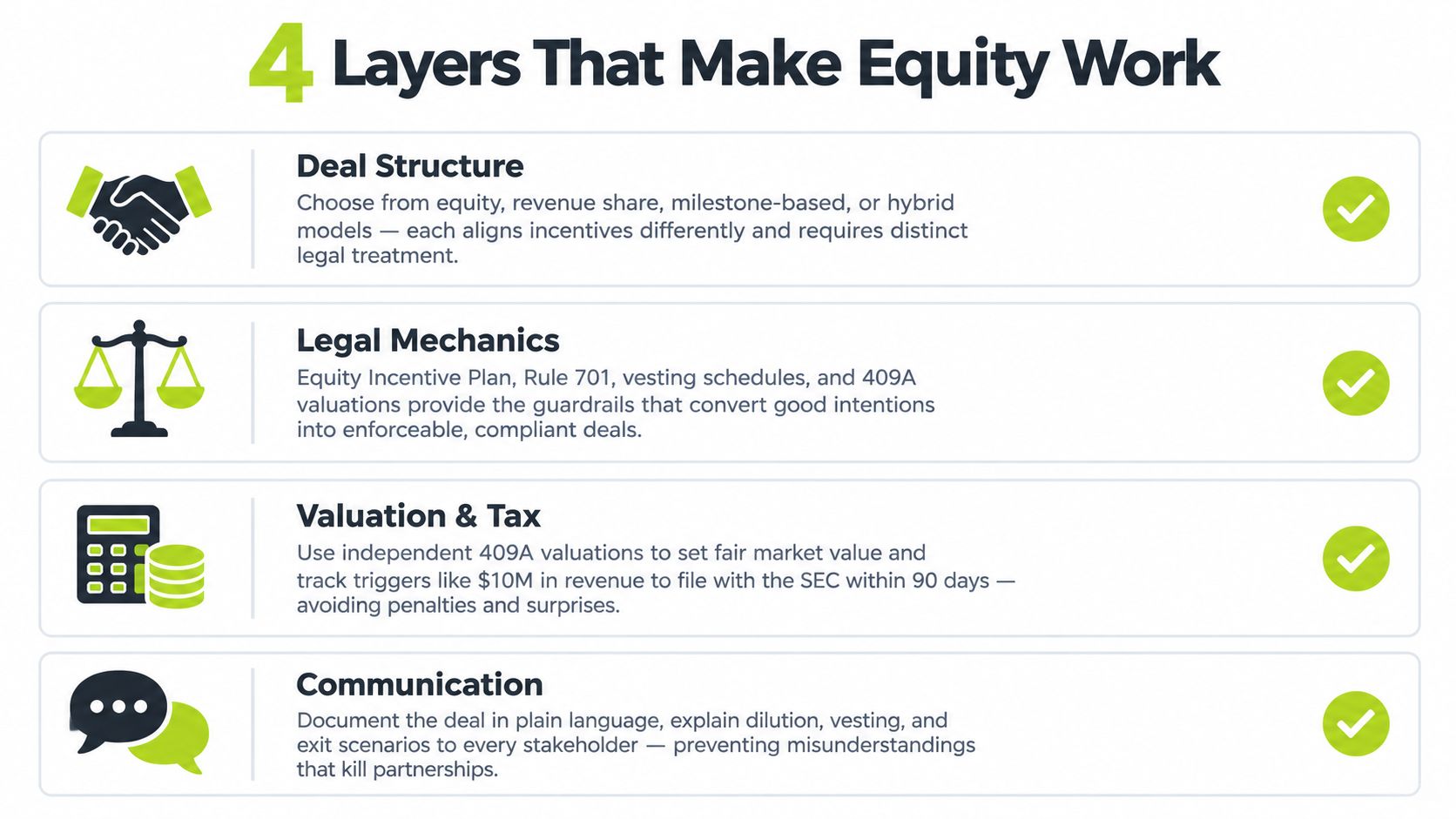
The operating system has four parts: choose the compensation model, document the legal mechanics, benchmark the grant against stage and scope, then run milestones through a visible workflow.
The Four Compensation Models Founders Use
The right model follows the deliverable, not the provider's job title. Pure equity fits a fractional CTO or senior advisor taking meaningful company risk. Revenue share suits an agency or growth consultant whose work can be tied to sourced revenue. Milestone cash works for a defined build, launch, hire, or fundraising deliverable. A hybrid protects both sides when neither cash nor equity alone reflects the bargain.
| Model | Trigger | What Counterparty Receives | Best-Fit Scenario |
|---|---|---|---|
| Pure equity | Time or service vesting | Shares or options | Fractional executive or strategic advisor |
| Revenue share | Attributed revenue or collection | Agreed share of receipts | Agency or GTM consultant |
| Milestone cash | Accepted deliverable | Fixed payment | MVP, pilot, hire, or audit |
| Hybrid | Multiple conditions | Cash plus equity or revenue share | High-value operator with cash constraints |
Benchmark sources place advisor grants around 0.25% to 1%, fractional executive grants around 0.5% to 2%, and agency arrangements around 1% to 5% with vesting, as summarized in the supplied market guidance. Those are negotiating reference points, not automatic entitlements. Stage, hours, exclusivity, and whether the person owns an outcome should move the number.
Founders should also document vesting and intellectual-property ownership together. Guidance on vesting IP roles for founders illustrates why ownership rights and service obligations shouldn't sit in separate informal conversations. For milestone mechanics, the guide to milestone-based compensation for platform startups provides a useful operating frame.
Legal and Cap Table Mechanics That Make It Safe
A clean deal starts with an authorized Equity Incentive Plan, a written agreement, an appropriate exemption, and a cap-table entry. Service-provider equity plans can grant shares or options to eligible employees, advisors, directors, and consultants through a formal compensation mechanism (service-provider equity plan overview).
For US companies, Rule 701 generally requires bona fide compensatory services and excludes capital-raising work from the consultant or advisor activity. The supplied legal guidance also identifies an enhanced disclosure threshold of $10 million in sales during a 12-month period, with disclosure timing requirements described in the rule. Counsel should confirm recipient eligibility, state filings, grant type, and the applicable calculation.
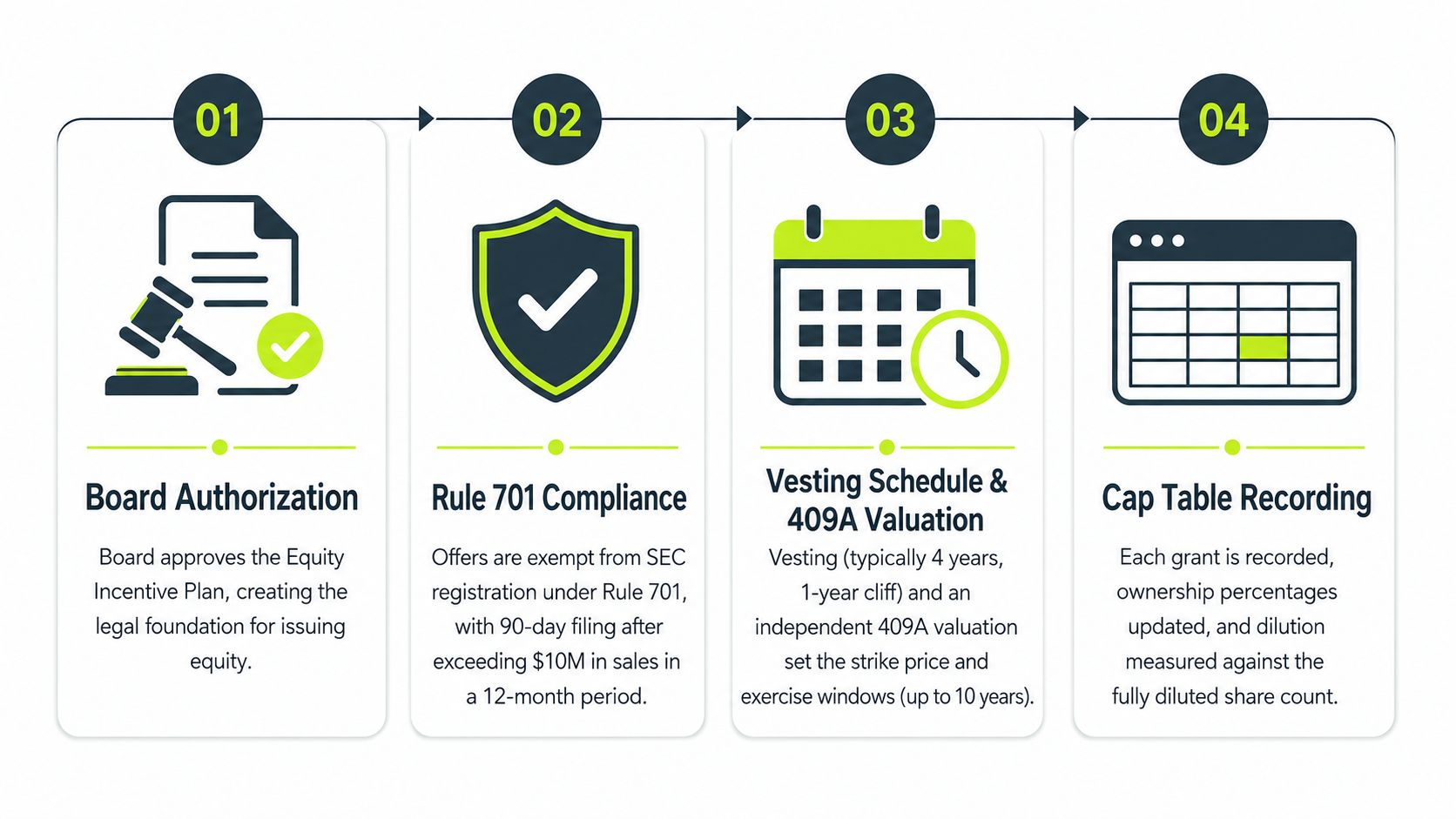
Use a written agreement that names the scope, acceptance standard, vesting schedule, termination treatment, IP assignment, and approval condition. Advisor arrangements commonly use two-year vesting with monthly vesting, often with a short cliff or no cliff (advisor vesting guidance). Fractional operating work may use a shorter schedule when the deliverable is concentrated.
Dilution must be modeled against the fully diluted cap table. A grant described as 1% still changes ownership, option-pool availability, and future investor math. The company should approve the grant, confirm its valuation process, issue the award from the correct plan or authorized source, and record it consistently. Capstacker can standardize agreements, milestone records, document storage, and cap-table updates, while its agreement workflow shows how the administrative handoff can be organized.
Stage-Specific Equity Benchmarks That Hold Up
A benchmark is useful only after you define stage, role, time commitment, and accountability. Broad advisor ranges obscure the difference between occasional strategic advice and a provider who owns a revenue, product, or fundraising outcome.
| Stage | Common Role | Equity Range (FD) | Typical Vesting | Usual Cash Element |
|---|---|---|---|---|
| Pre-seed | Fractional operator or build specialist | 0.25% to 1.0% | One-year service vesting | Small milestone payment |
| Seed | Operator with defined workstream | 0.5% to 2.0% | Milestone or monthly vesting | Revenue share or project cash |
| Series A | Functional leader | 1.0% to 3.0% | Role-based vesting | Salary or revenue share |
These ranges come from the supplied editorial framework, while separate advisor benchmarks cluster around 0.25% to 0.5% at pre-seed, 0.25% at seed, and 0.1% to 0.25% at Series A, with higher-intensity strategic roles reaching toward 0.5% to 1.0% (advisor equity benchmarks).
Anchor the conversation to the fully diluted, post-plan percentage. Then check whether the option pool contains enough shares, whether the provider is taking meaningful risk, and whether the work changes a measurable company outcome. A low-touch advisor shouldn't receive the same treatment as an operator responsible for execution.
The Deal Workflow From First Call to Signed Contract
A founder can close these arrangements quickly when every decision has an owner. Start with a one-page scope that states the deliverable, deadline, definition of done, expected effort, and information the company must provide.
Next, select the payment model and set the percentage, vesting schedule, cliff, milestone trigger, and source of dilution. Put the terms into an agreement covering representations, IP assignment, termination treatment, and any applicable Rule 701 disclosure. Revenue-linked arrangements also need clear attribution, collection, refunds, and recognition rules. A practical revenue automation guide can help founders think through those definitions before negotiation.
Then obtain board or written-consent approval and update the cap table. Don't let signature precede authorization if the grant depends on an incentive plan.
Finally, onboard the provider into a milestone log. Each milestone should have an owner, due date, evidence requirement, approval status, and payout consequence. The counterparty should know exactly what counts as completion before work begins, not after a disagreement appears.
How a Real Deal Runs Once It Is Signed
A fractional head of growth might receive 1.0% over twelve months plus a 10% revenue share on sourced ARR. The contract defines sourced pipeline, the dashboard records attribution, and the payout calculation runs when the quarter closes. The equity continues vesting independently from the revenue event.
A product designer may agree to deliver a clickable prototype and design system by week six for $8,000 plus 0.3% equity, with monthly vesting from signing. Founder approval marks the milestone complete, releases the cash, and starts the equity administration record.
A fractional CFO could rebuild the financial model and close the seed round for 0.75% plus a 2.5% fee on capital raised. The closing event triggers the fee calculation, while the equity grant is recorded against the updated cap table. Fundraising compensation requires careful legal review, particularly because Rule 701 does not cover capital-raising services.
These examples work because each deal separates service vesting, milestone acceptance, and payment calculation. Combining them into one vague promise creates disputes over whether time worked, output delivered, or company results should control.
Why Structure Beats Good Intentions Every Time
Equity deals fail in a predictable order. A handshake collapses without vesting. Vesting becomes ambiguous without a written grant. A grant becomes risky without an approved plan and securities-law review. Even an approved award creates future friction if the cap table doesn't match the signed documents.
The final layer is operational visibility. A milestone log connects the provider's work to the cash payout, revenue share, or equity event. Without that record, founders rely on inbox searches and memory when an investor asks who owns what.
Before signing the next operator, confirm five items:
- Written scope: Deliverables, deadlines, acceptance tests, and responsibilities are explicit.
- Board-approved plan: The Equity Incentive Plan or other issuance authority is in place.
- Rule 701 review: Recipient eligibility, compensatory purpose, disclosures, and state compliance are checked.
- Vesting on the cap table: The grant, start date, schedule, and termination rules match the agreement.
- Milestone log: Each trigger maps to a documented payout or share event.
Equity for services should be something founders can run every quarter, not a special favor reserved for the person who helped before demo day.
Capstacker gives you structured equity, revenue-share, milestone, and hybrid agreements with contract records, milestone tracking, and payout workflows in one place. Visit Capstacker to turn your next operator deal into a documented, trackable arrangement before work starts.