Revenue Share Model for Fractional Executives: How It Works

The headline percentage is the wrong place to start. If the revenue event, attribution, and termination terms are sloppy, a bigger share just means a bigger mess. A revenue share model works when you define what gets paid, when it gets paid, and what happens when the work stops. Anything less is a dispute dressed up as a deal.
Table of Contents
- Why the Headline Percentage Is the Wrong Place to Start
- How a Revenue Share Model Actually Works
- Typical Deal Structures and Cost Ranges
- Revenue Share vs Milestone Gates, Equity, and Success Fees
- Contract Terms That Decide Whether the Deal Holds Up
- How Deel, Upwork, GoFractional, Toptal, and Catalant Fit
- A Founder's Pre-Sign Checklist
Why the Headline Percentage Is the Wrong Place to Start
A founder's first mistake is negotiating the percentage before deciding what triggers payment. A smaller share of clean, collected revenue is usually better than a larger share of revenue that's disputed, uncollected, or impossible to attribute. That's not theory, it's the difference between a deal that keeps running and one that turns into a collections problem.
Start with the revenue event, not the rate
For fractional executives and agencies, the contract has to say whether payment is based on a collected customer payment, a completed sale, a renewal, or another measurable transaction. Basing payment on invoices issued can create collection risk because the client may owe a percentage before cash arrives. You also need to define treatment of refunds, chargebacks, taxes, discounts, credits, and renewals.
Practical rule: if you can't explain the payment trigger in one sentence, the contract isn't ready.
Revenue share is also not profit share. Revenue is divided before operating expenses come out, so the provider can get paid even while the client is still unprofitable. That's why these deals work best when the revenue base is narrow and the measurement is objective, not when someone waves at “company revenue” and hopes for the best.
How a Revenue Share Model Actually Works
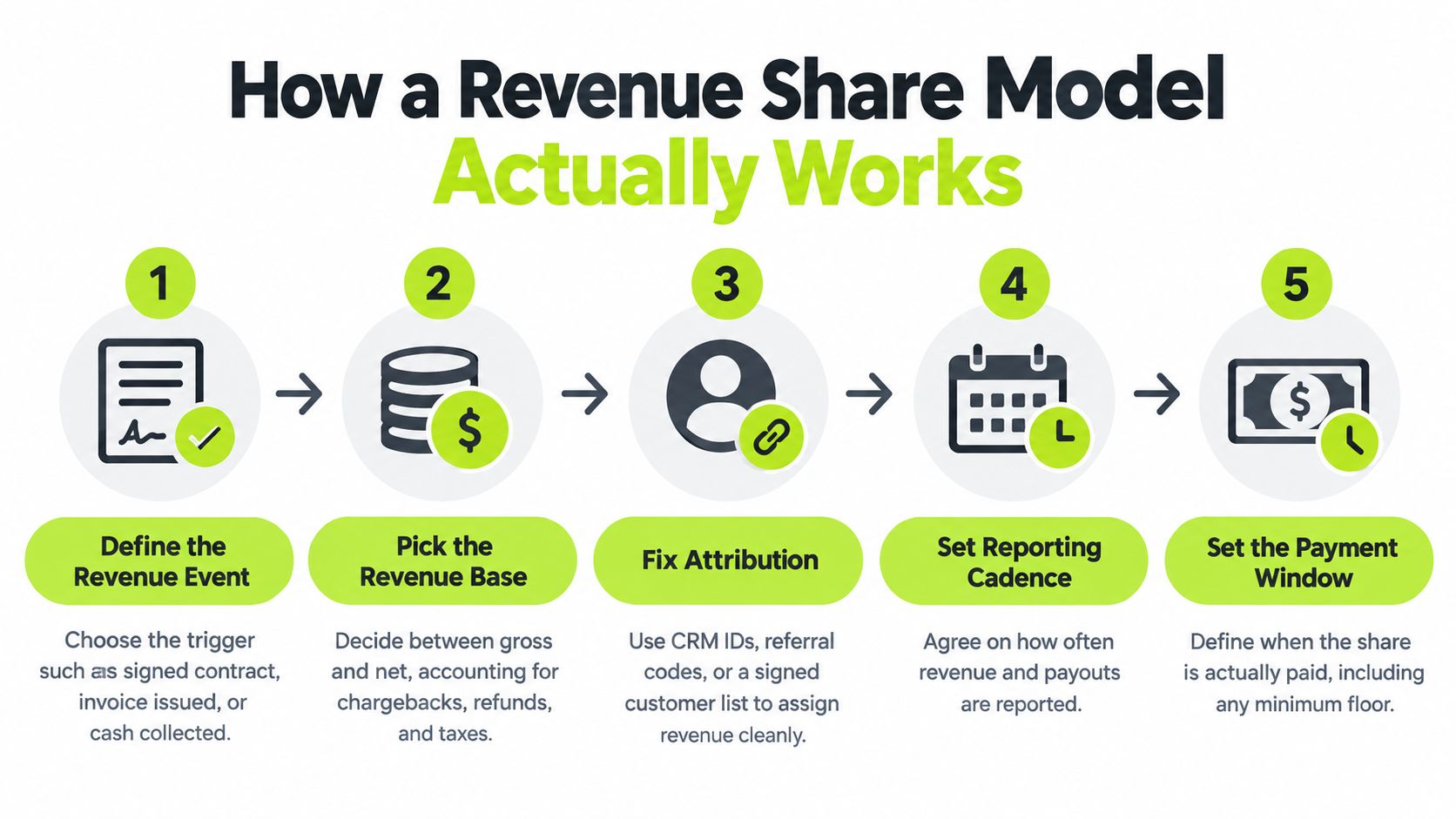
A clean structure usually follows five clauses in order. First, define the revenue event. Second, pick the revenue base. Third, fix attribution. Fourth, set reporting. Fifth, set the payment window.
A simple founder example
Say you hire a fractional CMO on a percentage of collected revenue with a monthly floor. The contract should say the share applies only to customers assigned through agreed attribution rules, not to all company sales. It should also say whether the base is gross or net, and whether refunds, taxes, or chargebacks are excluded.
Attribution needs objective identifiers. Use a signed customer list, CRM opportunity IDs, dedicated landing pages, referral codes, or an agreed source-of-truth report. That's the only way to keep everyone from arguing later about who “really” brought in the deal.
Write the mechanics into the agreement
The payment clause should cover reporting dates, payment deadlines, and audit or data-access rights. If monthly reconciliation is the cadence, spell out exactly what data gets reviewed and when the payment follows. If there's a minimum floor, make that floor explicit so the provider knows the engagement won't collapse into pure variable pay.
For a useful outside reference on the SaaS side of this structure, profit-sharing strategies for SaaS gives a helpful adjacent frame. The point is the same. If the math isn't auditable, the model isn't durable.
Typical Deal Structures and Cost Ranges
The three structures founders use are simple. One is safer for cash flow. One is easier to administer. One is better when you want to pay for proof instead of promises.
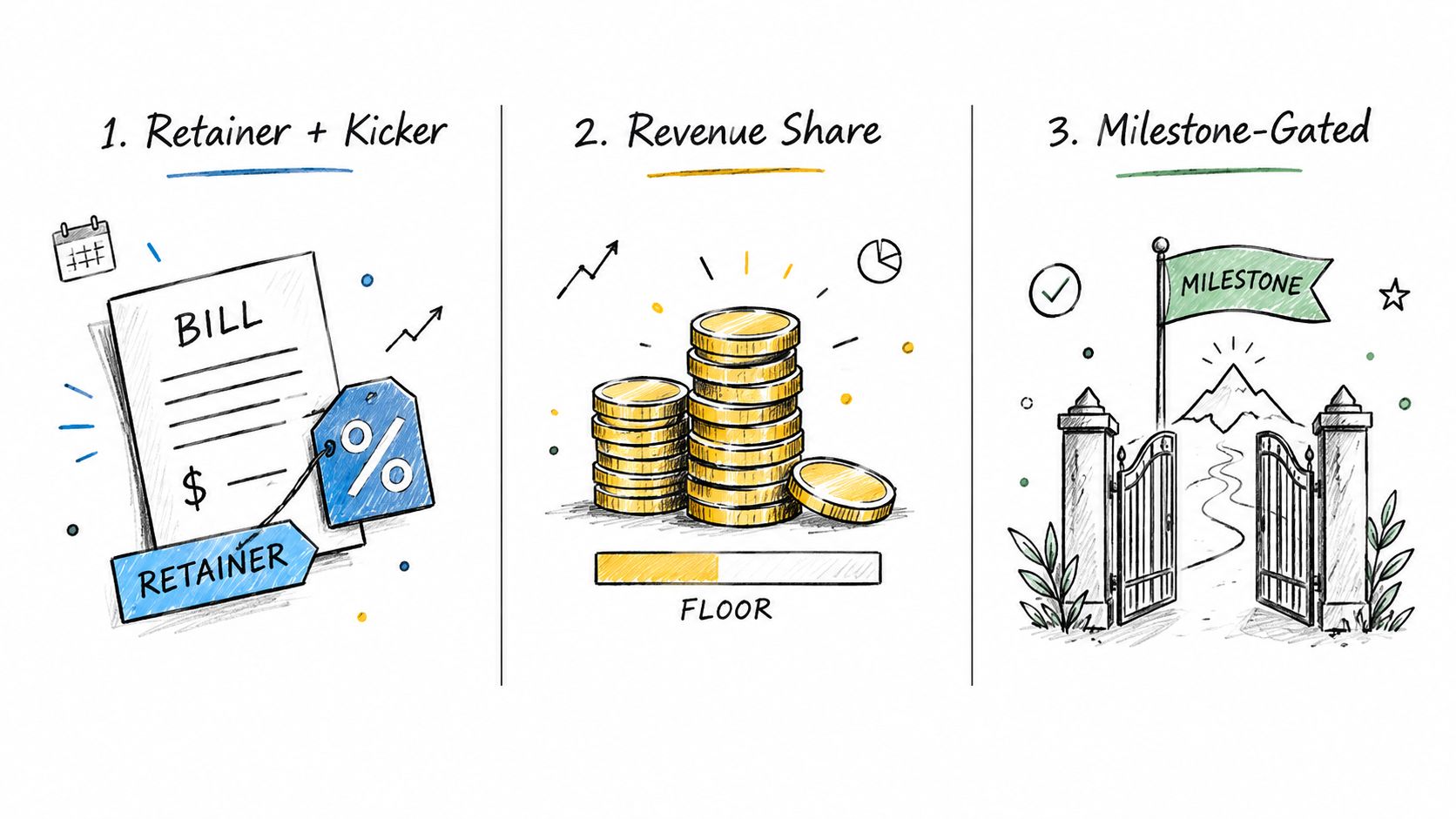
The three shapes that show up in real deals
A retainer plus a percentage kicker is the most straightforward for agencies and fractional operators. The retainer covers baseline effort, and the share rewards upside. It's clean because nobody is pretending the variable piece alone pays for all the work.
A pure revenue share with a small fixed floor is what you use when cash is tight but the provider still needs some guaranteed compensation. This is usually better than a big headline percentage with vague attribution, because the floor makes the economics survivable while the share stays tied to actual results.
A milestone-gated structure works best when you want to de-risk the relationship. A launch milestone triggers the first payment, qualified pipeline triggers the second, and collected revenue determines the variable share. That sequencing is what makes the deal feel earned instead of speculative.
For founders comparing agency pricing models, compare AI agency pricing options is a useful framing piece. And if you want a closer look at a related structure, see how Capstacker frames revenue share with agencies.
| Structure | Best for | Founder cost | Provider risk | Admin load |
|---|---|---|---|---|
| Retainer plus kicker | Ongoing fractional work | Predictable baseline plus upside | Lower, because some cash is fixed | Medium |
| Revenue share with floor | Cash-constrained growth work | Lower upfront cash, variable upside | Medium to high | Medium |
| Milestone-gated payments | Launches, pipeline builds, defined deliverables | Paid only as proof appears | Higher early, lower after gates | Higher |
Revenue Share vs Milestone Gates, Equity, and Success Fees
Revenue share is not always the right tool. Use it when you want to reward continuing measurable services and individually attributable results. Use something else when the value is one-time, ownership-based, or tied to a single event.
Pick the structure that matches the behavior you want
Milestone gates are better when the work has clear deliverables and you want to limit downside for both sides. Equity-for-services is different. Under Internal Revenue Code Section 83, property transferred for services can be taxed as compensation, and that can apply to partnership interests as well as stock. That means the agreement has to state the equity type, amount, transfer date, vesting or forfeiture terms, and purchase price. If the provider wants upside but the work isn't paid like revenue, equity belongs in a separate document, not mixed into a revenue-share clause.
Success fees fit one-shot outcomes, like a hire or a close. They're cleaner when the outcome is discrete and the work stops once the event happens. The success fee agreement topic is useful if you're deciding whether you want a one-time trigger instead of an ongoing share.
| Structure | Best for | Founder cost | Provider risk | Admin load |
|---|---|---|---|---|
| Revenue share | Ongoing attributable revenue | Variable, tied to collection | Medium | Medium |
| Milestones | Defined deliverables and launch work | Tied to proof, not promise | Medium to high early | Medium |
| Equity | Long-term upside alignment | Dilutive, not cash-based | High, depends on exit | High |
| Success fee | One-time outcomes | Paid once the event happens | Medium | Low |
Contract Terms That Decide Whether the Deal Holds Up
The contract terms matter more than the headline percentage. If they're vague, the relationship goes sideways fast. If they're tight, you can run the deal without constant arguments.
The clauses that prevent fights
Start with the revenue event. Say exactly what triggers payment, then define the base as gross revenue or a clearly stated net amount. If the arrangement includes renewals, expansion revenue, taxes, discounts, or refunds, name those rules in the contract instead of relying on goodwill.
Next, lock down attribution and audit rights. If the provider can't verify the calculation, the share turns into a trust exercise. That's a bad idea once money starts moving.
Good contracts make disputes mechanical, not emotional.
Termination is where many revenue-share agreements break. You need to decide whether there's no tail after termination, a fixed tail for pre-termination opportunities, or a customer-specific tail that runs through renewal. Short, campaign-specific terms with active obligations are cleaner than uncapped lifetime participation.
There's also a hard boundary on fundraising-based compensation. The SEC has said that soliciting investors for transaction-based compensation generally requires broker registration, and compensation tied to the size or success of a securities transaction is a broker-dealer hallmark. If someone is getting paid a percentage of capital raised, stop and get securities counsel involved before you sign anything. The finders and unregistered broker-dealers guidance is the kind of thing you read before you wing it.
How Deel, Upwork, GoFractional, Toptal, and Catalant Fit
Most platforms are fine for staffing. Fewer are clean for a true performance-based structure. That's the dividing line founders should care about.
Deel is built for contractor and payroll administration, so it can help with payments and agreements, but it isn't the place you go for a custom revenue-share structure. Upwork is mainly a marketplace for scoped freelance work, so it's better for hourly or fixed-price engagements than for attribution-heavy payouts. Toptal and Catalant are strongest for curated expert access and project work, not for bespoke revenue participation. GoFractional is closer to the fractional-executive use case, but founders still need to check whether the specific engagement terms support revenue share, milestone gates, or equity-for-services.
If you're structuring a deal around payment triggers instead of just hourly rates, the question is simple. Can the platform handle the agreement mechanics, or will you still need a separate contract?
A Founder's Pre-Sign Checklist
Before you sign, make sure the revenue event is defined, the attribution method is objective, the reporting cadence is written down, and you have audit rights if the numbers are disputed. Confirm refunds, renewals, taxes, and discounts are handled explicitly. Put a cap, sunset date, or buyout in place so the provider is paid for the defined service period, not forever.
If the deal touches equity, use separate documentation. If it touches capital raised, get legal review first. And if you want a second set of eyes on the financial mechanics, a fractional CFO guidance resource can help you pressure-test the numbers before you commit.
Capstacker helps founders structure revenue share, milestone payouts, equity-for-services, and the agreements around them in one place. If you're turning a fractional or agency deal into something measurable instead of hand-wavy, visit Capstacker and use it to shape the payment model before you sign.