How to Structure a Revenue Share with Agency

Most founders are told that a pure revenue share with an agency creates perfect alignment. It doesn't. It often transfers nearly all commercial risk to the agency, while leaving both sides to argue later about which sales were caused by the work.
The safer structure is usually a base fee plus a narrow, auditable upside formula. That gives the agency enough stability to execute and gives the founder a clear limit on exposure. The contract matters more than the headline percentage.
Table of Contents
- Why Pure Revenue Share Deals Fail
- Defining the Revenue Basis and Percentages
- Solving the Attribution and Data Problem
- Choosing Between Revenue Share and Milestones
- Drafting the Acceptance and Dispute Clauses
- Managing the Deal Week to Week
Why Pure Revenue Share Deals Fail
Pure revenue share looks elegant on a spreadsheet. The agency gets paid when the company earns, and the founder preserves cash before results appear. In practice, the model becomes fragile as soon as the agency controls only one part of the buying journey.
A paid media agency may generate the first visit, while a sales team closes the account. A lifecycle agency may influence expansion revenue, while product quality and customer success determine retention. If the contract pays a share of all revenue, the agency gets credit for outcomes it may not control. If it pays only for directly sourced revenue, the founder may underpay for work that materially improved conversion or retention.
The practical answer is not to offer a larger upside percentage. It's to narrow the claim and pay a modest base fee for execution. Agency revenue-share guidance makes the same core point: the strongest agreements are often not the ones with the highest upside, but those that combine a base fee with a defined and auditable formula.
What agencies see in the deal
An agency accepting pure upside is financing your acquisition, delivery, staff time, and payment delay. Established agencies may reject that risk. Less experienced providers or agencies with weak pipelines may accept it, but that doesn't automatically make the deal attractive.
The model also creates a perverse negotiation dynamic. When results are mixed, the founder wants to reduce the payout because the agency didn't create enough value. The agency wants to broaden attribution because it contributed to the result. Without a base fee, every disagreement threatens the relationship because the provider has no guaranteed compensation for the work already completed.
Practical rule: If the agency can't influence the full path from qualified lead to collected cash, don't promise a share of broad company revenue.
A hybrid deal keeps the economics viable when performance takes time, the funnel has multiple owners, or external conditions affect sales. The agency receives compensation for defined delivery, while the founder pays additional money only for a result that can be traced to a specific channel.
Defining the Revenue Basis and Percentages
Before negotiating the percentage, define the revenue it applies to. “Revenue generated” is not a usable contract term unless both parties agree whether it means gross bookings, collected cash, recognized revenue, or revenue after refunds, discounts, taxes, payment fees, and chargebacks.
For most agency arrangements, collected revenue from a defined source is easier to verify than a broad accounting figure. The agreement should identify the source system, the qualifying customer or transaction, the attribution window, and the point at which revenue becomes payable. It should also state how the calculation handles refunds, cancellations, credits, free trials, discounts, annual prepayments, renewals, and churn.
A workable economic boundary
Agency pricing references commonly describe sourced-deal revenue shares in the 10% to 30% range, with recurring programs lasting for a year or the customer lifetime, depending on the arrangement. Those figures come from SalesHive's revenue-sharing overview, which also reports that nearly one-third of agencies receive more than 11% of their total revenue from partnerships.
Those ranges aren't a recommendation. They show why the definition of revenue matters more than the percentage alone. A smaller share of lifetime revenue can cost far more than a larger share limited to the first transaction or a defined period.
Use the contract to answer these questions in plain language:
- Revenue definition: Is the base gross revenue, net collected revenue, or incremental revenue above an agreed baseline?
- Exclusions: Are refunds, taxes, chargebacks, discounts, pass-through costs, and unpaid invoices excluded?
- Attribution: Which source, campaign, referral code, account record, or opportunity field establishes eligibility?
- Timing: Is payment monthly, quarterly, or after a customer's payment clears?
- Cap: What is the maximum total payout per customer, campaign, or engagement?
- Tail: How long does the agency continue receiving payments after the contract ends?
The underlying agreement should also specify the parties, calculation method, revenue definition, and payout frequency. Sprintlaw's discussion of US revenue-share agreements notes that these contracts generally operate under state contract law, rather than one federal statute governing every deal.
A cap protects runway, but it also gives the agency a clear ceiling for its risk and effort. If the agency asks for uncapped lifetime participation, require a stronger justification, a narrower revenue definition, or a declining share over time.
Solving the Attribution and Data Problem
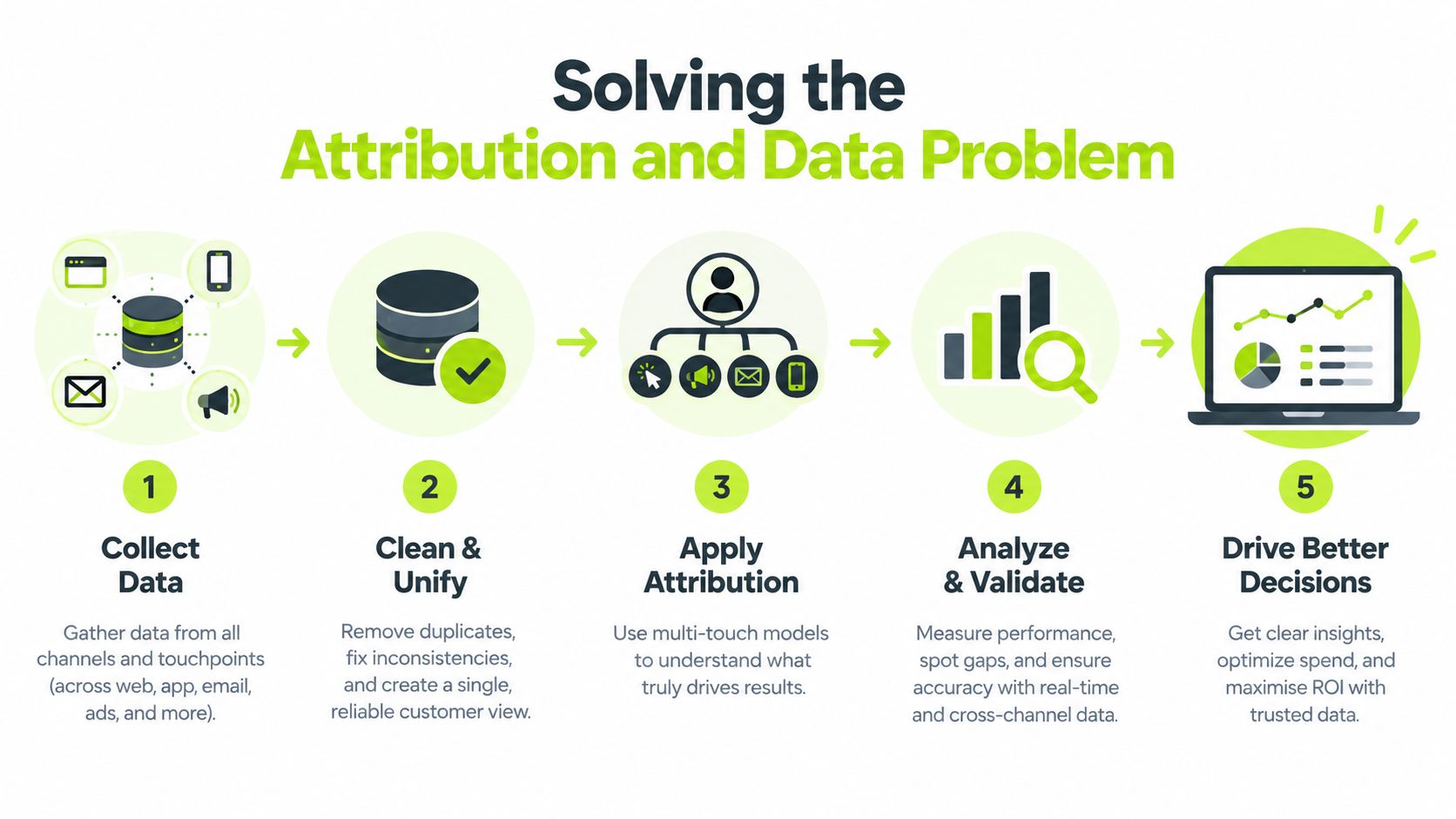
Attribution is where most revenue-share agreements stop being simple. Outcome-based pricing research identifies attribution methodology as a critical barrier for 69% of agencies, while 68% cite insufficient client data as a problem. Those figures appear in agency guidance on revenue-share mechanics, and they explain why a percentage can't rescue an incomplete measurement system.
The contract should make verification part of the deal design. Don't wait until the first payout dispute to decide which dashboard is authoritative.
Build the source of truth first
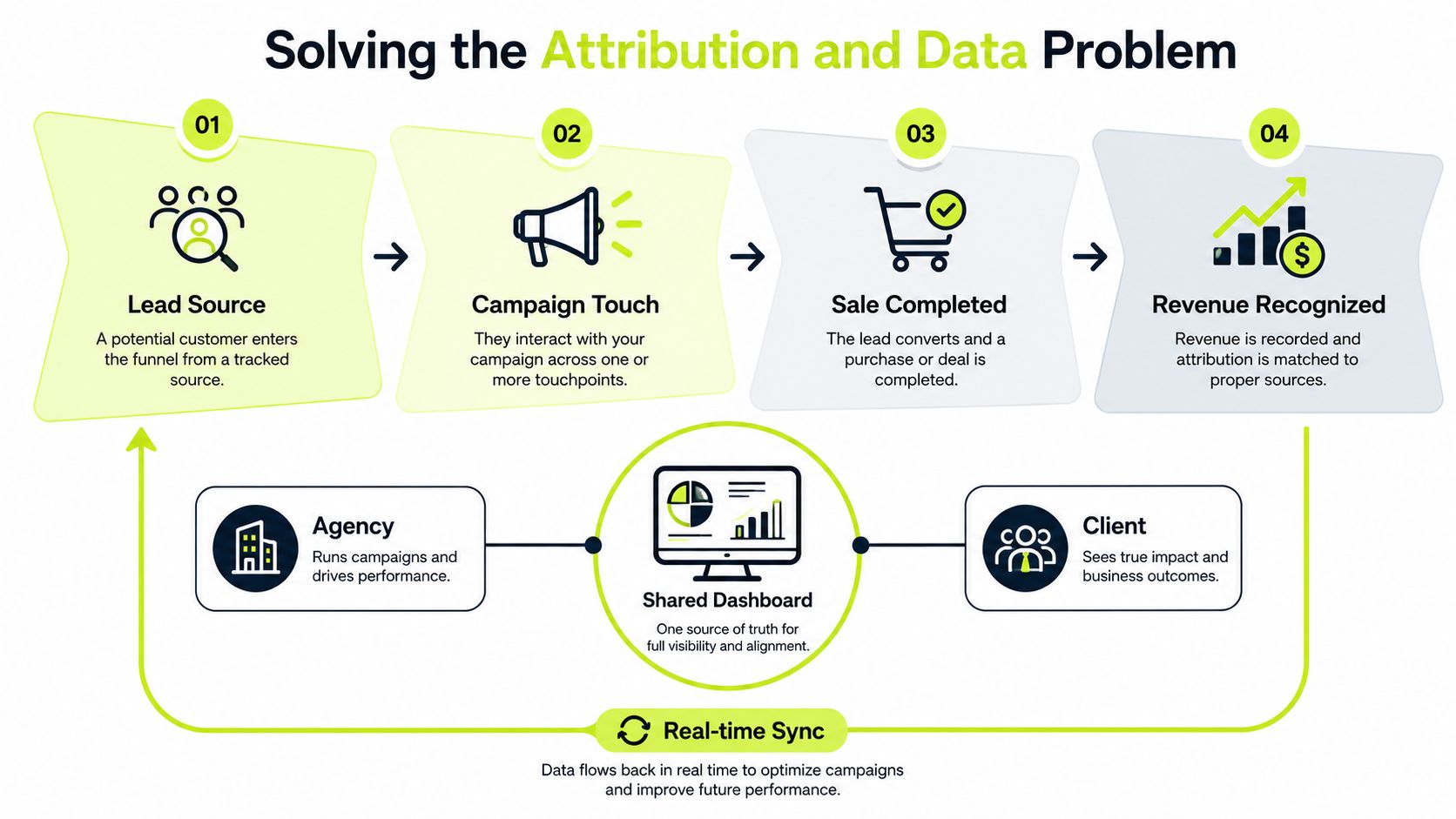
Start with one narrow channel. For example, the agency might receive a share only from new customers whose first qualified touch came through an agreed campaign source and whose opportunity record contains the required attribution field. That is more defensible than giving the agency a percentage of every sale during the engagement.
Then document the data path:
- Lead creation: Define which system creates the lead and what fields are mandatory.
- Campaign touch: Record the campaign, referral, landing page, or source identifier.
- Sale completion: Identify the CRM or billing event that confirms the transaction.
- Revenue recognition: Specify whether the calculation uses collected cash or another agreed basis.
- Reporting: Give both parties access to the same report and preserve a record of changes.
A practical guide to revenue attribution in SaaS can help teams think through the difference between acquisition source, customer-level attribution, and revenue reporting before those definitions reach the contract.
Write the disagreement process
Your agreement needs a fallback for missing or contested data. State who prepares the payout statement, when the other party can object, what evidence supports an objection, and what happens if the source system is incomplete.
A sensible clause can pause the disputed portion while undisputed amounts continue through payment. It can also require the parties to use the agreed source system rather than privately maintained spreadsheets. Audit rights should be limited enough to protect confidential information, but broad enough to verify the calculation, source records, refunds, and payments.
If attribution can't be reproduced by someone who didn't negotiate the deal, the formula isn't finished.
Don't attribute revenue across the whole funnel when several vendors influence the sale. Limit the share to a channel the agency can materially affect, use a named source system, and define a dispute process before launch.
Choosing Between Revenue Share and Milestones
Revenue share fits an engagement when the agency directly controls a measurable commercial channel and the business can reliably connect activity to collected revenue. Milestones fit better when the work produces deliverables, infrastructure, or operational change that may influence revenue later but can't fairly be assigned to one provider.
Fractional executive arrangements show why a hybrid approach is common. A 2024 sales-leadership benchmark found retainers in roughly two-thirds of assignments, with an average monthly fee of $9,651 and an average hourly rate of $213, compared with $176 the prior year. The same fractional sales leadership report says variable success fees tied to revenue or performance targets are commonly added to retainers.
Match payment to control
A milestone should describe an accepted output or verified business event. Examples include an approved sales process, a completed implementation, a launched reporting system, or a qualified pipeline milestone. A revenue share should describe a transaction or revenue event, not a general feeling that the agency helped.
| Model | Best For | Risk to Founder |
|---|---|---|
| Base fee plus revenue share | An agency that controls a defined acquisition or conversion channel | Ongoing payout obligations if the tail and cap are vague |
| Milestone-gated pay | Deliverables, implementations, and short engagements | Paying for completion that doesn't translate into commercial value |
| Retainer plus success fee | Fractional executives or agencies with continuing operating responsibility | Fixed cost remains even when performance is weak |
| Equity for services | Long-term strategic contribution with clearly defined commitment | Permanent dilution for work that may be temporary or poorly defined |
Revenue share shouldn't become a substitute for every other form of compensation. A 2026 fractional executive cost guide places common monthly retainers between $3,000 and $25,000, with a median of roughly $10,000 to $14,000 for 15 to 25 hours of work, and says fractional executives can cost 50% to 80% less than a full-time hire when the broader hiring package is included. Those figures are from Fractional Pulse's cost guide.
Treat equity as ownership, not delayed cash
Recent fractional-executive coverage describes hybrid packages combining a modest retainer with 0.25% to 2% advisory equity, while positioning revenue share or success fees as more suitable when the operator can directly move a measurable commercial result. The analysis appears in Optionality Lab's fractional executive coverage.
That distinction matters. If the engagement is short, cross-functional, or milestone-driven, equity may reward vague execution long after the work ends. A milestone-first structure usually preserves more flexibility. If equity is appropriate, define vesting, deliverables, termination treatment, and the point at which unearned ownership stops accruing.
For a useful legal framing of contingent consideration, review this definition of earn out agreement. The terminology is often associated with transactions, but the underlying discipline is relevant here: define the event, the measurement period, and the payment consequence.
Drafting the Acceptance and Dispute Clauses
The contract should not say that the agency gets paid when it “delivers results.” It should identify the deliverable, the acceptance criteria, the review period, and the consequence of silence or rejection.
This is especially important for technical and operational services. One service-agreement analysis reports that 42% of disputes in tech services arise from undefined performance metrics, and recommends payment after delivery is accepted or deemed accepted within a fixed review window. The analysis is set out in Capstacker's service-agreement drafting guide.
Define acceptance before work begins
For each milestone, write down what a reasonable reviewer can verify. A launch may require the agreed assets to be live in the specified environment. A reporting implementation may require the named data sources to populate the agreed fields. A sales-process project may require documented stages, ownership, and handoff rules.
Avoid subjective acceptance terms such as “high quality,” “market ready,” or “satisfactory progress” unless you define them elsewhere. If the founder rejects a milestone, the notice should identify the missing criteria and give the agency a reasonable cure path. If the founder doesn't respond within the agreed review window, the contract can treat the milestone as accepted.

Make payment and audit operational
A usable payment section should connect four events:
- Delivery: The agency submits the milestone or payout statement.
- Review: The founder has a defined period to accept or dispute it.
- Payment: The undisputed amount becomes payable under the stated schedule.
- Correction: Refunds, credits, duplicate records, or calculation errors are corrected in a later statement or reimbursed under the agreement.
For revenue share, add a statement format that shows the qualifying customer, source identifier, transaction date, included revenue, exclusions, percentage, prior payments, and remaining cap. Give both parties access to the underlying records, while protecting customer and commercially sensitive information.
A US agreement should also state the governing law and dispute venue. There's no single federal statute that governs all revenue-share deals, so enforceability and interpretation depend heavily on the contract and applicable state law, as the earlier US revenue-share agreement guidance explains. Have counsel adapt the language to the states and entities involved.
Managing the Deal Week to Week
Signing the agreement doesn't make the economics work. The founder and agency need a recurring operating rhythm that checks the source data, reviews accepted work, and deals with misses before frustration turns into a contract dispute.
Use one shared record for the agreement, milestones, attribution rules, payout statements, and disputes. A structured agreement workflow, such as the one described on the agreement workflow page, is useful when the payment model depends on conditions that spreadsheets tend to obscure.
Review the right questions
A weekly or monthly review should answer:
- Which milestones were delivered and accepted?
- Which revenue events qualified under the attribution clause?
- Which records are missing or contested?
- Are refunds, credits, and churn being reflected correctly?
- Is the agency still controlling the channel tied to the upside?
- Has the engagement reached its cap or sunset date?
Keep strategy changes separate from retroactive changes to the compensation formula. If the target is missed, decide whether the problem is execution, market conditions, a broken funnel, missing data, or a target that was never measurable. Then change the operating plan prospectively, with a written amendment when the economics change.
Data enrichment can help when account and lead records are incomplete, but it shouldn't replace the agreed source of truth. For teams evaluating data workflows, this agency API for enrichment is a relevant resource to consider alongside the contract's data requirements.
The cleanest exit is defined in advance. When the cap is reached, the attribution window ends, or the agency no longer controls the channel, move to a standard retainer, milestone plan, or a new negotiated term. That keeps a successful engagement from turning into an indefinite claim on future revenue.
If you're negotiating a revenue share with an agency, Capstacker helps you structure milestone payouts, revenue-share or equity deals, legal templates, tracking, and the contract-to-payout workflow in one place. Use it to turn the agreed formula into a deal your team can verify and operate without rebuilding the process in spreadsheets.