Fractional CMO Hourly Rate for 2026

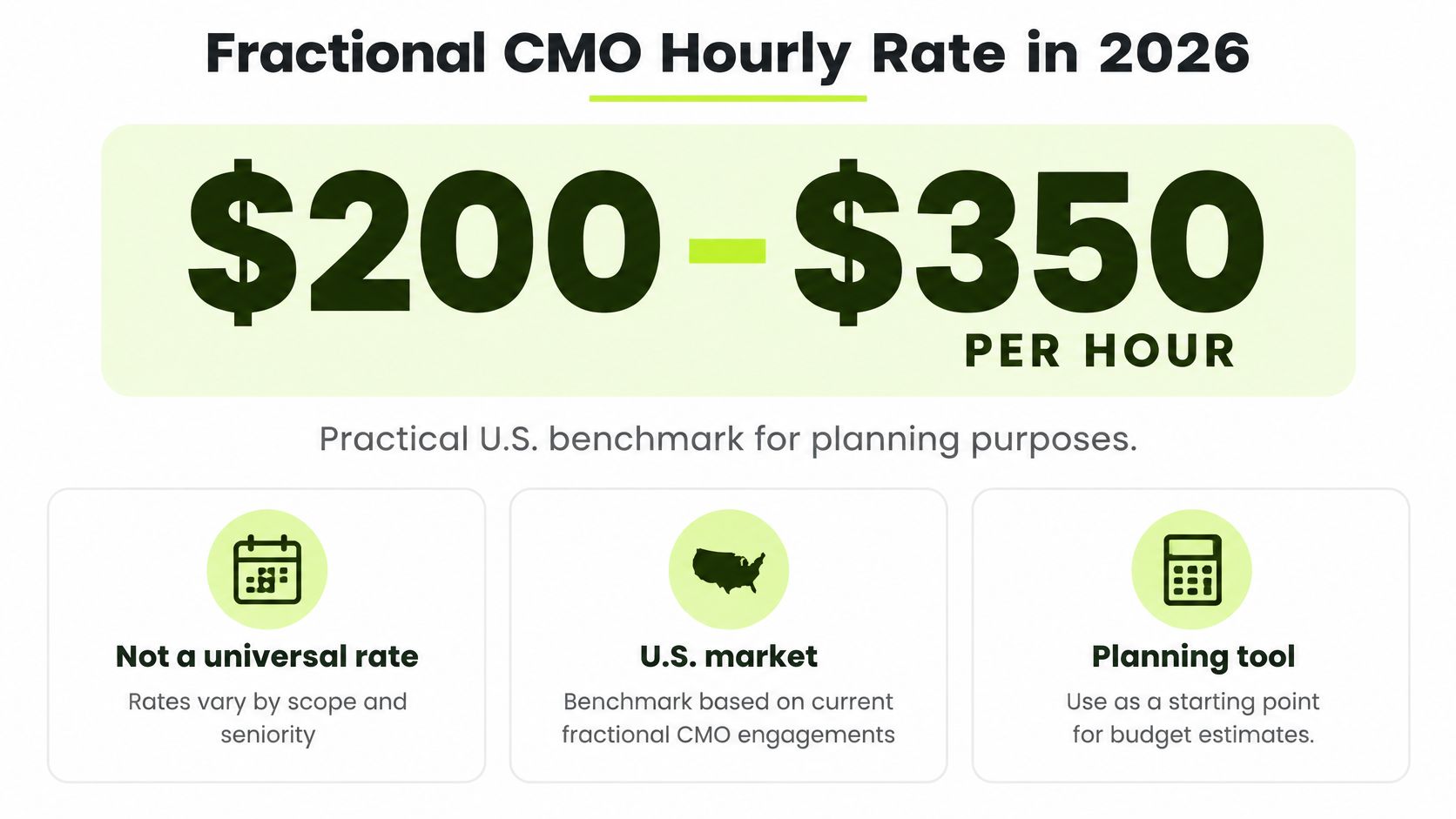
A practical U.S. fractional CMO hourly rate is roughly $200 to $350, while the broader observed market runs about $150 to $500 per hour depending on experience, responsibility, and scope. Treat that rate as the price of executive capacity, not the price of a complete marketing function.
The usual advice, compare hourly quotes and pick someone experienced, skips the important question: what can this person decide and deliver? A competitive rate doesn't help if you're buying recommendations when you need someone to lead.
Table of Contents
- What Is the Fractional CMO Hourly Rate in 2026
- What Determines a Fractional CMO Rate
- Hourly Billing Compared With Alternative Compensation
- Sample Calculations for Monthly and Project Budgets
- How to Negotiate the Rate and Payment Structure
- When Capstacker Fits the Engagement
What Is the Fractional CMO Hourly Rate in 2026
Use the opening range for planning, not as a universal price list. Executive leadership and marketing execution aren't interchangeable purchases, even when both proposals use the same job title.
The useful benchmark is the cost of accountable executive capacity, not the cheapest available marketing hour.
Fractional CMO rate context
| Offer type | Observed reference | What it usually reflects |
|---|---|---|
| Junior execution | $50 to $100 hourly, per Strategic Pete's rate guide | Task delivery rather than executive ownership |
| Marketing consulting | $101 hourly average across 286 submissions, per Contractrates.fyi's marketing-consultant dataset | A mixed consulting category, not a CMO-only benchmark |
| Senior fractional executive | $300 to $500+ hourly, in the Strategic Pete guide linked above | Executive analysis, direction, and strategic accountability |
A fractional CMO may own positioning, demand generation, budget allocation, agency oversight, executive reporting, and team direction. Those responsibilities explain why comparing the role with a specialist's task rate can mislead you.
Start by defining what a fractional CMO means for your business. Then use Sensoriium's resource to help find the right fractional CMO against that scope, rather than treating the title as proof of fit.
My recommendation: evaluate judgment, authority, availability, and outputs together. Hours tell you how much capacity you're reserving. They don't establish whether you're buying advice, operating leadership, or implementation.
What Determines a Fractional CMO Rate
Define the job before negotiating its price. A senior advisor reviewing your plan isn't making the same commitment as an operator building it, managing agencies, and directing your team.
Independent consulting also has different economics from employment. Freelance Pricing's benchmark reports a $127.79 median hourly ceiling rate across 59 U.S. GSA marketing-consultant categories, versus a $37.87 median employee wage for market research analysts and marketing specialists in May 2025. Consultants must cover taxes, insurance, tools, overhead, unpaid administration, and gaps between engagements.
Turn the quote into a capacity agreement
Ask these questions before deciding whether the proposal is affordable:
- Included work: Do preparation, stakeholder interviews, analysis, reporting, and vendor coordination consume the allocation?
- Availability: Are you reserving scheduled sessions, ongoing leadership access, or both?
- Decision rights: Can the CMO redirect spending and instruct vendors, or must every decision return to you?
- Implementation ownership: Who turns an approved strategy into campaigns, assets, and reporting?
For a broader way to assess how scope affects fees, AmaJova's service pricing frameworks for 2026 provide a useful companion resource.
Don't ask for executive accountability while retaining every operating decision yourself. I'd either delegate clearly or narrow the engagement to advisory work. Otherwise, you're paying for leadership capacity that the agreement doesn't let the executive use.
Hourly Billing Compared With Alternative Compensation
Use hourly billing when the effort is uncertain. Use milestones when the deliverable is clear. Neither structure automatically aligns incentives, and variable compensation doesn't remove the need for management.
The Strategic Pete guide cited earlier recommends separating uncertain discovery work from controllable deliverables and measurable downstream outcomes. That's the right distinction: choose the payment model around what the executive can influence, not around your preferred invoice size.
Compensation model decision table
| Payment model | Best fit | Main risk | Key safeguard |
|---|---|---|---|
| Hourly billing | Diagnosis and executive judgment | Uncapped cash exposure as effort expands | Spending ceiling and approval for overruns |
| Capped monthly block | Recurring leadership within reserved capacity | Work exceeds the block or availability is unclear | Included activities and overage rules |
| Milestone payments | Positioning, launch plans, or reporting systems | Disagreement about completion | Written acceptance criteria |
| Revenue share | Clearly attributable commercial outcomes | Shared attribution and uncertain future payouts | Defined revenue base, attribution window, and payment cap |
| Equity for services | A deliberately negotiated long-term arrangement | Dilution and ambiguous service obligations | Legal review and explicit earning conditions |
A capped block makes spending predictable, but it doesn't promise unlimited execution. Milestones make acceptance explicit, but the founder still needs to supply information and approve work.
For downstream incentives, distinguish a revenue-share model from payment for completing a project. Revenue attribution needs more care than approving a document. Equity requires a separate discussion about dilution, termination, and legal and tax compliance with qualified advisers.
Selection rule: Pay for uncertain effort with capped capacity, defined outputs with milestones, and attributable upside with narrowly written variable compensation.
I'd favor a hybrid when you need ongoing leadership and specific deliverables. Keep the executive's availability funded rather than making every payment depend on a result outside their control.
Sample Calculations for Monthly and Project Budgets
Convert the hourly quote into a monthly commitment before comparing proposals. Using Firefly CMO's practical U.S. benchmark, 20 hours per month costs $4,000 to $7,000, while 40 hours costs $8,000 to $14,000.
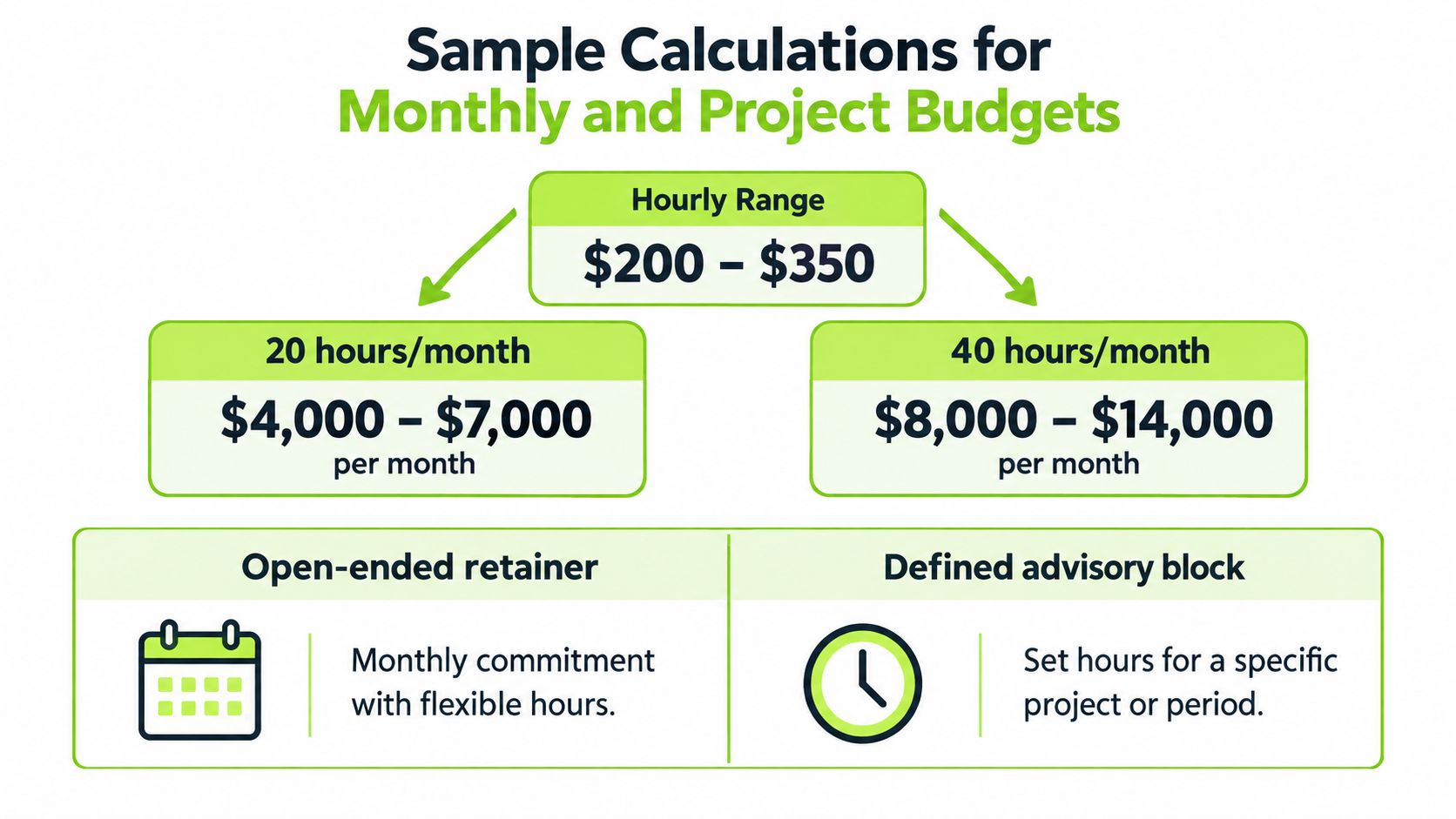
The smaller block may be the better purchase when your team can implement and only needs executive decisions. The larger block makes sense when the executive must also coordinate delivery. Neither is better without matching scope and authority.
Compare a flexible retainer with a defined advisory block by asking what capacity is reserved and what happens when demand exceeds it. Compare either with a milestone project by identifying the accepted output, not by guessing how quickly someone should produce it.
Compare the complete commitment
Project minimums matter too. A survey of more than 600 U.S. digital-marketing providers reported by SHNO's marketing consulting statistics found that 69.44% set minimum single-project prices below $3,000. An hourly quote doesn't necessarily mean you can buy an isolated hour.
Use total agreed fees divided by approved deliverables as a comparison tool, while checking that those deliverables are equivalent. Record preparation, meetings, and coordination alongside delivery time; GetBill's hourly billing worksheet for freelancers is a practical reference for documenting that breakdown.
A lower rate isn't a saving if it leaves you coordinating the work the other proposal includes.
How to Negotiate the Rate and Payment Structure
Negotiate scope and payment exposure before asking for a discount. First separate executive leadership from implementation. A proposal should distinguish the CMO's decisions and management responsibilities from production work assigned to employees, agencies, or other contractors.
Then put included hours, response expectations, deliverables, vendor ownership, and decision rights in writing. The earlier Strategic Pete guidance identifies product readiness, sales execution, budget, attribution quality, and demand as dependencies outside the CMO's sole control. Your agreement should reflect those boundaries.
Set the approval and payment rules
For a milestone, define the deliverable, acceptance criteria, reviewer, and approval deadline. Specify what happens when the founder delays inputs or changes direction after approval.
For a success fee, record the baseline, named measurement system, target, attribution window, and payment trigger. If compensation depends on pipeline, define what qualifies and which campaigns count. Don't leave those decisions until after results arrive.
- Cap exposure: Require written approval before extra hours or expanded scope.
- Report progress: Review capacity used, accepted outputs, dependencies, and upcoming decisions.
- Define the exit: Address unfinished milestones, accrued fees, handover, and any continuing revenue-share obligations.
Don't tie the entire fee to revenue when product, sales, and marketing share responsibility for the result.
I'd preserve a fixed payment for accountable executive capacity, then add variable compensation only where measurement is clean. If the budget won't support the scope, reduce the scope. A discount won't resolve unclear ownership or missing implementation capacity.
When Capstacker Fits the Engagement
A deal-structure tool fits when you've moved beyond a simple hourly purchase. If you're buying occasional advice with a clear spending cap, an hourly agreement may be enough. If you're combining reserved leadership capacity with milestone payouts, revenue share, or equity, the payment rules need more explicit documentation.

One option is to use the publisher's agreement-structure workflow for milestone payouts, revenue-share arrangements, and equity-for-services deals, with legal templates and tracking. The relevant comparison isn't talent access. It's whether your chosen process makes obligations and payment triggers explicit.
Match the structure to your commitment
Keep the hourly benchmark as a reference for the capacity you're reserving. Separately identify what should be paid on approval, what could earn a downstream bonus, and whether equity belongs in the arrangement at all.
Templates and tracking don't decide whether a target is fair or an attribution rule is workable. You and the executive still need to negotiate those terms, and equity arrangements deserve qualified legal review.
Choose the simplest agreement that accurately describes the work. Don't add revenue share or equity just to avoid discussing an unaffordable scope.
Capstacker offers milestone payouts, revenue-share and equity deal structures, legal templates, and tracking for service engagements. Bring your fractional CMO proposal to Capstacker to make the work, payment triggers, and runway commitment explicit before you sign.