Upwork vs Fiverr for Startups Which Platform Wins
Most founders pick Upwork vs Fiverr on brand familiarity, then overpay for the wrong economics. That's backward. If you're buying outcomes, the question is which marketplace keeps working once AI makes low-ticket tasks cheaper, and which one taxes every dollar of delivery.
I've hired on both. My blunt take is this, Upwork is usually the better fit for ongoing, higher-value work, while Fiverr is fine for narrow, packaged tasks with a clear finish line. If you're hiring a fractional operator, the more interesting comparison isn't feature lists, it's fee structure, buyer behavior, and whether you should use a marketplace at all.
For founders, the legal risk sits outside the marketplace too. If you're shaping a long-running relationship with control over hours, scope, or exclusivity, you should also think about legal risks in misclassification before you treat a freelancer like a disguised employee.
| Platform | Best fit | Cost shape | Buyer behavior |
|---|---|---|---|
| Upwork | Ongoing projects, repeat work, senior freelancers | Variable fees plus client-side charges | Proposal-driven, relationship-based |
| Fiverr | Small, defined, quick-turn tasks | Flat seller commission plus buyer checkout fees | Catalog-driven, transaction-first |
Table of Contents
- Introduction Why This Comparison Matters Now
- How Upwork and Fiverr Actually Work
- Pricing and Fees What Founders and Operators Really Pay
- Talent Quality and Senior Fractional Fit
- Contracts IP Protection and Dispute Resolution
- Hiring Workflows and Real World Use Cases
- When to Choose Upwork Fiverr or an Outcome Based Platform
Introduction Why This Comparison Matters Now
The old question, “Which platform is cheaper?” misses the issue. AI is pushing down low-end freelance work, so the better test is whether a marketplace still makes sense once simple tasks get cheaper and margins get thinner. Upwork's reported revenue and marketplace revenue have held up better than Fiverr's, which points to where higher-value demand is surviving. Upwork statistics
Fiverr still has reach, but its buyer base has shrunk while spend per buyer has risen. Upwork has shown a similar pattern on the client side, with fewer active clients and more spend per client, which says the market is concentrating around larger accounts and repeat work. AI freelance pay in 2026
That is why I do not compare them as if they are interchangeable. Upwork works more like a working relationship market. Fiverr is a catalog of packaged tasks. If you need repeat execution, the fee curve, buyer behavior, and legal risks in misclassification matter more than the logo.
How Upwork and Fiverr Actually Work
Upwork is built for hiring. You post a brief, review proposals, interview candidates, and choose someone for work that may grow or repeat. Fiverr is built for buying a defined service. You pick a packaged offer, choose the scope, and check out. That structure matters because it shapes the kind of talent you reach and how much room you have to keep working together.
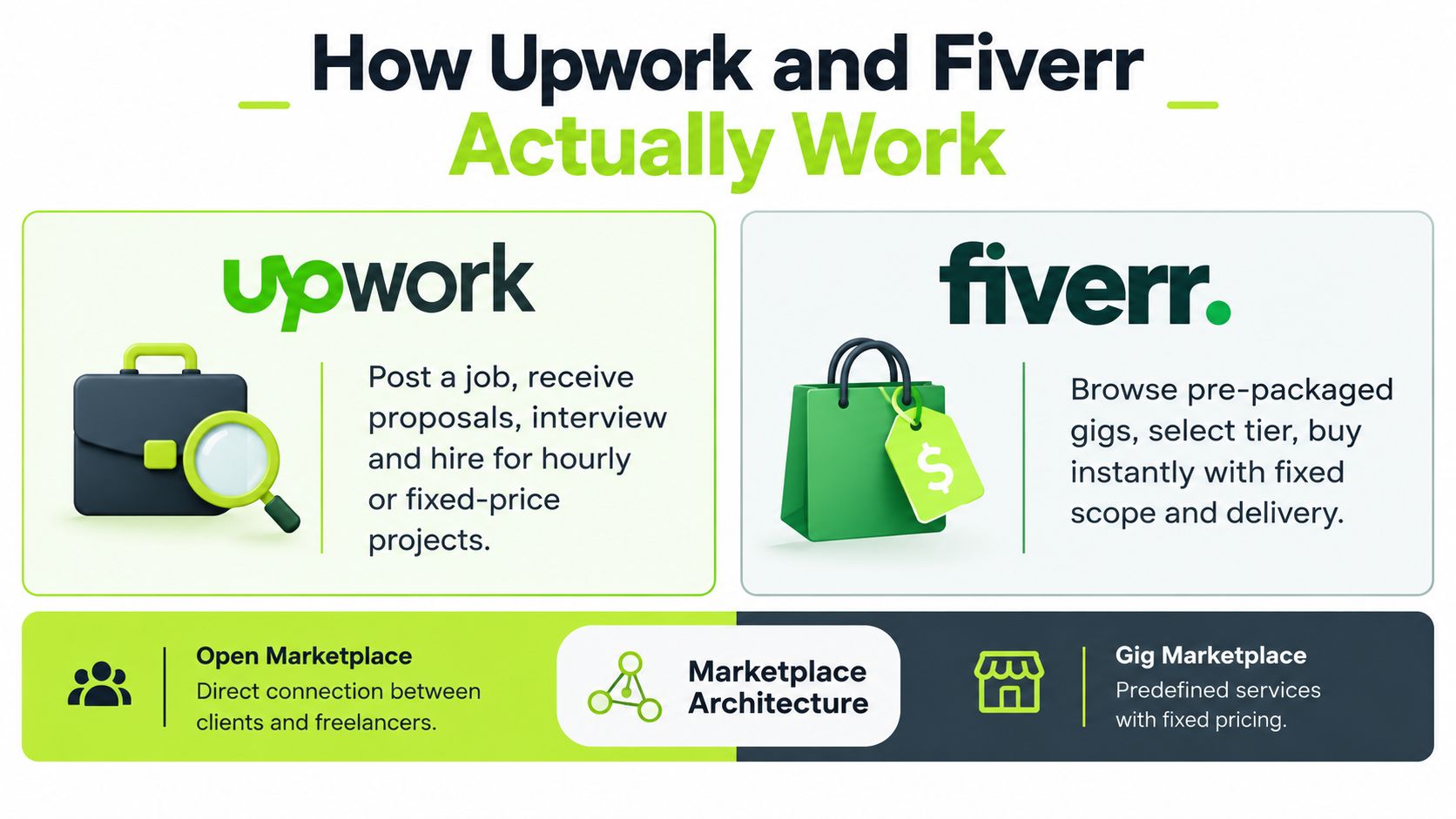
Upwork gives you more control over selection. Fiverr gives you more speed. I use Upwork when I need to judge judgment, communication, and fit before money changes hands. I use Fiverr when the deliverable is narrow and I already know exactly what I want.
Practical rule: if you need someone to think with you, use the marketplace that starts with a conversation.
Senior fractional work usually fits Upwork better. A fractional marketer, operator, or technical lead needs context, revision cycles, and room for the scope to change after the first pass. Fiverr can still work for a clean one-off deliverable, but it is a poor fit for work that evolves week to week.
Pricing and Fees What Founders and Operators Really Pay
Upwork and Fiverr only look cheap if you ignore fees. The more useful comparison is total cost to deliver the work and total net to the person doing it. That is where the economics separate fast.
Upwork's fees are layered, not flat
Upwork's client pricing starts with a 3% marketplace fee for eligible U.S. ACH payments on the free Basic plan, and 5% for most other payments. Business Plus charges 8% to 10% on payments to freelancers, and those fees apply to fixed-price, hourly, Project Catalog, bonuses, Direct Contracts, and BYO contracts. Upwork also adds a one-time contract initiation fee of $0.99 to $14.99 depending on contract value. Upwork pricing page Upwork fee breakdown
Fiverr takes more from every order
Fiverr's seller fee is a flat 20% on completed orders, with no volume tiers in the fee structure described by fee guides. Buyers also pay an added service fee of about 5.5% plus a small fixed fee on lower-value orders. The listed price is not the checkout price, and the seller never nets the full headline amount. Fiverr fee calculator
| Fee Component | Upwork | Fiverr |
|---|---|---|
| Client or buyer marketplace fee | 3% on eligible U.S. ACH payments, 5% for most other payments, or 8% to 10% on Business Plus | About 5.5% buyer service fee plus a small low-order surcharge |
| Freelancer or seller fee | Variable 0% to 15% freelancer service fee | Flat 20% seller commission |
| First-contract cost | $0.99 to $14.99 initiation fee on new contracts | No comparable contract startup fee in the cited fee structure |
The mistake is comparing gig price to gig price. The more useful comparison is total cost to deliver the work and total net to the person doing it.
My view is straightforward. If you expect multi-stage work, Upwork's fee curve is easier to live with. If you are buying a one-off packaged task, Fiverr's commission structure is tolerable because you are not trying to build a long relationship. For founders paying for outcomes, repeated usage makes Fiverr feel expensive faster.
Talent Quality and Senior Fractional Fit
Upwork is where I look first for senior fractional talent. Fiverr is better for bounded deliverables, not for someone who has to own a messy business problem. Once the work shifts from execution to judgment, that gap matters.
Why profile depth matters
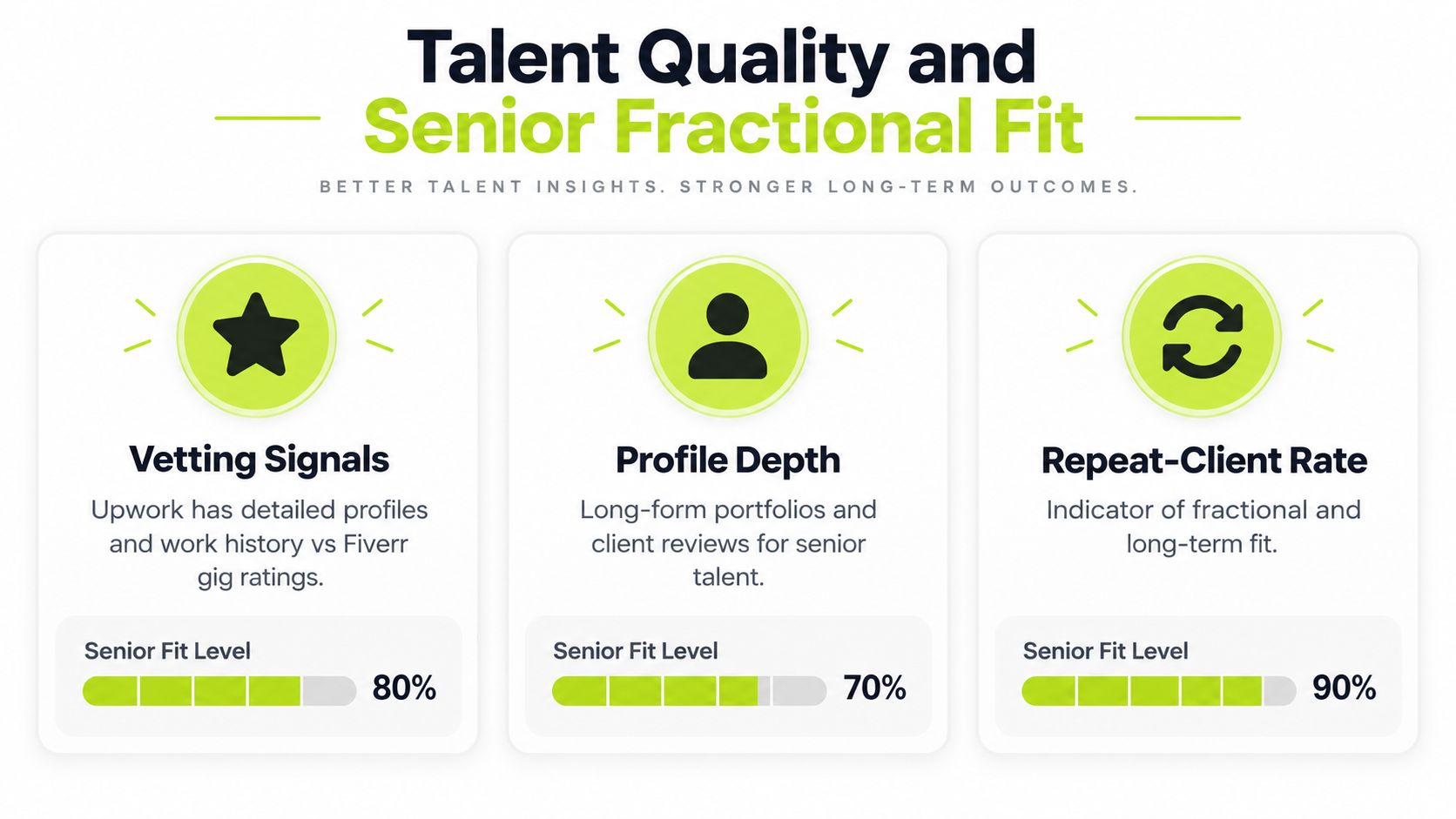
Upwork profiles usually give you more to inspect. Work history, client feedback, and project patterns make it easier to judge whether someone has solved a similar problem before. Fiverr profiles are package-first, which works when the deliverable is obvious, but leaves less room to assess how someone handles ambiguity.
Senior operators do not buy a logo. They buy evidence that the person has solved a similar problem before.
The AI pressure on low-ticket work makes the divide sharper. Both platforms are getting squeezed at the bottom of the market, while higher-value buyers are concentrated around more involved engagements. The result is simple, commodity work gets easier to compare, and good talent has less patience for thin, one-off gigs.
For fractional work, I care more about repeat-client behavior than star ratings. A real operator has to handle changing priorities, unclear inputs, and a second version of the brief without losing the thread. Upwork's proposal flow and relationship history usually support that better. Fiverr still works when the outcome is tightly defined, but it is a weak fit for someone you want inside the business context.
Contracts IP Protection and Dispute Resolution
I judge these deals by one thing first, who owns the work if the relationship ends badly. Upwork gives you a cleaner starting point than Fiverr for formal structure, but neither marketplace should substitute for a real contract when the work touches product, brand, code, or strategy.

Platform terms help with setup, not with judgment. You still need written language on scope, ownership, handoff, and what happens if the deliverable changes halfway through. A milestone plan works only if the milestones match the actual job. For a plain example of where milestone thinking breaks on fractional leadership work, read why Upwork deals fall apart when your fractional CTO wants milestone pay.
Escrow protects timing of payment. It does not fix bad scope.
I care more about the contract than the checkout flow. If I'm buying outcome-based work, I want deliverables spelled out, review checkpoints named, and ownership assigned before the first task starts. That is the only way to avoid a messy handoff later. For complex operator relationships, I trust a contract that matches the work shape, not platform defaults or generic templates.
Hiring Workflows and Real World Use Cases
Upwork is the better hiring workflow when the work needs screening. Fiverr is the better workflow when the work is already packaged in your head. That's the operational split that founders feel on day one.
When I'd use Upwork
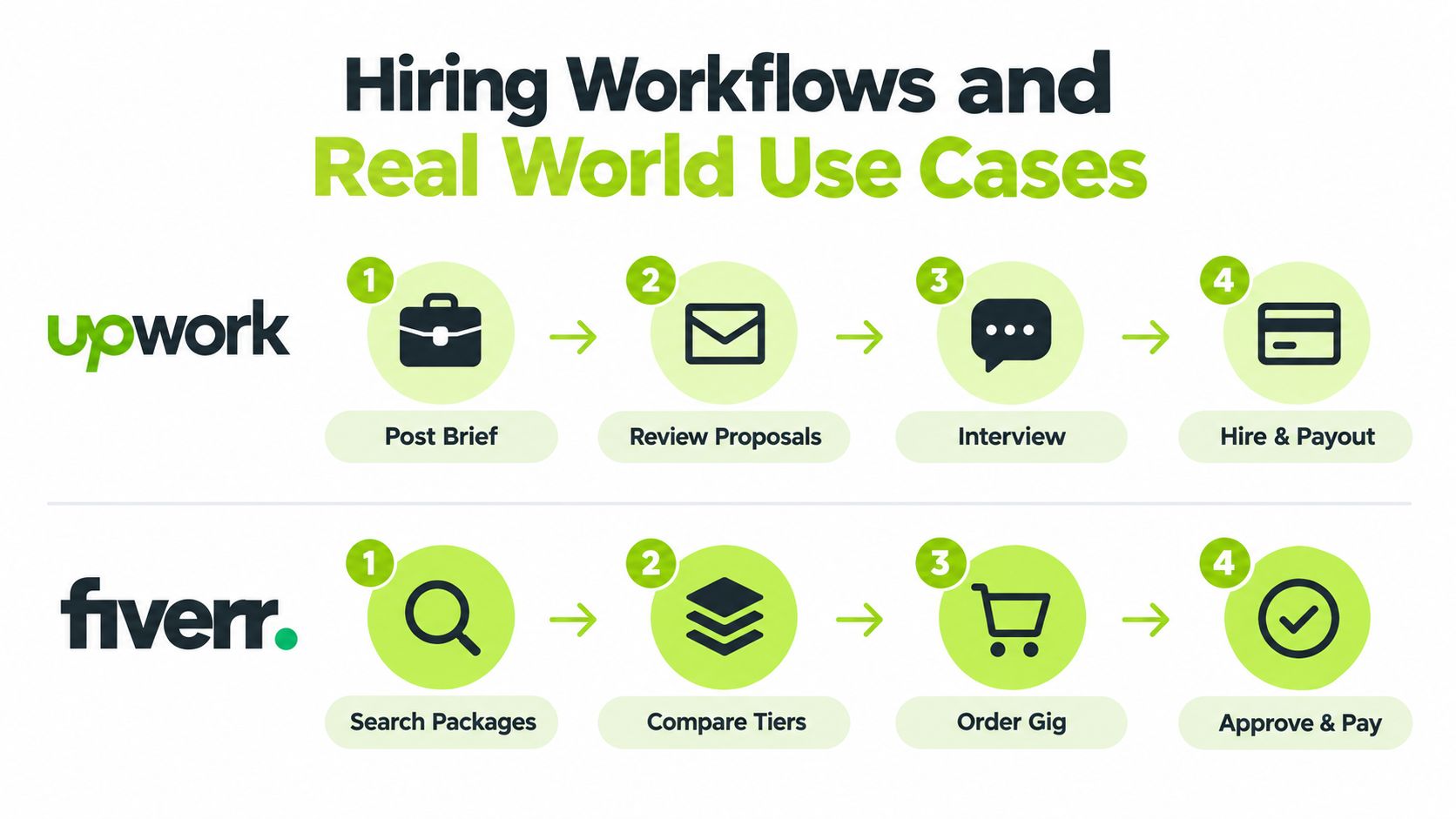
If I need a growth marketer to audit a funnel, a product designer to work across revisions, or a contractor who may stay on after the first deliverable, I start on Upwork. Post the brief, review proposals, interview the strongest people, then hire. That flow gives me room to judge judgment, not just speed.
When I'd use Fiverr
If I need a logo cleanup, a landing page banner, a one-off voiceover, or another task where the output is obvious and the scope is tight, Fiverr works. Search packages, compare tiers, order the gig, approve the result. That's efficient for commodity work, and it's why the platform keeps moving fast on small transactions.
I'd use neither for senior fractional work that needs outcome pricing. If the person is effectively acting like a part-time CMO, COO, CFO, or CTO, the marketplace assumption starts to get in the way. In those cases, I'd rather use a structure built for milestone payouts, revenue share, equity, legal templates, and tracking. Capstacker sits in that lane, and so does the wider class of outcome-based deal platforms.
For founders hiring outside the U.S. talent pool, LatHire, latam's largest talent marketplace is a more relevant comparison point than Fiverr if your goal is screened regional talent rather than quick gigs. And if you want a broader comparison framework for how I think about marketplace fit, I've laid that out on Capstacker's Upwork comparison page.
When to Choose Upwork Fiverr or an Outcome Based Platform
Upwork wins when the work is iterative, ongoing, or senior enough to need conversation before commitment. Fiverr wins when the deliverable is narrow and the speed advantage matters more than relationship depth. Neither wins when the person you're hiring should be paid for business results instead of labor units.
If I'm paying for a one-off execution task, I'll use Fiverr and move on. If I'm building a working relationship that may stretch across multiple milestones, I'll use Upwork. If I'm hiring a fractional leader or a specialist whose value comes from outcomes, I skip both and structure the deal directly.
That's where outcome-based platforms make more sense than a gig marketplace. They let you define milestone payouts, revenue share, equity, legal templates, and payout tracking in the same workflow, which matches how senior operators work. If you're hiring in that mode, you're not really shopping for a freelancer, you're building a deal.
If you're weighing a fractional hire, a milestone project, or a revenue-share engagement, visit Capstacker and structure the deal before you start the work. You'll get milestone payouts, revenue-share and equity terms, plus the tracking and templates needed to close faster without turning every hire into a legal scramble.