Performance Based Pricing for Startups: A Founder's Guide

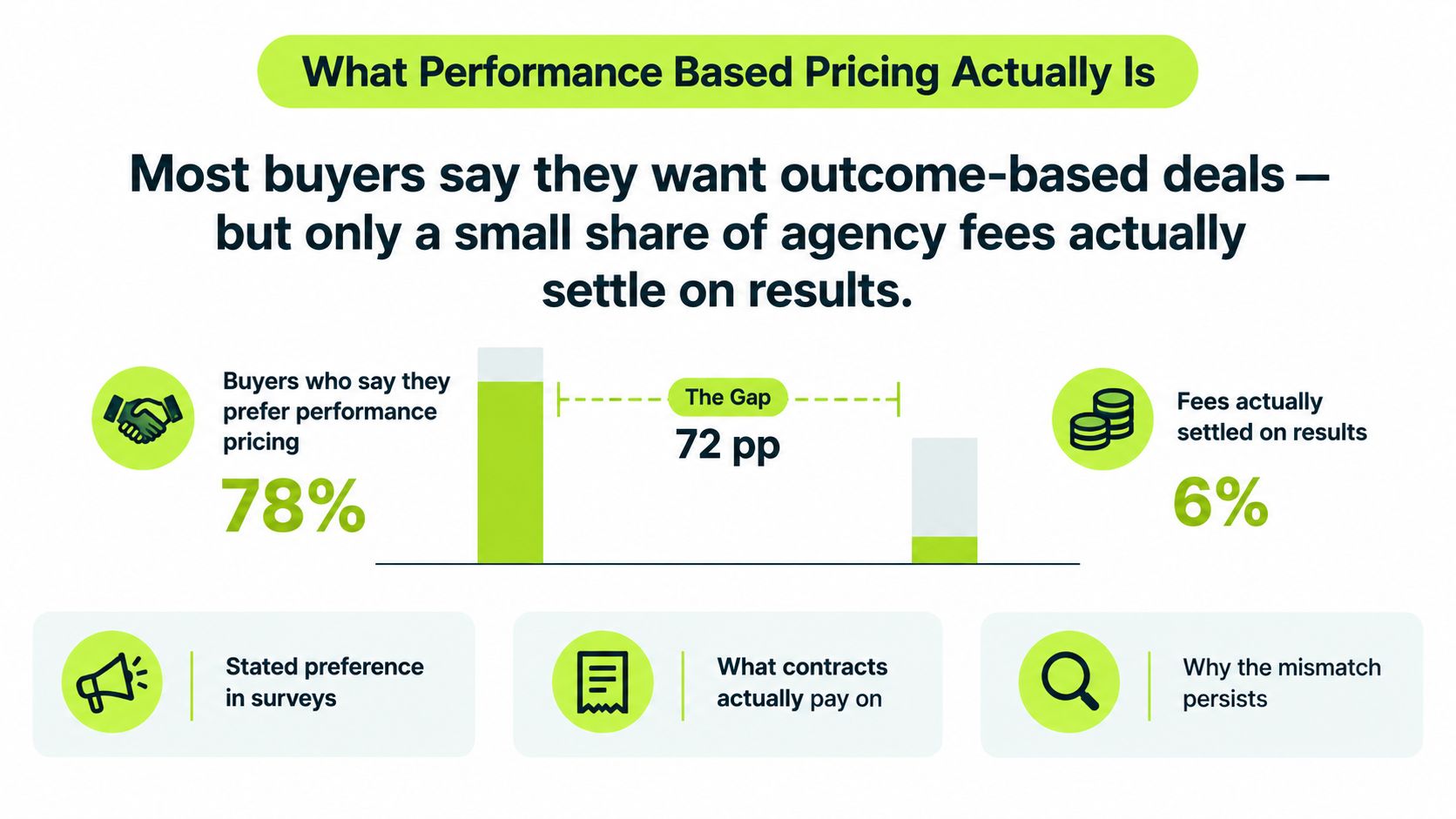
Customers increasingly push for outcome-based pricing, yet agency compensation still rarely depends on outcomes: 64% to 80% of respondents say performance remuneration makes up less than 20% of total fees in the cited agency research summarized by NetSuite. That gap tells you where these deals fail. The difficult question isn't what percentage to charge. It's who gets credit, which data counts, and what happens when the numbers disagree.
Table of Contents
- What Performance Based Pricing Actually Is
- The Four Deal Shapes Founders Use
- How to Set the Fee Without Guessing
- Attribution Is Where These Deals Break
- When Pure Performance Pricing Backfires
- Contract Terms Worth Negotiating
- The Deal Most Founders Should Default To
What Performance Based Pricing Actually Is
Performance based pricing ties a meaningful part of a provider's fee to a measurable result the buyer values. The provider might receive a reduced base plus upside, a payment at an accepted milestone, a share of traced revenue, or a fixed fee for each qualified outcome. It isn't the same as usage-based billing, which can be useful in usage based pricing models for SaaS, because the trigger here is usually a business result rather than consumption.
A deal qualifies only when three conditions exist:
- A definable outcome: Both sides can describe the event without interpretation.
- Attributable causation: The provider's contribution can be separated from other influences.
- A trusted payout mechanism: The contract names the source of truth, calculation, timing, and dispute process.
The model has history. The Interactive Advertising Bureau's 2017 revenue report found that 62% of full-year 2017 US internet advertising revenue used performance-based pricing, compared with 64% in 2016. The model remained the leading internet advertising pricing approach since 2006, with 61.8% in 2018.
That maturity doesn't make every startup deal sensible. Founders who treat performance pricing as a clever rate card usually discover that attribution was the contract.
The Four Deal Shapes Founders Use
The right structure depends on the trigger you can observe and the part of the result the provider controls.
| Shape | Trigger | Payout | Best For | Main Risk |
|---|---|---|---|---|
| Milestone | Accepted deliverable | Fixed amount on acceptance | Early-stage projects | Disputes over “done” |
| Revenue share | Traced revenue or margin | Percentage of commercial result | Ongoing growth or sales | Noisy attribution |
| Success fee | Defined result unit | Fixed amount per unit | Repeatable transactions | Delayed or disputed trigger |
| Hybrid | Base plus measured upside | Reduced floor and variable kicker | Most startup engagements | Poorly defined variable band |
Milestone pricing works when the outcome is still developing but the deliverable is observable, such as a launched integration or activated cohort. Payment follows acceptance, not time recorded. The milestone-based pricing guidance says each deliverable should have a payment value and test, with nothing payable for work in progress. The catch is obvious: if “accepted” isn't defined before kickoff, the invoice becomes the negotiation.
Revenue share fits a provider who touches a continuing commercial function. It spreads payment across actual performance, but shared influence makes credit noisy. Success fees are cleaner for a funded loan, closed deal, or qualified lead, provided the event is repeatable and independently verifiable.
Hybrid deals are the practical default. A reduced base covers unavoidable delivery work, while the variable portion rewards results. Pure models break when either party must carry risks the other controls.
How to Set the Fee Without Guessing
Start with a value corridor, not a market rate. The Open University outcome-based contract framework recommends setting the ceiling from customer economic value and the floor from provider delivery cost. The gap determines whether a gain share, milestone payout, or success fee can work.
Consider a B2B lead-generation agency selling to a Series A SaaS company. If one closed deal creates $4,800 of outcome value at a 20% close rate, and delivery costs are around $220 per SQL, a fee corridor of $700 to $900 per SQL can survive stress testing. Those figures are the worked example for this deal, not a market benchmark.
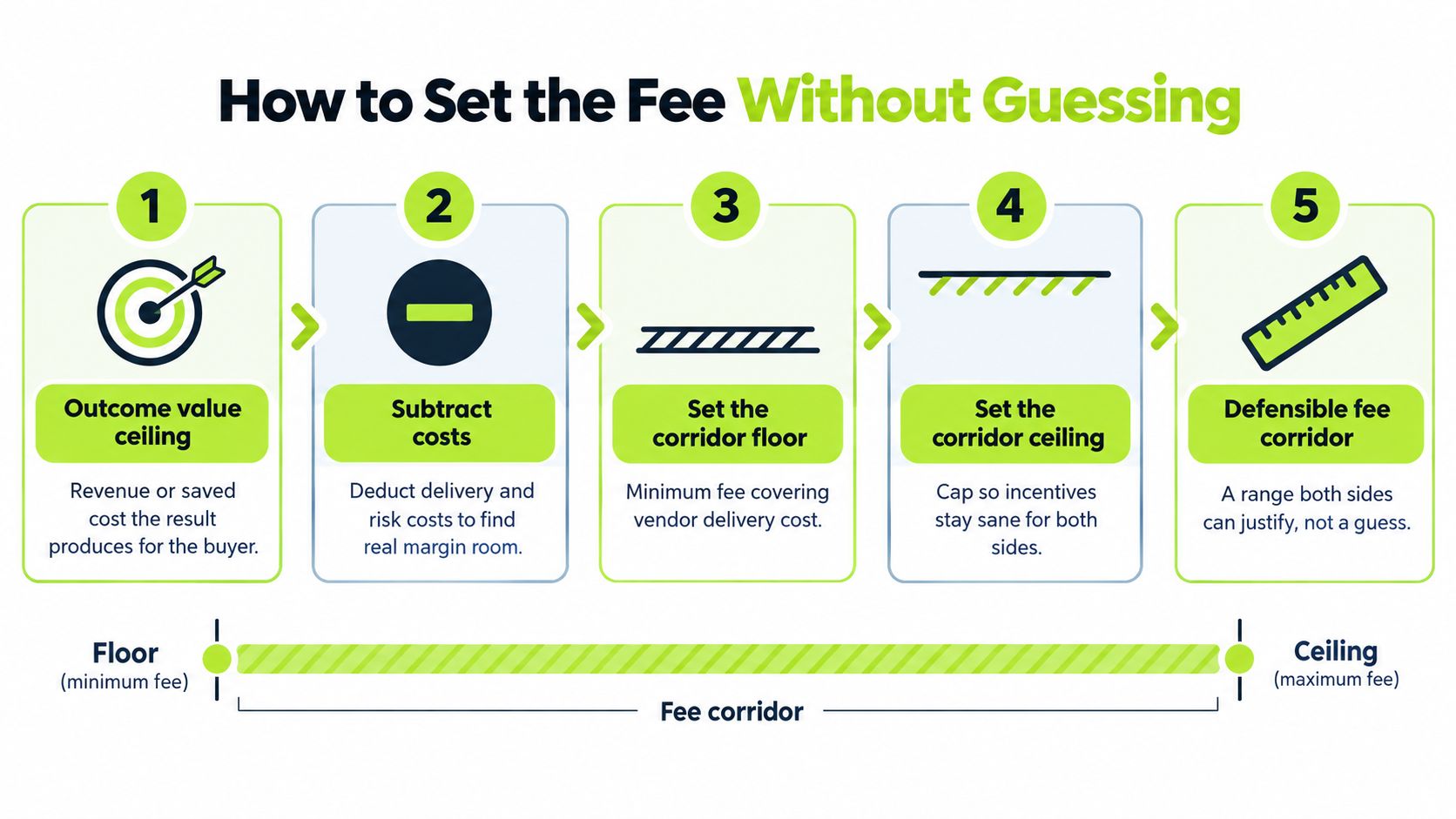
The calculation is straightforward:
- Set the outcome ceiling: Estimate the revenue or saved cost created by the result.
- Subtract delivery cost: Include fully loaded labor, tooling, media exposure, and risk.
- Set the floor: Make sure the provider can deliver without losing money.
- Set the ceiling: Keep the payout below a sensible fraction of buyer value.
- Stress-test assumptions: Vary close rate, volume, sales-cycle length, and delivery cost.
Pricing rule: The floor protects delivery, the ceiling protects economics, and the shared sensitivity table protects the relationship.
Founders often anchor to the market rate and lose sight of value. Providers anchor to cost and cap their upside. Price from both directions, then agree on the assumptions that can change the payout.
Attribution Is Where These Deals Break
Most failed performance deals die in attribution, not arithmetic. Research summarized by Acalytica's analysis of outcome-based agency pricing says 69% of agencies identify agreement on attribution methodology as a critical or strong barrier, while 68% cite insufficient client-data access. That makes measurement design a commercial term, not an analytics detail.
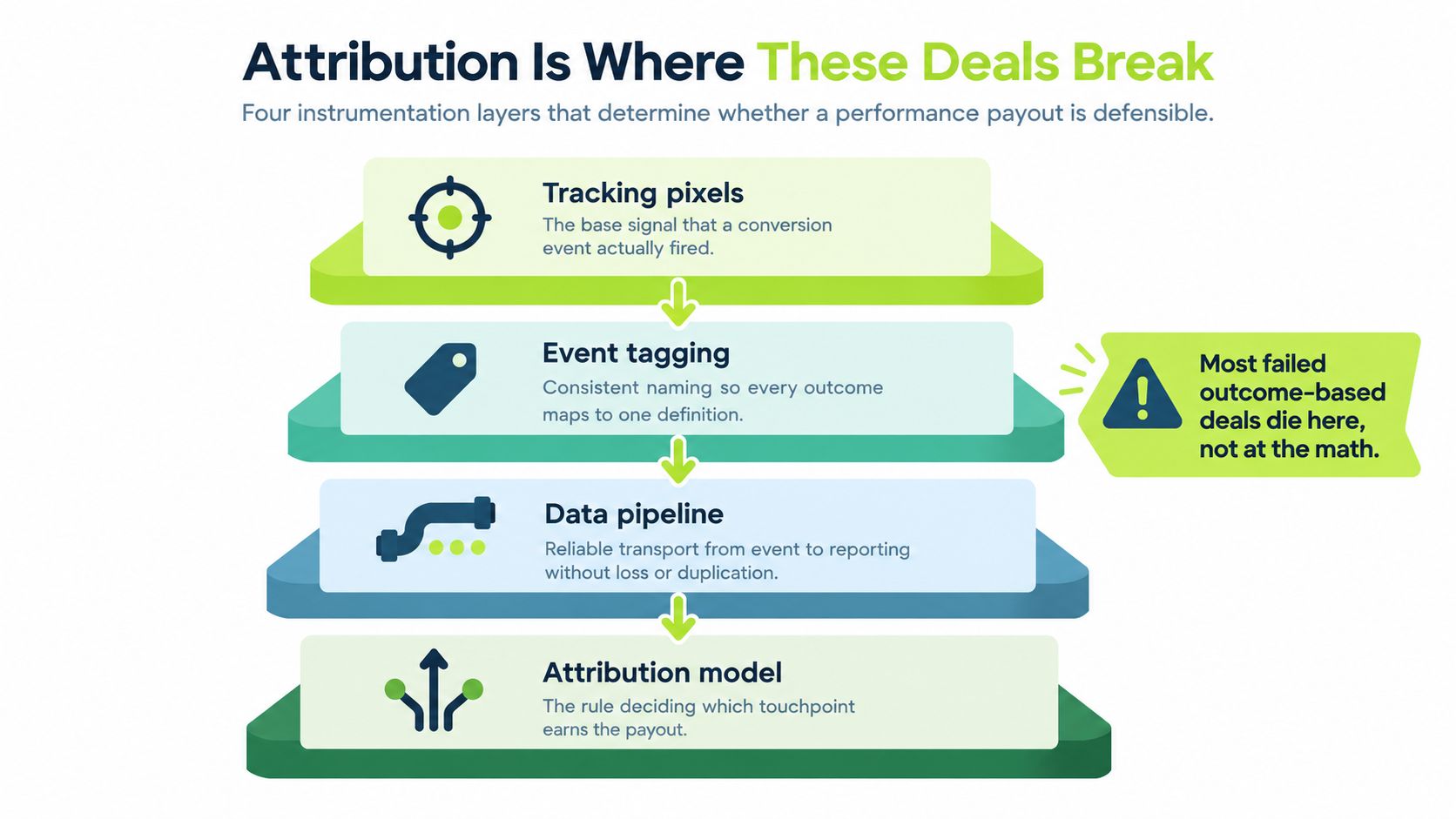
Build four layers before signing:
- Tracking pixels and postbacks establish that the event fired.
- CRM source fields preserve the original source when a lead enters the funnel.
- UTM hygiene keeps campaign changes from breaking reporting.
- Server-side deduplication prevents ad platforms and the warehouse from counting the same conversion twice.
Take a paid social, demo booked, trial activated, paid conversion path. Last-click attribution may reward the touchpoint that closed the deal while starving the channel that opened the relationship. If the vendor can't reproduce its model from your CRM or warehouse, don't accept its report as the bill.
Document the attribution window, such as 7, 14, or 30 days, the single source of truth, the audit cadence, and the reconciliation process when figures diverge by more than 5%. A revenue share agreement with a marketing agency should make those rules explicit rather than leaving them to monthly calls.
When Pure Performance Pricing Backfires
Pure performance pricing means the provider receives no base fee and gets paid only when the agreed result arrives. It looks founder-friendly, but it transfers too much operating risk to the provider and often distorts the work.
The first failure is cherry-picking. A vendor paid only on closed revenue has a reason to reject low-fit leads, which can make funnel data look healthier while hiding acquisition costs. The second is short-term optimization. An agency rewarded for a first conversion may use aggressive direct-response tactics that damage retention and long-term customer value.
Cash flow creates another fault line. A provider that funds media or labor upfront can't comfortably wait through a 60 to 90 day payback period without a floor, a media budget commitment, or a higher effective rate. Finally, a vendor may stop once it reaches its payout target, even when the next dollar could still produce strong returns.
The cited OpenView and Forrester figures in the supplied research aren't verified here, so they shouldn't be used as evidence. The broader market evidence still points toward restraint: NetSuite's performance-pricing overview reports that 77% of business leaders in a cited Stripe survey say customers increasingly push for outcome-based pricing, while agency fees remain predominantly non-outcome-based.
| Dimension | Pure Performance | Hybrid Floor + Upside |
|---|---|---|
| Provider cash flow | Highly exposed | Partly protected |
| Incentive | Strong but narrow | Strong with continuity |
| Attribution tolerance | Very low | More manageable |
| Founder risk | Lower fixed spend, higher distortion risk | Predictable base plus bounded upside |
Contract Terms Worth Negotiating
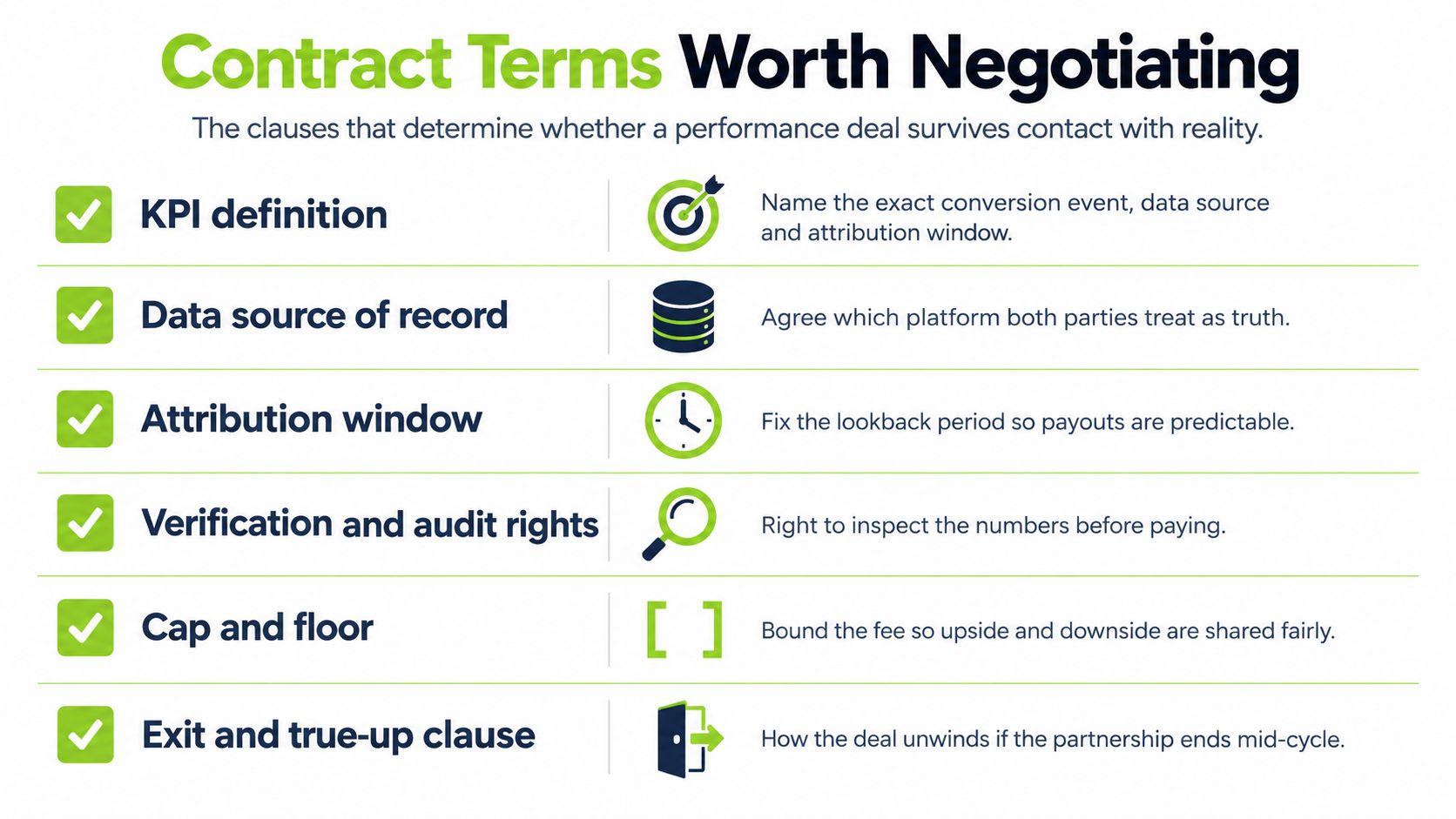
The KPI clause deserves the most attention. Name the exact event, data source, attribution window, payout timing, and fallback if the source goes down. “Qualified lead” isn't a KPI until the contract defines qualification.
Request these line items directly:
- Floor and cap: Set the minimum monthly retainer and maximum payout during a measurement period.
- Audit rights: Provide access to raw tracking data, permit an independent attribution audit, and allow a 30-day cure period for discrepancies.
- Exit and true-up: Permit either side to exit with 30 days' notice if rolling 90-day performance falls below the agreed threshold. Define wind-down, open payouts, and data handover.
- Media responsibility: State who funds media upfront, what markup is allowed, and how spend is reconciled.
- IP and learnings: Assign ownership of audience data, creative, dashboards, attribution models, and documented experiments.
A performance-based contracts guide can help organize these provisions, but don't copy a template without adapting the measurement rules to your funnel. The contract should also state whether a viral spike, seasonality, stock problem, pricing change, or product outage changes the payout. Ambiguity is expensive because both parties interpret it in their own favor.
The Deal Most Founders Should Default To
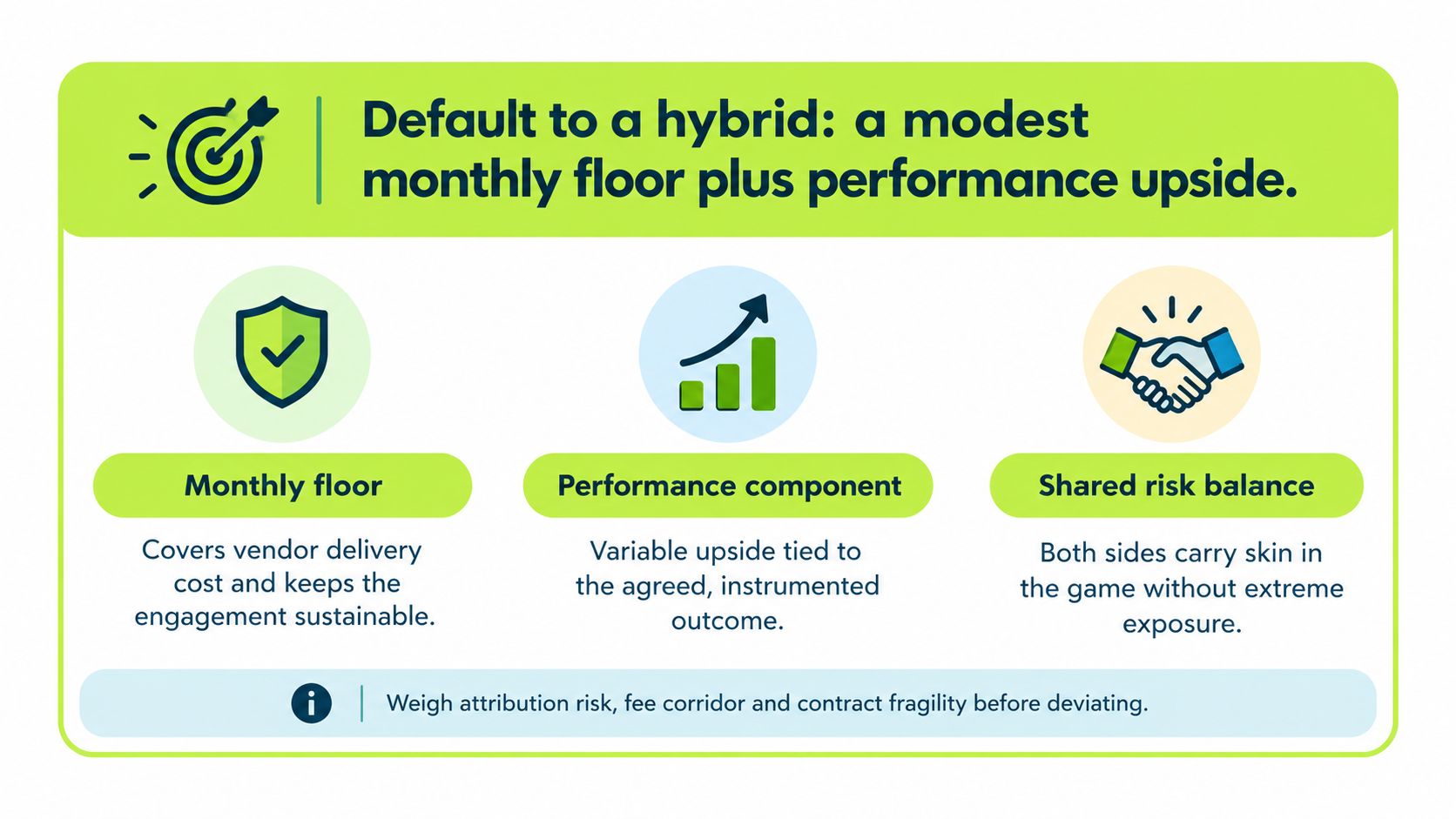
Default to a hybrid structure: a modest monthly floor, one primary KPI, one fallback metric, and capped upside. The floor should cover delivery cost, while the variable band rewards an instrumented result without exposing either side to unlimited volatility.
Pure revenue share makes sense when the provider owns a continuing function and the revenue trail is clean. A success fee is better when one narrow event has a reliable trigger. Milestones work when the provider controls a specific deliverable, such as a shipped landing-page test or a closed-won deal. Don't use any of them just because the headline fee looks lower.
The hybrid protects founders from paying for unmeasured activity and protects operators from outcomes controlled by product, sales, pricing, or market conditions. Keep the variable band explicit. The supplied plan proposes an upside cap of 1.5x to 3x the floor, which is a negotiating range for this structure, not a universal benchmark.
For founders comparing compensation mechanics with financing mechanics, how RBF works for startups offers useful context on revenue-linked payments. The concepts aren't interchangeable, but both require clear definitions of the revenue base, timing, and downside.
Lead with the hybrid in negotiation. Deviate only when attribution is unusually clean or the provider controls the outcome directly, and document that reason before anyone signs.
Capstacker helps founders structure milestone payouts, revenue shares, success fees, equity deals, legal templates, tracking, and integrated payouts in one workflow. Visit Capstacker to turn your next outcome-based engagement into a documented deal with clear triggers, payment terms, and fewer attribution arguments.